

























































Union members and their families are gathering in downtown Milwaukee this Labor Day for Laborfest, a parade and lakefront festival that organizers say is open to everyone, not just card-carrying union workers. The parade steps off at 11 a.m. from Zeidler Union Square and winds roughly one mile before ending at the Summerfest grounds, where a full day of festival activities, entertainment, and a classic car show await.
The event is rooted in a fight that stretches back nearly a century and a half. As TMJ4 News reports, Vince Gallo IV, a business agent at Plumbers Local 75, said Labor Day celebrates “the work and sacrifice that secured workers' rights” — protections like weekends off, overtime pay, and vacation time that many workers today take for granted. Gallo, whose father was also in a union, said he followed that same path into labor organizing.
Ian Gunther, president of ASME Local 47 and an employee of Milwaukee Waterworks, echoed that sentiment, telling the outlet that Labor Day represents “the ongoing fight workers have waged to support one another and build a better livelihood.” Gunther welcomed anyone, union or not, to come to the festival grounds simply to rest and reflect on the day.
Free Parking and a Shuttle to the Starting Line
For attendees planning their morning, the Summerfest grounds offer free parking in Lots H and P. A Laborfest shuttle will carry people from the festival grounds to the parade's starting area at Zeidler Union Square, but that shuttle only operates until 10:30 a.m., so early arrival matters. Once the parade wraps up, attendees are responsible for arranging their own return trip back to their vehicles.
Once the crowd reaches the festival grounds, there's plenty to keep families occupied. A children's area features bucket truck rides and a splash pad, while the classic car show runs from noon to 3 p.m. alongside entertainment throughout the day, according to the same TMJ4 report.
A Local Tragedy Behind the Holiday
The roots of Labor Day in Milwaukee trace back to one of the deadliest chapters in Wisconsin labor history. On May 5, 1886, Wisconsin National Guardsmen opened fire on an estimated 1,500 marchers advocating for an eight-hour workday at the Milwaukee Iron Company rolling mill in Bay View, killing seven workers, according to the Wisconsin Labor History Society. The Bay View Massacre remains the deadliest labor dispute in state history and helped shape decades of local political organizing around workers' rights.
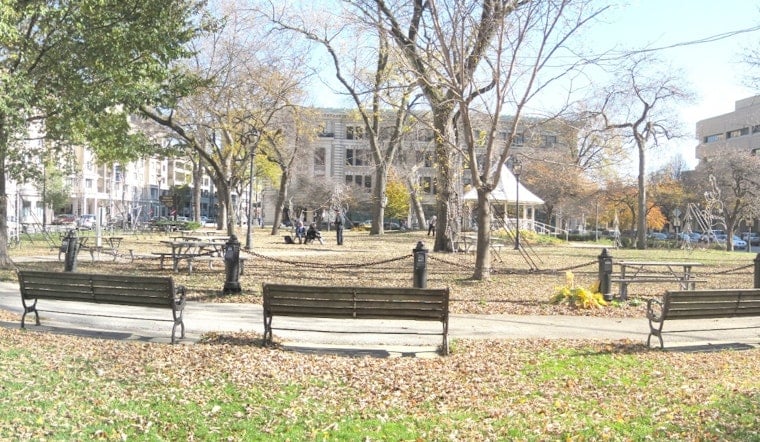
The parade's starting point carries its own echo of that history. Zeidler Union Square was established in 1835 as Fourth Ward Square and renamed in 1995 to honor the city's labor movement and former Mayor Carl F. Zeidler, according to Wisconsin Bandshells and Stands. The park's gazebo bandstand, also built in 1995, was constructed by 175 union volunteers as a memorial to working people.
Wisconsin's Union Numbers Keep Sliding
The festive parade unfolds against a sobering statistical backdrop. Just 6.4 percent of Wisconsin's wage and salary workers were union members in 2025, according to data published by the U.S. Bureau of Labor Statistics in March 2026 — a rate tied for a record low first reached in 2024 and down sharply from 20.9 percent in 1989. That decline accelerated after Wisconsin's right-to-work law took effect in 2015, when union membership dropped from 11.7 percent in 2014 to 8.3 percent the following year, according to CBS 58.
Wisconsin's rate now trails its upper Midwest neighbors by wide margins, with the station reporting that Minnesota sits at 14.1 percent, Illinois at 13.1 percent, and Michigan at 13.0 percent. Labor leaders cited in the same report attribute the gap to state laws including Act 10 and right-to-work legislation. Gallo told TMJ4 that protecting union workers' rights also benefits non-union workers, arguing that union raises and benefit increases can lift wages and conditions for everyone.
Act 10's Fate Still Unresolved
Wisconsin's legal battle over public-sector union rights remains unsettled. In July, the Wisconsin Court of Appeals reversed a Dane County Circuit Court ruling and upheld the constitutionality of the state's 2011 Act 10 law, which restricts collective bargaining for most public-sector employees, according to the Associated Press. The case is expected to be appealed to the Wisconsin Supreme Court, leaving the law's long-term future in limbo even as this year's Laborfest goes forward.
Milwaukee's Laborfest carries a national profile of its own — President Barack Obama delivered a Labor Day address to union workers and community members at Henry Maier Festival Park in September 2010, according to the White House. That lakefront site, a 75-acre stretch along Lake Michigan named for Milwaukee's longest-serving mayor, once served as a Cold War-era military installation for Nike anti-aircraft missiles before becoming a municipal park and festival grounds in 1970.
Behind the parade and the festival lies an organizing effort aimed squarely at reversing that membership decline. The Milwaukee Area Labor Council, AFL-CIO, founded in 1959, represents 85 local unions and regional councils across Milwaukee, Washington, and Ozaukee counties, covering roughly 25,000 union workers. The council has scheduled a post-Laborfest social event for young workers on September 13 at Layman Brewing in West Allis, an effort local labor leaders describe as vital to building solidarity among newer union members and reversing the state's decades-long slide in membership.
Hoodline previously reported on Ald. Jackson's Labor Day push last year, as Milwaukee leadership invited residents to join the parade and festival grounds. This year's Laborfest keeps that invitation open, with Gunther and Gallo both framing the day less as a celebration of victory already won and more as a reminder of a fight that, in their telling, is still very much underway.





