

























































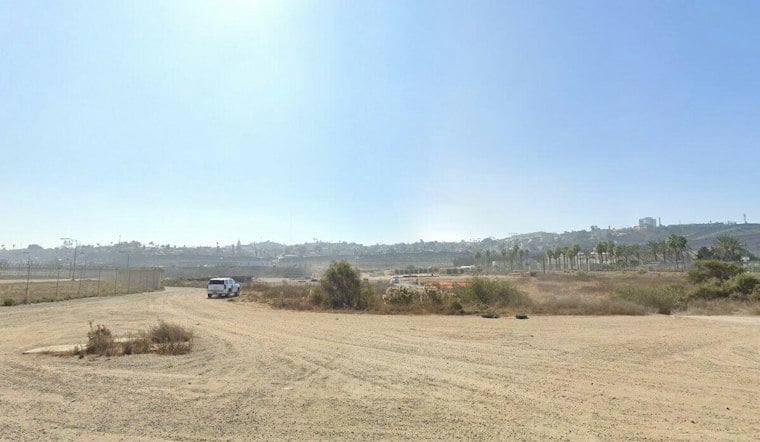
Hydrogen-sulfide readings at the Nestor monitoring station have risen sharply this year, adding urgency to two laws Gov. Gavin Newsom signed to address the Tijuana River sewage crisis. One directs California to revisit its decades-old air-quality standard for the gas; the other sets workplace protections for outdoor workers exposed to cross-border pollution. The signings came days after a federal health agency found that short-term spikes can pose a public health hazard.
Senate Bill 58 directs the California Air Resources Board to update the state's air quality standard for hydrogen sulfide, which, according to the San Diego Union-Tribune, has not been updated in more than half a century. The current standard, set at 30 parts per billion averaged over one hour, was designed to control odor nuisance rather than protect public health, the paper reports. The bill also requires a response framework for hydrogen sulfide exposure events in the Tijuana River Valley and Salton Sea regions, built through consultation with local air districts, state health and emergency agencies, universities, tribal governments and community groups.
A Second Bill Covers Workers on the Front Lines
The companion measure, Senate Bill 1046, directs Cal/OSHA to develop workplace standards minimizing exposure to cross-border pollution, protecting lifeguards, park rangers and other outdoor workers in the Tijuana River Valley. Sponsored by Sen. Catherine Blakespear, the bill requires Cal/OSHA standards covering personal protective equipment, hazard communication, incident reporting and training, developed with input from affected communities, lifeguards, park rangers, labor unions, air districts and academic experts.
“Workers exposed to untreated wastewater pouring into the Tijuana River Valley need protection,” Blakespear said. SEIU sponsored the bill; SEIU Local 221 represents more than 13,000 workers in San Diego County. Workers in the valley have experienced headaches, fatigue, nausea and bloody noses. Both SB 58 and SB 1046 take effect January 1, 2027.
Hydrogen sulfide is a colorless gas that smells like rotten eggs. Exposure can cause headaches, nausea, and eye and respiratory irritation, according to the Union-Tribune's reporting. The San Diego County Air Pollution Control District monitors hydrogen sulfide at San Ysidro Fire Station No. 29, Berry Elementary School in Nestor and the Imperial Beach Civic Center, listed on its air quality monitoring page.
Monitoring Shows a Worsening Trend at Nestor
The legislation lands amid data showing conditions have deteriorated at the Nestor monitoring station. Hourly hydrogen sulfide readings there exceeded the 30-parts-per-billion threshold more than 10% of the time so far in 2026, up from under 2% in 2024, based on county air monitoring data.
On June 2, 2026, Nestor recorded a high reading of 915 parts per billion, the same day a parallel gravity sewer line collapsed. A Scripps account of UC San Diego research led by Kimberly Prather says community members alerted researchers to a particularly strong-odor area along Saturn Boulevard, where the river releases gases and aerosols. By comparison, since October 2024, about 1% of hourly readings exceeded the threshold at the Imperial Beach Civic Center and about 0.5% did so at San Ysidro, underscoring how concentrated the worst exposure has been near Nestor.
Federal Assessment Confirms Short-Term Health Hazard
About a week before the bills were signed, the Agency for Toxic Substances and Disease Registry found that hydrogen sulfide in outdoor air near the Tijuana River had reached levels that could harm people's health. As reported by the Union-Tribune, the federal agency concluded that “short-term exposure to the gas at those levels is a public health hazard,” after analyzing more than 800,000 air measurements collected from September 2024 through May 2025 at four monitoring sites.
Separate instruments operated by UC San Diego at Leon Avenue recorded a one-minute hydrogen sulfide peak of 4,500 parts per billion and a highest one-hour average of 2,100 parts per billion, according to a Scripps Institution of Oceanography summary of the findings. The federal agency also said that average hydrogen sulfide levels over weeks and months were not high enough to cause additional harm beyond what's tied to short-term spikes, though it said it could not determine whether exposure before September 2024 harmed residents. Longer-term exposures of 14 days or more were not expected to pose an additional hazard, the assessment found, per the Scripps summary.
One-minute readings exceeded the 0.5-parts-per-billion odor threshold 70% of the time at San Ysidro, 82% at Leon Avenue, 89% at the Imperial Beach Civic Center and 96% at Berry Elementary School, according to KPBS. The station notes that hydrogen sulfide levels were highest at Leon Avenue, directly across the street from Berry Elementary School.
Wastewater Infrastructure Still Playing Catch-Up
The new laws arrive as the South Bay International Wastewater Treatment Plant continues expanding capacity, having grown from 25 million to 35 million gallons per day, with a target of 50 million gallons per day by December 2027. The South Bay coastline has experienced more than 1,300 consecutive days of beach closures tied to the broader sewage crisis. In one earlier weekend incident, a four-hour average at the Nestor monitor reached 384 parts per billion — exceeding the federal Acute Exposure Guideline Level 1 threshold of 360 parts per billion — before falling to 5 parts per billion by 10 a.m., according to the County of San Diego, which has worked with the air pollution control district and partner agencies since 2024 on sewage treatment issues, progress updates and health guidance.
How Sewage Projects and Local Records Are Tracked
The South Bay plant’s treatment capacity is distinct from pumping capacity elsewhere in the system. According to the EPA’s June 30 update, construction on the separate Pump Station 1 project began April 27, and the project is expected to raise pumping capacity to 80 million gallons per day by November 2027. The update documents those milestones but does not provide funding details here. The City of Imperial Beach says the County’s sewage-crisis dashboard brings together hydrogen-sulfide readings, beach-closure data and air-quality complaints; these are distinct measures, not interchangeable records.



