

























































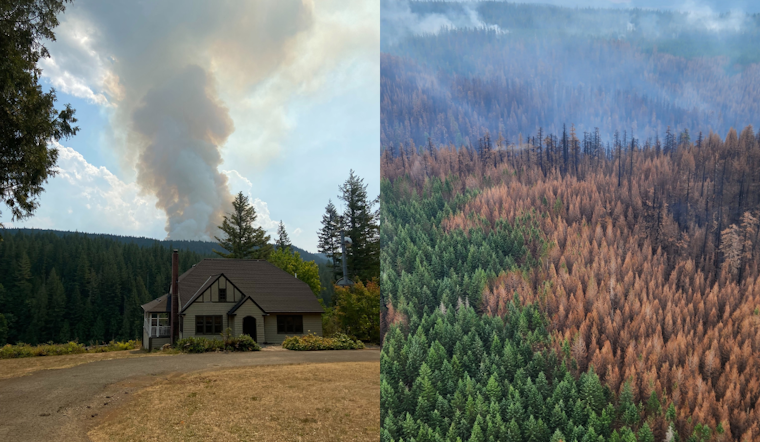
A lightning strike touched off the Camp Creek Fire inside Portland's Bull Run Watershed on the night of August 24, 2023, eventually burning 2,055 acres and coming within 1.3 miles of a drinking water reservoir before nearly 600 firefighters brought it under control. Three years later, the city is revisiting that fire as a warning sign, not a closed case, as officials say a lengthening fire season makes another blaze in the watershed increasingly possible.
The fire and its aftermath are laid out in a retrospective post from the Portland Water Bureau, titled “A Look Back at 2023's Camp Creek Fire,” published Thursday. According to the bureau, suppression efforts were led by the U.S. Forest Service, and the blaze ultimately caused no significant impacts to water quality. The area has since been recovering quickly, the bureau says, with native vegetation, including tree seedlings, taking hold again.
A Rare Fire in a Rainforest Watershed
The Camp Creek Fire was notable in part because of how unusual it was: it marked the first significant wildfire in the Bull Run Watershed since 1881, fourteen years before the watershed became Portland's primary water source in 1895, according to the bureau's historical account. Bull Run is a temperate rainforest, where large wildfires have historically been infrequent. Almost the entire 2,055-acre burn perimeter sat on U.S. Forest Service land within Mt. Hood National Forest, with just 0.25 acres burning on land owned by the City of Portland.
A Burned Area Emergency Response, or BAER, team assessment completed after the fire found that only 3 percent of the burn area suffered high soil burn severity. Twenty-eight percent experienced moderate severity, 56 percent low severity, and 13 percent remained unburned entirely, per the bureau's April 2024 documentation of the Camp Creek BAER survey conducted in Mount Hood National Forest. Soil burn severity matters because it signals the risk of sediment and ash washing into reservoirs, though the largely low-to-moderate damage limited that threat this time.
How Crews Caught the Fire Early
Wildfire response personnel were able to quickly locate and track the fire's start using smoke-detecting cameras operated by Portland General Electric's Pano AI system, a technology credited with speeding up detection during dry late-summer conditions. Portland works closely with the U.S. Forest Service on the broader Bull Run Wildfire Protection Program, which the bureau describes as encompassing prevention, early detection, and full suppression. Annual tours with fire personnel are part of that effort, supporting rapid suppression when new fires break out.
Public entry into the 147-square-mile Bull Run Watershed Management Unit remains strictly prohibited under federal law through the Bull Run Management Act and local city code, a closure meant to reduce the risk of accidental, human-caused fires and protect drinking water quality. The watershed stays closed to the public for that reason, even as the bureau emphasizes that fire suppression and forest resilience work continue behind the closed gates.
Climate Change and the Case for a Backup Supply
Portland officials say climate change is lengthening the fire season in the Bull Run, and with it, the risk that another fire could threaten the watershed again. That backdrop is part of why the city has invested in the Columbia South Shore Wellfield as a backup groundwater supply. The wellfield draws from 25 wells across four aquifers and can produce nearly 100 million gallons per day during emergencies or Bull Run disruptions, according to the Tualatin Valley Water District.
The Bull Run Watershed supplies drinking water to roughly one million residents across the Portland metro area, close to a quarter of Oregon's total population, per the Institute for Sustainable Infrastructure. That scale of reliance is a central reason Portland is also pressing ahead with a new filtration facility, which officials say will let the city continue serving Bull Run water even after a future fire washes dirt and ash into its reservoirs. The plant is set for completion in 2029.
A Billion-Dollar Backstop, Years in the Making
That filtration project has ballooned to an estimated $2.56 billion in 2026, driven by inflation, added construction requirements, and complex land-use permitting delays, a cost escalation Hoodline previously reported alongside oversight concerns. Under a Bilateral Compliance Agreement with the Oregon Health Authority, Portland is legally required to deliver filtered water treating Cryptosporidium and surface water contaminants by September 30, 2029, an extension from an original 2027 deadline tied to land-use appeal delays. The Bull Run Filtration Facility, planned for east Multnomah County, is engineered for an initial capacity of 135 million gallons per day, with hydraulic capability to expand to 220 million gallons per day, according to the Institute for Sustainable Infrastructure.
The Camp Creek Fire itself left the water supply largely unscathed, but it illustrated the exact scenario the new plant is designed to guard against: a fire close enough to a reservoir to raise the specter of contamination, in a watershed where large burns were once rare but may not stay that way. For now, Portland Water Bureau officials frame the anniversary post as both a retrospective and a reminder that the risk of another fire in the Bull Run has not gone away.




