

























































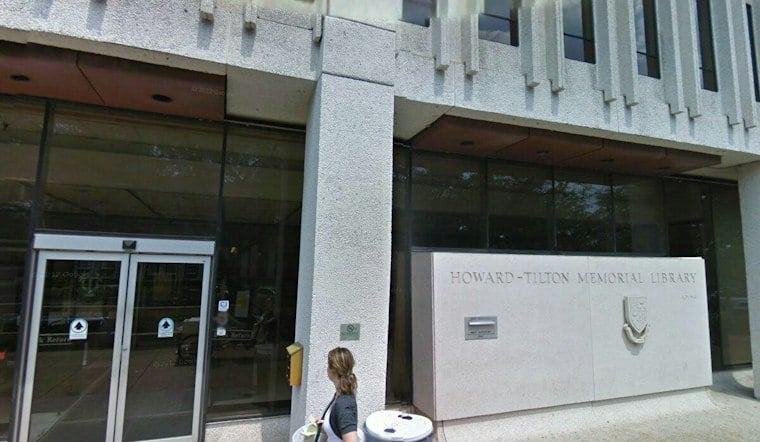
Queen Sofia of Spain spent Thursday inside Tulane University's Howard-Tilton Memorial Library, touring a new exhibition highlighting Spain's often-overlooked support for the American Revolution. The queen, mother of Spain's current king, greeted Tulane exchange students from Spain before walking through rare 18th- and 19th-century documents tracing Spain's military and financial backing of the rebelling U.S. colonies. Her visit doubled as the public opening of the exhibition itself, which debuted the same day on the library's fourth floor.
The exhibition, titled Spain, Spanish America and the Atlantic World in an Age of Revolution, is free and open to the public at 7001 Freret Street, according to Tulane University Libraries. It was curated by Hortensia Calvo, Teresa Clifton, Juan Pablo Gómez and Christine Hernández, with Ashley Reynaga and Verónica Sánchez collaborating. Calvo directs Tulane's Doris Z. Stone Latin American Library and Research Center, and the exhibition was built through a yearlong academic effort by Tulane scholars, as reported by NOLA.com. Calvo said the exhibit uses original documents to show how people actually experienced those extraordinary events. Patrick Norton, Tulane's senior vice president and chief operating officer, welcomed the queen to the exhibit.
New Orleans as a Wartime Supply Hub
The exhibition's central claim is that Spain used New Orleans as a base to funnel arms and funding to the rebelling U.S. colonies during the Revolutionary War, per the same Tulane library account. Spain sent food and muskets during the Revolutionary War. Bernardo de Gálvez, who governed Louisiana under Spanish rule, led campaigns along the lower Mississippi and Gulf Coast after Spain entered the war against Great Britain in 1779 — a push that weakened British forces in West Florida and culminated in the capture of Pensacola in 1781, according to Tulane University Libraries. Gálvez later received honorary U.S. citizenship in 2014.
Jason Wiese, chief curator at the Historic New Orleans Collection, discussed Spain's aid to the American revolutionary cause.
Documents Spanning Decades of Upheaval
Beyond the Revolutionary War material, the exhibition traces political upheaval across the Atlantic world from the 1760s through the 1820s. It also covers the Spanish American revolutions of the early 1800s with particular attention to Mexico, Central America and northern South America, according to the Doris Z. Stone Latin American Library and Research Center. Tulane's library account notes the exhibit presents independence not as a single event but as a prolonged, often bloody process shaped by Napoleon Bonaparte's 1808 invasion of Spain and the forced abdications of King Charles IV and his son Ferdinand VII, which raised unprecedented questions about where sovereignty resided once the legitimate king was gone.
Among the artifacts on display are confidential 1776 instructions from Minister of the Indies José de Gálvez to his nephew Bernardo de Gálvez, a model of the Spanish silver-carrying brigantine El Cazador lost in 1784, and the 1812 Constitution of Cádiz shown alongside the 1814 royal decree by which Ferdinand VII repealed it. A replica of the first Spanish-language newspaper printed in America also features in the show, drawn from rare books, manuscripts, broadsides and maps in Tulane's collections. The exhibit is listed as running through May 2027, with June 1, 2027, also given as its closing date.
A Symposium Timed to America's 250th
Queen Sofia's tour swing through New Orleans followed earlier stops in Madrid in 2024 and Washington, D.C. in 2025, concluding in the Louisiana city because of its history as a Spanish colony, per NOLA.com. Her visit coincides with the America&Spain250 initiative, a two-day symposium that kicked off with the Tulane exhibition's opening and focuses on Spain's contributions to American independence. The initiative is a collaboration between the Queen Sofia Spanish Institute, the Historic New Orleans Collection and other foundations.
M. Begoña Santos, president and CEO of the New York-based Queen Sofia Spanish Institute, said the history of the Gulf states is integral to American history, according to the station's report. The Historic New Orleans Collection is set to host lectures Saturday at the Williams Research Center covering Spanish America's role in the Revolutionary War, Gálvez's Mississippi campaign and imperial slavery systems. St. Louis Cathedral is also scheduled to host an opening ceremony Friday featuring lectures on Louisiana's place in the Spanish empire and Spanish New Orleans.





