

























































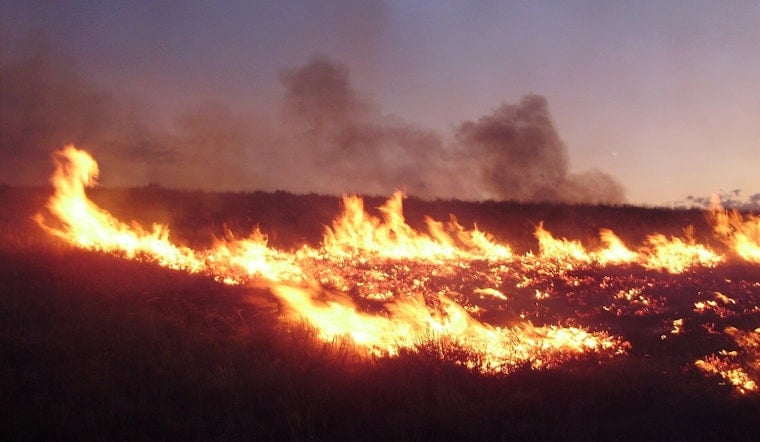
A wildfire tore through more than 200 acres in Texas County on Thursday, and the crews who fought it faced a danger almost as serious as the flames themselves: the triple-digit heat that put several firefighters at risk of heat exhaustion. The blaze broke out amid a punishing late-summer dry spell that has left much of the region primed to burn.
According to Atlanta News First, the fire scorched over 200 acres in Texas County on Thursday, and crews suffered heat exhaustion while battling the blaze. The report did not detail the number of firefighters affected or specify their conditions, but the danger they faced lines up with a warning issued just days earlier by local emergency officials.
On August 31, the Texas County Office of Emergency Management issued a public safety alert cautioning that firefighters faced severe risk of heat stroke and heat exhaustion while battling grass fires in heavy protective gear during triple-digit heat. That alert reflects a physical toll that has become a recurring theme this fire season: crews suited up in full turnout gear, performing strenuous suppression work, while the mercury climbs well past 100 degrees.
Why Heat Becomes Its Own Emergency
Heat exhaustion stems from severe water and salt loss through excessive sweating, causing dizziness, weakness, and nausea, according to health guidance from Anthem Blue Cross. Left unmitigated, it can rapidly progress into life-threatening heat stroke. For firefighters wrapped in heavy protective clothing while battling flames in direct sun, that progression can happen fast.
Occupational safety guidance issued by OSHA and relayed in local emergency advisories recommends that emergency commanders enforce mandatory hydration, frequent rest rotations in shaded or cooled environments, and structured work-rest cycles during high-heat outdoor emergency operations, per a Jackson County Government advisory. Those protocols have become standard practice for departments across the region as they try to keep firefighters safe while containing fast-moving vegetation fires.
A Region Primed to Burn
The Texas County fire didn't ignite in isolation. It broke out against the backdrop of a rapid-onset flash drought that has severely depleted soil and vegetation moisture across the Southern Plains and Ozarks through August and September, conditions that have turned routine grass fires into fast-spreading threats. The Houston Herald reported that a separate grass fire burned roughly 10 acres in western Texas County, Missouri, during hot, dry evening conditions as the same drought pattern continued spreading across the Ozarks.
Statewide numbers from Texas A&M Forest Service, published by AgriLife Today, put the scale of the season in stark terms: crews had responded to 1,078 wildfires burning 301,528 acres statewide in 2026, with the flash drought driving 313 blazes and 121,774 burned acres in August alone. U.S. Drought Monitor data reported in mid-August found that January through July 2026 ranked among the driest such stretches in more than 130 years across parts of the Southern Plains, a historic rainfall deficit that set the stage for the late-summer fire surge.
Burn Bans Spread as Crews Stay Stretched Thin
The dry conditions have pushed local governments across Texas to lean on emergency powers rarely used at this scale. Under Subchapter D of Texas Local Government Code Chapter 352, county judges and commissioners courts hold statutory authority to prohibit or restrict outdoor burning during severe drought to protect public safety. As of late August, roughly 190 of Texas's 254 counties — nearly 75 percent — were under active outdoor burn bans, as previously reported by Hoodline.
Even with those bans in place, roughly 90 percent of Texas wildfires still stem from human activity, with equipment and vehicle use ranking as the second leading cause behind open debris burning, according to the same AgriLife Today report. That statistic underscores a persistent tension for fire officials: regulatory tools like burn bans can curb some ignition sources, but they can't eliminate the risk entirely, especially as crews already stretched thin from a brutal season face fresh callouts.
That strain has been visible elsewhere in North Texas this summer. The Ross Fire in Palo Pinto and Jack counties burned over 90,400 acres, becoming the largest summertime wildfire recorded in Dallas-Fort Worth area history, and mutual aid firefighters responding to that blaze were involved in a head-on crash while traveling to the fire lines. Whether in North Texas or the Ozarks, the same pattern keeps repeating: fast-moving fires fueled by historic drought, and exhausted crews pushing through extreme heat to put them out.





