

























































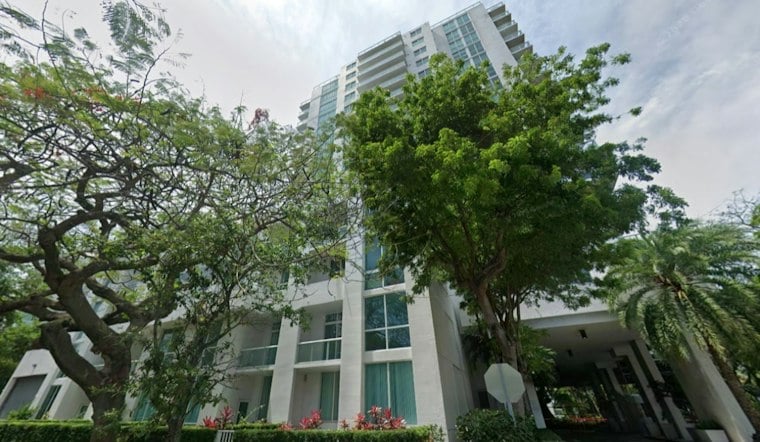
Two construction workers were brought safely to the ground Thursday after a scaffold failed at the 23rd and 24th floors of Terrazas Miami, a condo tower on Northwest South River Drive along the Miami River. The crew used two other suspended scaffolds to reach them; a rigging cord had given way, leaving the original platform tilted.
Resident Karla Vargas recorded the workers as they waited for help, according to WSVN. Vargas told the station she was “really nervous” watching the scene and saw one cord hanging loose.
Vargas posted the footage to the building’s neighbor chat and asked someone to open a window to help, WSVN reported. One resident opened a nearby window; one worker stood at its edge but did not enter, while the other held onto the exterior wall as they waited for the crew’s rescue.
A Second Scaffold Comes to the Rescue
The crew sent two other suspended scaffolds up the tower and brought both workers aboard, lowering them safely to the ground, according to WSVN. Fire crews arrived after the men were down; rescue officials said no one was hurt or needed hospital treatment.
Once on the ground, the workers thanked each other for helping through the ordeal, the outlet reported. The construction crew used the backup scaffolding equipment to bring them to safety.
Why Harnesses Likely Made the Difference
What OSHA Rules Require—and What Is Unknown OSHA requires workers on single-point or two-point adjustable suspension scaffolds to use both a personal fall-arrest system and a guardrail system, under standard 1926.451, also summarized in this Occupational Safety and Health Administration guidance. The rule does not establish what equipment the Terrazas workers were wearing. Terrazas Miami was completed in 2010 and overlooks the Miami River, according to Miami Residential Group.
Federal rules also require scaffold structures and components to support their own weight plus at least four times the maximum intended load, according to OSHA requirements cited by Able Safety Consulting. A designated “competent person” must inspect scaffolds and suspended rigging for visible defects before each work shift. The cause of the Terrazas rig’s failure—and whether pre-shift inspections were performed—has not been established.
What Federal Fall Data Can—and Can’t—Show
The U.S. Bureau of Labor Statistics reported 57,020 injuries resulting in days away from work and 595 worker deaths from falls to lower levels in 2013. Those figures cover falls generally, not scaffold incidents alone, so they do not measure scaffold-related harm or provide a direct comparison for this nonfatal Miami incident.
Part of a Broader Pattern of Scaffold Failures
Bureau of Labor Statistics injury data compiled by the EI Group shows that 72 percent of workers injured in scaffold incidents attribute the cause to support or planking failures, slipping, or being struck by falling objects — a pattern that echoes the loose cord Vargas said she spotted at the Miami River tower. Nationally, scaffolding accidents are estimated to cause 60 to 80 fatalities and roughly 4,500 nonfatal injuries each year, according to the Law Offices of Eric Richman.
South Florida has seen its own share of recent scaffold trouble. In February, a scaffolding collapse at a construction site on Lakeview Avenue in West Palm Beach injured four workers, as previously reported by Hoodline. The region's high-rise condo towers are also undergoing heavy exterior maintenance work tied to Florida Statute 553.899, the milestone inspection law passed as Senate Bill 4-D in 2022, which requires structural inspections for condo buildings 30 years or older, or 25 years near coastal waters. A July report found that local building officials received 8,736 Phase One and 1,575 Phase Two milestone inspection reports statewide during 2024 and 2025, with average repair permit values climbing to roughly $496,000, according to Fortify Restoration.


