

























































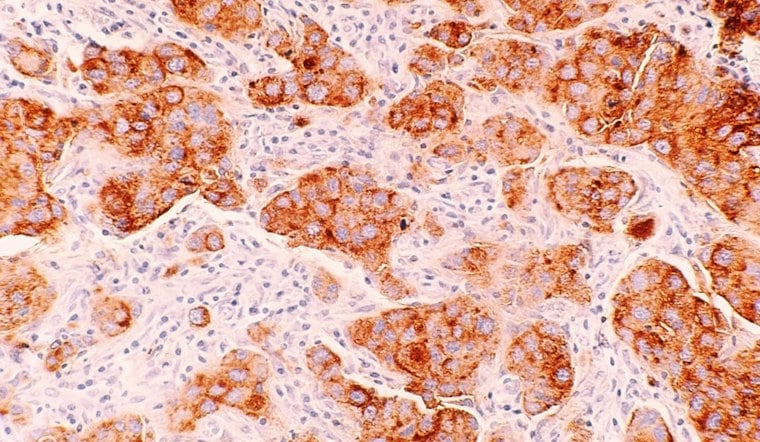
Dense breast tissue does more than make mammograms harder to read — it may actively set off a chain reaction that damages the DNA of nearby cells, according to a new study led by researchers at UCSF. Scientists found that stiffer, denser breast tissue attracts immune cells called macrophages and prompts them to release chemicals capable of mutating DNA in neighboring breast cells, a mechanism that could help explain why women with dense breasts face higher cancer risk.
The findings were detailed by Medical Xpress before KRON4 and come from a study led by UCSF postdoctoral scholar Mary Kate Hayward and senior-authored by Valerie M. Weaver. The research team examined breast tumor samples from UCSF patients, measuring tumor stiffness and collagen levels across different regions of the same tumors. What they found was consistent: the stiffest tumor areas showed more DNA mutations, more fibrosis and more macrophages than softer regions nearby.
How Stiff Tissue Sets Off a Chemical Cascade
The mechanism the team describes starts with the breast cells themselves. Breast cells can sense tumor stiffness, and in response they activate a protein signal called STAT3, which then recruits macrophages out of the bloodstream and into the stiff tissue. Once those macrophages arrive, they release reactive oxygen species, or ROS — and it's what happens next that appears to matter most for cancer risk.
Rather than the ROS itself directly damaging DNA, the study's report notes that the reactive molecules instead cause oxidative damage to fats inside the macrophages, converting them into aldehydes — chemicals capable of damaging DNA. Unlike the reactive oxygen species, the aldehydes can escape the macrophages entirely and travel to nearby breast cells, where they inflict the DNA damage that can eventually lead to cancer-cell development. Medical Xpress reported that dense, stiff breast tissue was tied to more macrophages, more aldehydes, more DNA damage and more advanced disease across tumor-cell models, mouse models and human breast-cancer biopsies.
The pattern held up in patient outcomes, too. Newsweek reported that an analysis of publicly available genomic data found more tissue scarring, DNA mutations and macrophages in cases linked to patients with worse outcomes than in cases linked to patients with better outcomes. The study was published in Cancer Cell under the title “Tissue tension fosters macrophage-driven lipid peroxidation-induced DNA damage,” per Medical Xpress.
Macrophages: Guardians That Can Turn Harmful
Macrophages normally serve a protective role, clearing pathogens, debris and dead cells, and can destroy damaged cells. But per KRON4, when macrophages aren't working properly, they can instead contribute to cancer development — and this study suggests dense, stiff tissue may be one condition that pushes them toward that harmful role.
The findings echo earlier research into why dense breast tissue carries elevated cancer risk. A study published in Breast Cancer Research found that increased mammographic density is a strong, independent risk factor for breast cancer, separate from the well-known problem that dense tissue can simply hide tumors on a mammogram, according to research published on Springer. That same research found high-density breast tissue showed a proinflammatory microenvironment, including increased expression of the immune signals IL-6 and IL-4, and concluded that immune-system activation may occur very early in breast-cancer development.
The Springer-published study also found that macrophages, dendritic cells, B lymphocytes and PD-1 expression were all significantly increased in high-density breast epithelium compared with low-density tissue. It noted that other studies had found cancers arising in high-density regions were more likely to show features suggesting a poor prognosis. Dense breast tissue may show immune-system activation very early in breast-cancer development.
What This Means for Women With Dense Breasts
Breast density is influenced by genetics, age and hormones. Importantly, women with dense breasts do not necessarily develop breast cancer — density is one risk factor among several, not a diagnosis. About half of women at screening age have dense breasts, according to the facts cited by KRON4, and the FDA requires health care providers to inform women about their breast density after a mammogram.
Hayward, the study's first author and a postdoctoral researcher at UCSF, said dense breast tissue is mechanically stiffer, and that the physical changes tied to that stiffness can trigger inflammation leading to DNA damage in nearby breast cells, per KRON4's report. She also said women should know their individual breast cancer risk, with breast density being just one part of that overall risk assessment. A broader breast-cancer risk assessment can help women and their health care providers develop an appropriate lifetime breast-screening strategy, including decisions about when to screen, how often, and whether different imaging methods may be appropriate.
Hayward and her colleagues are continuing to study the connection between breast tissue and lifetime cancer risk. She said she plans to investigate ways to interrupt the mechanisms linking breast density to cancer risk, with the goal of reducing that risk. Newsweek reported that the research team now hopes to explore drugs that could prevent aldehydes from forming inside macrophages in the first place — a potential path toward stopping the DNA damage before it starts.





