

























































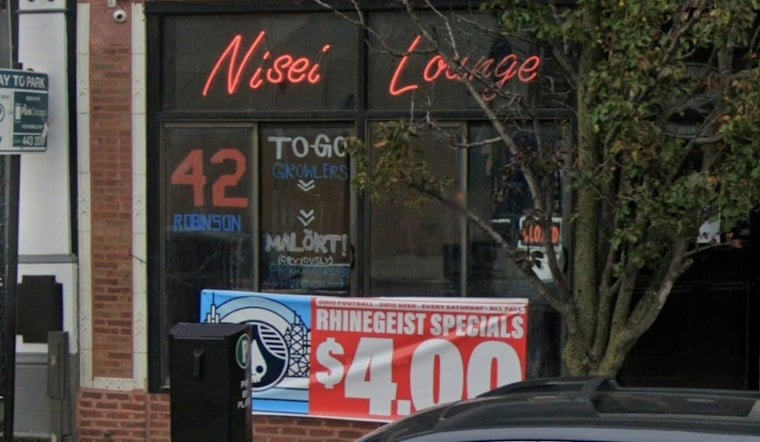
Nisei Lounge’s roughly 75 years in Chicago can be traced through a liquor license, a move between neighborhoods and, more recently, a reputation for baseball crowds and unusual Malört infusions. The bar at 3439 N. Sheffield Ave. sits a block south of Wrigley Field; its history also reflects the postwar relocation of Japanese Americans to Chicago.
According to Block Club Chicago, Hiroto Hirabayashi opened the bar after his release from a World War II incarceration camp. He received a liquor license in 1946 for a bar at 1238 N. Clark St. Nisei Lounge director of beer and baseball operations Patrick Odon places the move to Sheffield Avenue in 1951, though the exact date it opened at its current address has not been independently confirmed.
A Business Born Out Of Wartime Upheaval
President Franklin D. Roosevelt signed Executive Order 9066 on Feb. 19, 1942, authorizing military commanders to designate areas from which people could be excluded. U.S. authorities forcibly removed more than 110,000 people of Japanese descent from the West Coast during the war. Hirabayashi was released from an Idaho camp in May 1943 and sent to Chicago. Block Club Chicago reports that nearly 30,000 Japanese Americans moved to Chicago in the years that followed.
Hirabayashi sold the bar to longtime bartender Jimmy Isuha in the mid-1970s. By 2000, it no longer served exclusively the Japanese American community, Scott Martin said. Dave Jemilo and Martin bought the lounge in the early 1990s; Jemilo sold his share to Mike Flammang in 1997. Craig Morrall and Brian Pistorius became owners in 2010.
Baseball, Boilers And A Renovation Two Decades Ago
Odon describes Nisei as a holdover from an earlier Wrigleyville. Its last major renovation was around 2004. After the boiler exploded, the bar closed for a week while the owners removed the wood paneling behind the bar. It now has air conditioning and steam-boiler heat.
Migration and the Neighborhood Around Nisei
Federal resettlement policy provides context for Hirabayashi’s move to Chicago. According to the National Archives, only about 5,000 of roughly 120,000 Japanese Americans living in the affected area managed to resettle inland before authorities enforced mandatory removal. Block Club Chicago reports that nearly 30,000 Japanese Americans moved to Chicago in the years that followed; the figures describe different stages of wartime and postwar migration.
A 2006 44th Ward master plan described Sheffield north of Belmont as an entertainment district tied to Wrigley Field, while the stretch farther south leaned toward dining, retail and residential uses. The plan documents that distinction at the time, rather than establishing when the area’s commercial patterns developed.
When Japanese Emperor Hirohito visited Chicago in October 1975, a Japanese American meat cutter at Nisei reportedly treated the visit as unremarkable, saying Hirohito was just another visiting foreign dignitary.
The Malört Experiments That Made It Famous
Nisei Lounge, pronounced knee-say, has experimented with Malört infusions for about 15 years. Block Club Chicago reports that it may have been the first bar to offer infused Malört. Its trials have included a hop-infused version, a seasonal candy cane infusion and a banana Laffy Taffy edition.
Haymarket Beer Company made a beer to mark the lounge’s 75th anniversary. Nisei plans to revisit its infusion experiments during the celebration, featuring what the bar regards as its biggest successes and failures.
What's Next For The Anniversary
Odon said, according to the report, that official anniversary events will take place after baseball season. Plans include a retro beer celebration organized by decade and charity events; dates and times have not yet been announced. Some listings describe Nisei Lounge as Wrigleyville’s oldest bar, dating its founding to 1951.





