

























































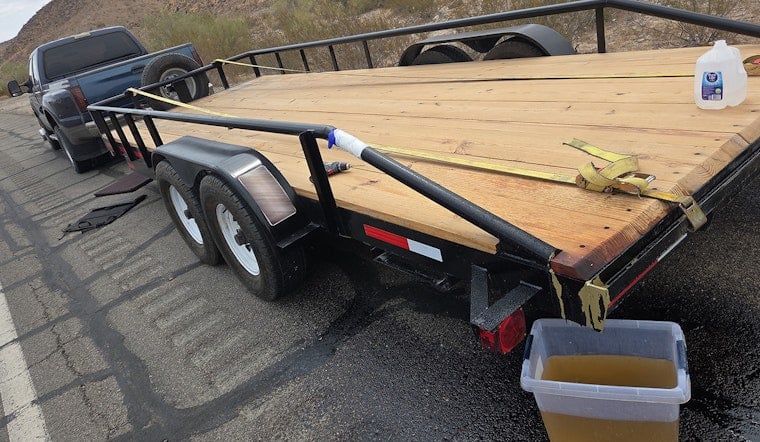
An Arizona Department of Public Safety Canine District trooper stopped a Ford F-350 pickup truck towing a trailer on Interstate 8 near Yuma on August 11, discovering 106 gallons of liquid methamphetamine concealed inside the trailer's hollow frame rails. Hazmat crews spent hours draining the liquid into twenty-one 5-gallon buckets before investigators arrested both the driver and passenger on felony drug possession and transportation charges.
The stop and its aftermath were detailed in a post from the Dept. of Public Safety, which described troopers finding the narcotics tucked into structural components of the trailer rather than a cargo compartment. Based on U.S. Drug Enforcement Administration conversion standards, one gallon of liquid methamphetamine yields approximately seven pounds of solid crystal methamphetamine, meaning the 106-gallon Yuma seizure is roughly equivalent to 742 pounds of finished crystal meth, according to figures published by the DEA.
Why Smugglers Are Turning to Liquid Form
Liquid methamphetamine is essentially crystal meth dissolved in water or solvents at 80% to 90% purity, a formulation that poses hazardous material and fire risks for law enforcement during roadside extractions, per First Steps Recovery. That volatility is why Hazmat personnel, rather than troopers alone, handled the draining process at the scene, and why investigators needed conversion math to translate the liquid volume into a solid-weight equivalent that reflects the seizure's true market impact.
The tactic of hiding narcotics inside structural vehicle cavities isn't isolated to this stop. Federal border authorities intercepted 900 pounds of liquid methamphetamine hidden in a tractor-trailer fuel tank at the Otay Mesa cargo port back in March, according to FOX 10 Phoenix, a case Hoodline covered in its report on officers pulling liquid meth from a truck's gas tank. The trend reflects a broader shift among trafficking organizations toward disguising bulk shipments within vehicle operational fluids and structural components rather than relying solely on false floors or cargo hides.
A Familiar Route for Bulk Narcotics
Interstate 8 near Yuma is considered one of Arizona's three main east-west highway drug transit pipelines, alongside Interstate 10 and Interstate 40, according to Oliverson Law. High-volume corridors like this one connect international border crossings to inland markets, making them a consistent focus for interdiction efforts. This latest bust follows a January seizure on the same highway, when an AZDPS Canine trooper found 167.55 pounds of methamphetamine hidden in a false floor compartment near Wellton, a case Hoodline detailed in its coverage of the Wellton meth cache found under a fake floor.
Just weeks before the Yuma stop, AZDPS troopers seized 175 pounds of meth and cocaine in a single day across Interstate 8 and Interstate 40, a case Hoodline previously reported. Statewide numbers show the scale of the ongoing effort: in June alone, AZDPS troopers seized 215 pounds of methamphetamine, 30 pounds of fentanyl and 7 pounds of cocaine, while also making 380 DUI arrests and nearly 16,000 speeding stops.
Legal Exposure and Task Force Support
Under Arizona Revised Statutes § 13-3407, possessing or transporting methamphetamine for sale is classified as a Class 2 felony, carrying a mandatory prison sentence of 5 to 15 years for first-time offenders, per Oliverson Law. That statute frames the legal exposure now facing the driver and passenger arrested near Yuma, though the dossier does not identify either suspect by name.
Interdiction efforts like this one are backed by Operation Desert Guardian, a multi-agency task force coordinating local, tribal, state and federal law enforcement resources to target cartel smuggling along Arizona's highway corridors. Several open questions remain about the case, including the identities of the driver and passenger, their intended destination, and whether state prosecutors or the U.S. Attorney's Office will take the lead in prosecuting the charges.





