

























































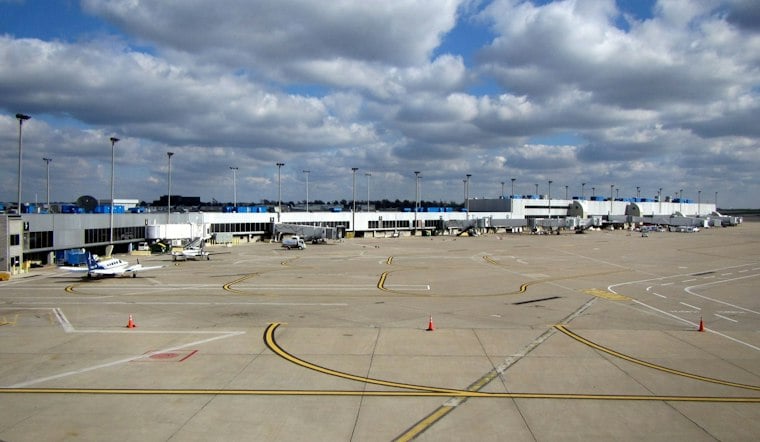
An Air Canada Jazz flight bound for takeoff at St. Louis Lambert International Airport was cleared, then abruptly ordered to stop just seconds before a Southwest jet touched down. The incident unfolded just after 9 a.m. as the Air Canada flight stopped short of entering Runway 12R; required separation between the two aircraft was maintained throughout, and no one was reported hurt.
According to air traffic control audio obtained by First Alert 4, controllers first cleared Southwest Flight 3082 to land on Runway 12R, and the crew confirmed the clearance. Moments later, controllers cleared Air Canada Jazz Flight 886 for takeoff on the same runway before quickly instructing the Jazz crew to stop, which the pilots confirmed they were doing by holding position. The Southwest pilot then asked controllers to confirm the landing clearance remained active, and controllers confirmed it did before Southwest 3082 touched down on 12R. Air traffic control subsequently instructed Jazz 886 to line up and wait, noting that traffic was on an 8-mile final for the runway.
The Federal Aviation Administration, which handles air traffic control operations at Lambert, told First Alert 4 Investigates that the Air Canada flight stopped short of entering the runway and that required separation between the two aircraft was maintained.
A Runway With a Painful History
Tuesday's close call occurred on the same airfield where a fatal collision once claimed two lives. On November 22, 1994, TWA Flight 427 struck a Cessna 441 during its takeoff roll after the smaller plane taxied onto the active runway, killing both occupants of the Cessna, according to the National Transportation Safety Board. Runway 12R/30L, the strip involved in Tuesday's incident, is Lambert's longest at 11,020 feet.
Lambert isn't the only airport to see ground-crossing close calls in recent memory. First Alert 4 Investigates notes that a fire truck was struck by a landing Air Canada Express jet at New York's LaGuardia Airport this year after controllers had cleared the truck to cross the runway. That incident followed the January 2026 collision between an American Airlines flight and a military helicopter while landing at Reagan National Airport in Washington, D.C., which killed 67 people. Since that crash, the Aviation Safety Reporting System has logged about six airport near-collisions per month nationwide, First Alert 4 Investigates reports.
National Data Shows Severe Close Calls Rising
Tuesday's incident lands amid a broader national trend that safety officials have been tracking closely. An FAA Safety Team report released in August found that while total U.S. runway incursions dipped 1% in 2025 to just over 1,600, severe Category A and B incursions — the most dangerous tier, involving narrowly avoided collisions or reduced separation requiring time-critical evasive action — jumped 44%, to an estimated 13 incidents nationwide, as reported by AVweb.
Nationally, controller operational errors account for roughly one-fifth of all runway incursions each year, while pilot deviations make up about 60% and vehicle or pedestrian deviations account for the remainder, according to the Federal Aviation Administration.
Lambert's Aging Infrastructure Back in the Spotlight
The incident comes as Missouri's congressional delegation pushes federal lawmakers to fund infrastructure upgrades at Lambert. U.S. Sen. Eric Schmitt introduced the $30 billion Modern Skies Act in late September, which would direct $10 billion toward modernizing or rebuilding aging terminals nationwide, with tower improvements and other infrastructure included in the broader bill, and has cited Lambert as a primary grant candidate, Hoodline previously reported. Transportation Secretary Sean Duffy visited Lambert this month to promote the bill alongside Schmitt.
Lambert currently relies on more than 100 Vehicle Movement Area Transmitters deployed across its ground vehicle fleet to track airfield movements and help prevent surface collisions, according to Aviation Daily. Other major towers have moved toward further digitization: Los Angeles International Airport began eliminating paper flight strips in favor of digital flight tracking systems in late 2026 to ease controller workload and increase monitoring time, as Hoodline has reported. Separately, an FAA Runway Incursion Mitigation summary published in August found that airports which physically reconfigured nonstandard taxiway geometry saw a 77% reduction in annual runway incursions, according to Aviation International News.
Tuesday's close call is the latest in a string of runway and taxiway scares across the country, including a near-collision between a commercial jet and a military helicopter at Greenville-Spartanburg International Airport and a similar incident at Boston Logan involving a landing Delta flight and a departing American Airlines jet. Whether the Lambert incident will factor into the push for new funding under the Modern Skies Act remains to be seen as the bill moves through Congress.





