

























































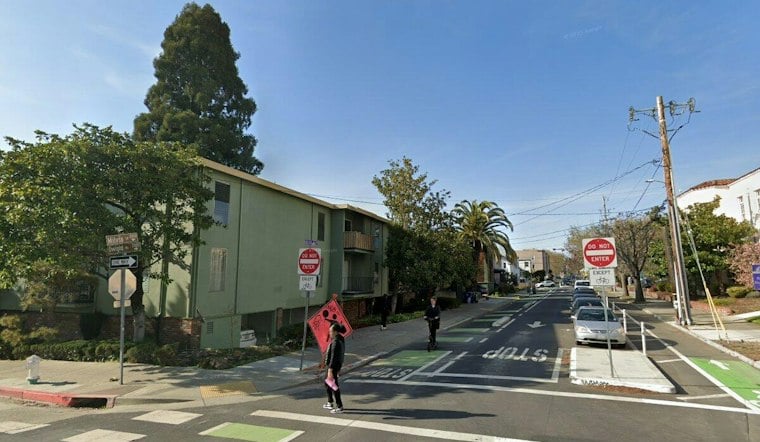
A man in his 40s was cut out of his flipped car and taken to the hospital Tuesday afternoon after a collision on Dwight Way near Milvia Street in downtown Berkeley left his black Toyota on its side. The crash, which also involved a black Honda, happened around 3:40 p.m. and brought a heavy emergency response to the 2000 block of Dwight Way.
Berkeley firefighters were dispatched to what was initially logged as an extrication assignment, according to The Berkeley Scanner. Crews initially believed there might be two patients based on emergency dispatches, but upon arrival they found just one person trapped inside the overturned Toyota. Firefighters used spreaders and cutters — the hydraulic tools commonly called the Jaws of Life — to pry open the car door and free him, a process that relies on equipment capable of delivering thousands of pounds of pressure to pull apart crumpled metal, per a Facebook video showing the tool in action.
The trapped driver sustained moderate injuries and was taken to Highland Hospital based on preliminary reports from the scene. The driver of the other vehicle, a man in his 80s, remained at the scene and there were no immediate reports of other injuries.
A Relatively Slow-Speed Crash With an Outsized Outcome
Investigators' initial look at the crash suggested it appeared to be a relatively slow-speed collision, even though the result was serious enough to trap a driver inside his car. That outcome tracks with how rollovers typically unfold: NHTSA research into crash mechanics has found that roughly 95% of single-vehicle rollovers are so-called tripped events, where lateral momentum is suddenly interrupted by contact with a curb, a wheel rim, or another vehicle, converting sideways force into a roll. Federal crash data cited by the Wetherington Law Firm shows rollovers make up only about 3% of passenger vehicle crashes nationally, yet account for nearly 30% of all vehicle occupant fatalities.
Highland Hospital, where the injured driver was taken, serves as the East Bay's only adult Level 1 Trauma Center, a designation the American College of Surgeons verified for the Oakland facility, operated by Alameda Health System, back in October 2017. The center treats more than 2,400 trauma patients annually, making it the regional destination for the most critically injured crash victims in Alameda County.
Dwight Way's Place in Berkeley's Traffic Safety Push
Dwight Way is a major east-west arterial through downtown Berkeley with a posted 25 mph speed limit, carrying heavy traffic through residential and commercial blocks, according to the City of Berkeley. The corridor sits within a few blocks of Martin Luther King Jr. Way, where the city completed quick-build pedestrian crossing and traffic-calming upgrades in May 2024 after finding that crashes along that stretch had climbed 64% annually between 2010 and 2019.
The crash also lands within Berkeley's broader Vision Zero framework, which the City Council adopted in March 2020 with a target of eliminating all traffic deaths and severe injuries on city streets by 2028. In August 2024, the city set aside $265,000 to launch a Street Trauma Prevention program inside the Berkeley Fire Department, creating a role dedicated to analyzing crash data from a first-responder's perspective to inform safer street design. Hoodline reported a Telegraph Avenue crosswalk crash that critically injured a 20-year-old just weeks earlier, part of a pattern of serious collisions on the city's arterial corridors.
Older Drivers and Crash Severity
The age of the second driver, a man in his 80s who stayed at the scene, lines up with broader national patterns around older motorists. CDC safety data shows drivers 70 and older face higher fatality rates per crash than middle-aged drivers, a gap researchers attribute to age-related physical vulnerability rather than a higher rate of crashes overall. The Insurance Institute for Highway Safety has also found that the number of licensed U.S. drivers 70 and older more than doubled between 1997 and 2024, now totaling 36 million people and representing 87% of that age group, up from 73% nearly three decades earlier.
No citations or fault determinations had been announced as of Tuesday evening, and the exact mechanics of how the Toyota flipped at what investigators described as a relatively slow speed remain part of the ongoing review.





