

























































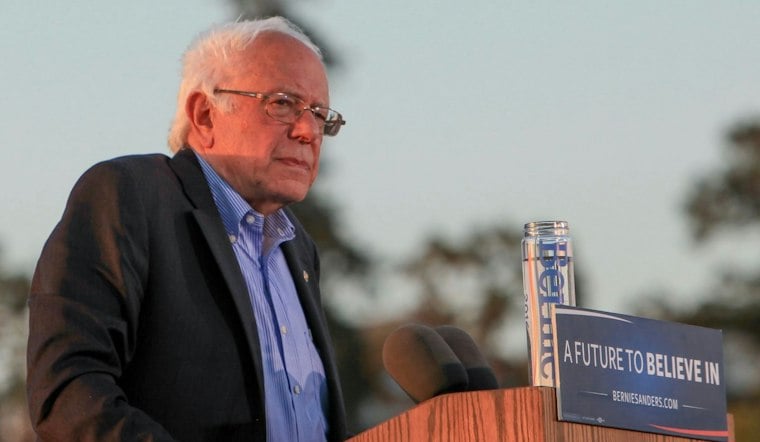
Vermont Sen. Bernie Sanders took the stage at San Francisco's Curran Theatre on Saturday to rally support for Proposition 40, a measure that would impose a one-time 5% wealth tax on Californians worth at least $1 billion. Sanders told the crowd the measure is the most important ballot initiative in the country, framing the November vote as a test of whether California will tax its roughly 200 billionaires to help fund health care.
Sanders Headlines Packed Curran Theatre Rally
The rally, billed as “Ballots Over Billionaires,” drew San Franciscans and health care workers to the 1,650-seat venue, according to the San Francisco Chronicle. Attendees included Carlos Mejia, who said he came out to support unity, positivity and working-class solidarity against billionaires. Mejia's reason for attending reflects the grassroots energy organizers hoped to channel into votes this fall.
Rep. Ro Khanna and former San Francisco Supervisor Jane Kim also addressed the crowd, according to the Chronicle's report. Khanna argued the choice facing voters is whether to stand with the working class or the donor class, and said some elected officials oppose Prop. 40 because they do not want to upset billionaire campaign donors.
What Proposition 40 Would Actually Do
Prop. 40 would levy a one-time 5% tax on the net worth of people whose wealth exceeded $1 billion as of January 1, 2026, according to the Chronicle's account of the measure. Per the CalMatters explainer, the tax would apply to roughly 200 California billionaires and would require the state to build, within six months, a system for valuing stocks, business interests, art and other assets. The outlet notes that pensions and individual retirement accounts would be exempt, except for Roth IRAs holding more than $10 million.
Officially, a yes vote would mean the state collects a one-time tax from billionaires equal to 5% of their wealth, according to the California Legislative Analyst's Office. Billionaires who were California residents on January 1, 2026 would owe the tax in 2027, with the option to spread payments over time, the Legislative Analyst's Office has said. The California Secretary of State's official voter guide describes the same one-time structure.
Health Care Stakes Drive the Pitch
Most of the revenue raised would be designated to backfill federal health care cuts, the Chronicle reported from the rally. Khanna told the crowd the issue is urgent because 3.5 million Americans would lose health insurance, and he warned that many people stand to lose Medicare and Medicaid coverage. Sanders, for his part, said the top 1% owns more wealth than the bottom 93%, framing Prop. 40 as a response to that imbalance.
Sanders also told the rally that supporters have been vastly outspent but that the whole country is proud of their effort, acknowledging that taking on the political establishment is difficult. He said billionaires have spent more than $200 million opposing the measure. CalMatters reports opponents have raised more than $205 million to stop Prop. 40, drawing on campaign finance records.
A Divided Democratic Party and an Uncertain Fiscal Picture
Not every Democrat is on board. Gov. Gavin Newsom and gubernatorial candidate Xavier Becerra oppose the measure, the Chronicle reported, arguing it could drive billionaires and their money out of California — even as some Democrats, including Sanders, Khanna and Kim, campaign for it. CalMatters notes opponents include Silicon Valley entrepreneurs, business interests, and some health and labor organizations, who argue the tax could backfire by pushing billionaires out of state and shrinking tax revenue over the long run.
Backers project Prop. 40 would raise roughly $100 billion over five years, according to CalMatters' voter guide, while the measure's own stated fiscal impact describes a temporary revenue increase of tens of billions of dollars spread over several years, alongside a possible ongoing annual income-tax revenue decrease of less than $1 billion. Experts say there is no way to know whether the tax would spark a large-scale exodus of billionaires, per CalMatters, though a Hoover Institution analysis cited by the outlet estimated that billionaires representing 30% of the tax base have publicly said they left California, a shift the analysis says would lower state revenue estimates by $60 billion.
Legal Clouds Still Hang Over the Measure
Experts also expect disputes and litigation over how to value privately held businesses under the new assessment system, CalMatters reports. A paper from the Tax Foundation argues Prop. 40 is vulnerable to numerous constitutional challenges. The same CalMatters piece notes that wealth taxes have become rarer worldwide — the Organisation for Economic Co-operation and Development counted 12 countries with wealth taxes in 1990, compared with just four today.
Polling gives supporters some momentum heading into November: a September Public Policy Institute of California survey found 52% of likely voters back the tax, according to the Chronicle. Sanders told the crowd that if California voters pass Prop. 40, he believes other states will follow as he continues pushing for a federal wealth tax on billionaires. Also performing at the rally before Sanders spoke were Mistah F.A.B. and Goapele.





