

























































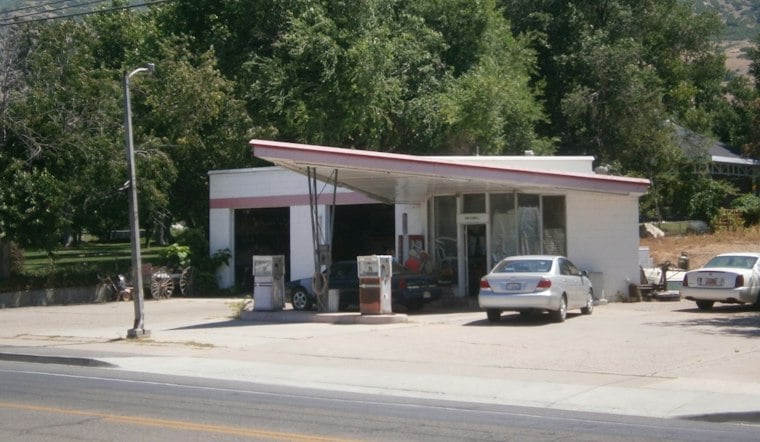
For nearly 80 years, a squat little building on Main Street in Centerville pumped gas, fixed tires and became a fixture in people's lives long after it stopped doing either. Now, with the death of its namesake owner in June, Ron Randall's Service Station is up for sale, and the community that grew up around it is hoping whoever buys it keeps the building standing.
The station dates back to 1948, according to FOX 13 News, and Ron Randall and his brother built the original structure themselves. The current building replaced it after a windstorm destroyed the earlier station in 1959, according to the Davis Journal. The station sold its last tank of gas in 1998, yet it still looks the part, down to vintage signage advertising gas at $1.87 a gallon.
Randall passed away in June, prompting his family to put the property up for sale, FOX 13 News reports. The station has been listed on the National Register of Historic Places since 2017, per the Davis Journal, though that designation alone does not prevent a future owner from redeveloping or even demolishing the building.
A Landmark Built on Full Service and Familiar Faces
Randall's station was known for the kind of full-service treatment that has mostly vanished from American gas stations: pumping gas, cleaning windshields and checking oil levels, the Davis Journal notes. Randall himself was often found sitting in a chair out front, greeting neighbors as they passed, the station's report states.
Patrick Neville said he leaned on Randall's mechanical know-how for years. “Ron always took care of us,” Neville said, per the station's coverage. Kennie Christiansen echoed that sense of reliability, saying residents could always count on Randall being there — and that preserving the station could showcase its history for future generations, according to the same report.
Anita Coyle, Randall's granddaughter, began working alongside him at the station when she was just 16. She said the station has been woven into a large portion of Centerville's history, and she hopes whoever buys the property preserves its structure and historic character, even if its use eventually changes.
What Could Come Next for the Historic Building
Centerville residents have floated several ideas for the space, including a soda shop, a restaurant, or another automotive business that would keep the building's working-garage roots alive. Those hopes echo a suggestion Randall himself made years earlier: he believed a full-service station offering tire checks and car washes could make a comeback, he told the Deseret News in 2007. A Centerville City Council member had even floated turning the station into a museum around that same time, preserving its contents and appearance, the paper reported.
Preservation officials say reuse, rather than museum status, is often what keeps old buildings standing. “In order to keep buildings alive and serving the community, oftentimes they have to have a new use,” according to the Utah State Historic Preservation Office. That office points to Dale's Sinclair Service Station in Logan, a 1955 mid-century building now leased by Meraki Floral Co. as a florist shop, as an example of a gas station finding new purpose while keeping its original character intact.
How Other Historic Stations Found New Purpose
The pattern isn't limited to Utah. Historic filling stations have become offices, diners and even concession stands elsewhere in the country, largely because their compact size and distinctive designs make them easy to repurpose, according to Indiana Landmarks. A 1934 station in Knightstown and a former Hoosier Pete station in Rising Sun were both converted into offices, the group notes, while a 1931 cottage-style station in Terre Haute was moved onto the Rose-Hulman Institute of Technology campus and rebuilt as a concession stand after facing demolition. A restored 1928 Standard Oil station in downtown Lafayette operated for years as the Red Crown Mini-Museum, and the 1931 Cammack Station outside Muncie now runs as a diner that displays automotive memorabilia and historic photos.
The National Park Service has documented similar transformations nationally, noting that old service bays have been converted into art galleries, photo studios, restaurant seating areas and open office space, per the agency's preservation guidance. Utah's historic preservation tax credit program offers a 20% credit to owners who rehabilitate buildings listed on the National Register, according to the Utah State Historic Preservation Office, among other potential benefits the office lists for National Register properties, including historical recognition, low-interest preservation loans, possible grants and building-code leniency, per the Utah State Historic Preservation Office's National Register FAQ.
Centerville itself has a formal mechanism for weighing in on buildings like Randall's. The city's Landmarks Commission was created to help identify, preserve, protect and enhance historic places and things within Centerville that carry architectural or historical significance, according to Centerville City. For now, no buyer, sale price or redevelopment plan has been made public, leaving the fate of Randall's Main Street station — and the community memories built around it — an open question.



