

























































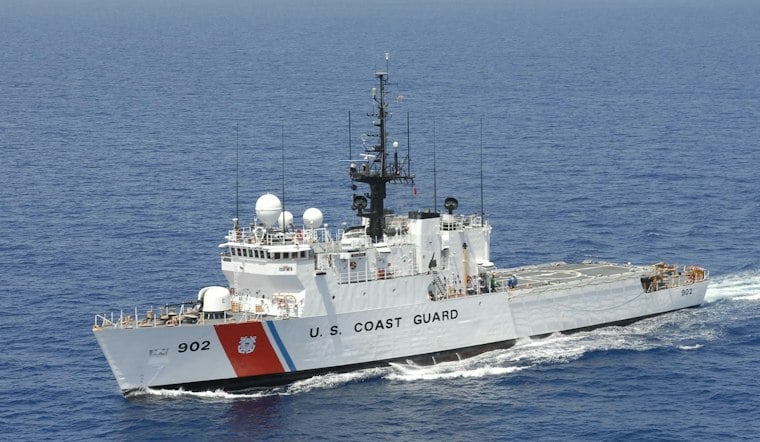
Nearly 15 tons of cocaine and marijuana were set for offload at Port Everglades in a haul valued at $226.7 million.
The shipment included approximately 29,600 pounds of cocaine and 3,355 pounds of marijuana, according to the U.S. Coast Guard. CBS News Miami reported that the drugs were to be offloaded at Port Everglades.
The Tampa itself is a 270-foot Famous-class Medium Endurance Cutter homeported in Portsmouth, Virginia, and vessels like it are routinely sent on multi-week counter-narcotics patrols spanning the Caribbean and Eastern Pacific transit zones, per the Coast Guard. Those extended deployments are what make offloads like Wednesday's possible — cutters accumulate contraband from multiple at-sea busts before finally bringing it ashore for a single, consolidated ceremony.
Part of a Bigger Federal Surge
Operation Pacific Viper is an elevated counter-drug campaign the Coast Guard launched in August 2025. In a September four-vessel operation, 13 suspected smugglers were detained, according to the Department of Homeland Security. Hoodline previously reported on a 25,000-pound seizure tied to the same campaign and the same cutter off Central America.
The numbers reflect a broader pattern. During fiscal year 2025, the Coast Guard interdicted over 511,000 pounds of illicit narcotics across the Eastern Pacific and Caribbean — more than triple its historical annual average of 167,000 pounds, per Military.com. Federal valuation metrics peg wholesale interdicted cocaine at roughly $16,588 per kilogram, and the outlet reports that 2025 seizures are estimated to have prevented $2.3 billion in direct healthcare costs.
Even so, Wednesday's $226.7 million haul doesn't come close to Port Everglades' all-time record. That mark was set on August 25, 2025, when the Coast Guard Cutter Hamilton brought ashore 76,000 pounds of illicit drugs — including 61,740 pounds of cocaine — valued at $473 million, according to U.S. Southern Command.
How the Drugs Get Tracked Down
Behind every offload ceremony is a sprawling detection network. Initial tracking of suspected smuggling vessels across a 42-million-square-mile operational area is coordinated by Joint Interagency Task Force South, based in Key West, according to U.S. Southern Command. The task force integrates military, federal law enforcement, and international partner assets to identify suspect vessels before Coast Guard teams move in for boardings.
When smugglers try to outrun pursuit, the Coast Guard sometimes calls on the Helicopter Interdiction Tactical Squadron, known as HITRON, which uses airborne use-of-force tactics — including warning shots and disabling fire — to stop non-compliant go-fast boats at sea, per the Department of Defense. HITRON crews fly armed MH-65 Dolphin helicopters designed to disable the outboard engines of fleeing suspect vessels.
Prosecuting Smugglers Caught Far From Shore
The Maritime Drug Law Enforcement Act addresses U.S. jurisdiction over stateless vessels.
One provision of that law, 46 U.S.C. § 70505, specifically bars individuals charged under the act from claiming a failure to comply with international law as a defense in U.S. court — that argument is reserved exclusively for foreign sovereign nations to raise, not individual defendants.
A Familiar Scene at South Florida Ports
Port Everglades offloads have become something of a recurring fixture in South Florida. Hoodline has covered several related busts over the past year, including a $6.7 million cocaine seizure near Cape Florida in May and a late-April offload of approximately 7,050 pounds at Port Everglades. The pattern underscores how frequently South Florida ports serve as the final stop for multi-ton contraband seized far out at sea before it reaches federal evidence lockers.





