

























































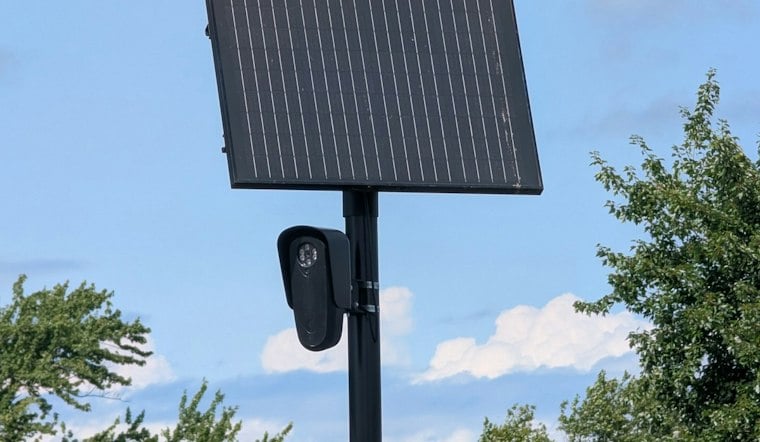
Elgin Community College hired Flock Safety in April 2025 to install six surveillance cameras on its far west suburban Chicago campus. Within months, college officials wanted them gone. Students were afraid to come to class, and administrators decided the cameras had to go.
More than half of the student body at Elgin Community College identifies as Latino, according to WBEZ, and the college had experienced a dip in enrollment. College president Peggy Heinrich said the school wanted students focused on learning and was doing everything possible to make campus feel safe. In October 2025, Elgin staff formally notified Flock that they wanted to cancel the contract and remove the equipment out of caution for students. Flock rejected the request within a day and refused to uninstall the cameras, Heinrich said.
The standoff dragged on. College officials reached out again in December 2025, this time offering to pay for the remaining five months of the contract just to get the cameras removed. Flock never responded, according to the same report. With no resolution in sight, Elgin staff began covering the cameras themselves, using black trash bags and zip ties — only to have workers in an unmarked vehicle repeatedly show up and strip the coverings away.
Cameras Finally Come Down When the Contract Expires
The impasse didn't end until Elgin Community College's Flock contract expired in April 2026, at which point the company uninstalled the cameras for good. Flock, which retains ownership of its equipment even while installed on client campuses, said it had not breached its agreement with the college, per the same account. The company did not respond to WBEZ's request for comment on the broader dispute.
The fight over the cameras unfolded against a backdrop of federal immigration activity on campus. A student at Elgin Community College was taken into custody by federal immigration authorities in a campus parking lot on September 18, 2025, according to NBC Chicago. The college said at the time that it does not engage in immigration enforcement and does not voluntarily share information about students' immigration status. Elgin officials later said an audit found no evidence that federal immigration agents had accessed the college's own Flock data.
A Statewide Pattern of Federal Access
Elgin's experience is not isolated. Federal immigration authorities directly accessed Flock data at some Illinois public colleges, and the state's Secretary of State's office found that U.S. Customs and Border Protection had searched Illinois Flock data in violation of state law, the Secretary of State's office said in filings from June 2025 and August 2025 announcing a crackdown and audit of license-plate-reader data use. Flock cameras use automatic license plate readers paired with artificial intelligence to track vehicle registration, models, dents and bumper stickers — technology the company says was intended to help locate stolen cars and missing people, though Fortune reports the same cameras capture a vehicle's plate, location and distinguishing marks down to a bumper sticker.
Flock cameras remain installed at five of Illinois's 12 public universities and at four community colleges, per the WBEZ report. At the University of Illinois Urbana-Champaign and the University of Illinois Chicago, Flock data was searched dozens of times last year in connection with immigration enforcement. Joliet Junior College, which has seven Flock cameras, also had its data searched in connection with immigration enforcement, and students there must pass at least one camera to reach class on the main campus.
A Student Organizer's Warning
Lui Rodriguez, a 26-year-old Joliet Junior College student who has raised funds for the student group Latinos Unidos by baking cookies with the dean of students, said the cameras felt like a betrayal to students — about a third of whom identify as Latino. Rodriguez said surveillance information can be used to track down and detain students and that the cameras do not make him feel safer on campus. Joliet Junior College spokesperson Katie Smith said the college remains committed to a welcoming and inclusive environment while providing a safe campus, and that the school reviews who has access to its Flock data and would take any misuse seriously. Joliet's Flock contract is up for renewal in July 2027.
Flock has said federal agencies can no longer access local Flock data unless law enforcement agencies grant access, per a company statement. But surveillance experts say the company is financially incentivized to have as many cameras gathering data as possible. Torin Monahan, a professor at the University of North Carolina at Chapel Hill, said Flock networks provide access to more cameras throughout the country — a reach that research published in the Journal found extends to at least 150 higher-education institutions nationwide, part of a system of more than 83,000 cameras that can run retrospective vehicle searches across jurisdictions covering the past 30 days.
Pushback Spreads Beyond Illinois
Students and educators across Illinois are now calling on college leaders to terminate their contracts with Flock, arguing the technology violates student privacy and endangers immigrant students and student activists. At the University of Illinois's three campuses, outside law enforcement searched Flock data more than 650,000 times over a single 30-day period in July and August, according to the Chicago Sun-Times, which also reported that Illinois's five public universities still using Flock have spent more than $450,000 on the company's services since 2021, including a two-year, $110,300 contract at UIC for 15 cameras.
The backlash extends well beyond Illinois. In Washington state, at least eight law enforcement agencies enabled direct sharing of their Flock networks with U.S. Border Patrol during 2025, and audits revealed apparent back-door access by Border Patrol to at least ten Washington police departments that had not explicitly authorized such searches, according to the University of Washington's Center for Human Rights. In Michigan, Lansing's City Council approved a resolution in August 2026 asking its police department to sever all Flock contracts and shut down the city's 26 cameras, while Bay City commissioners rejected a Flock contract that same month and Eastpointe ended its contract in September, according to MLive.





