

























































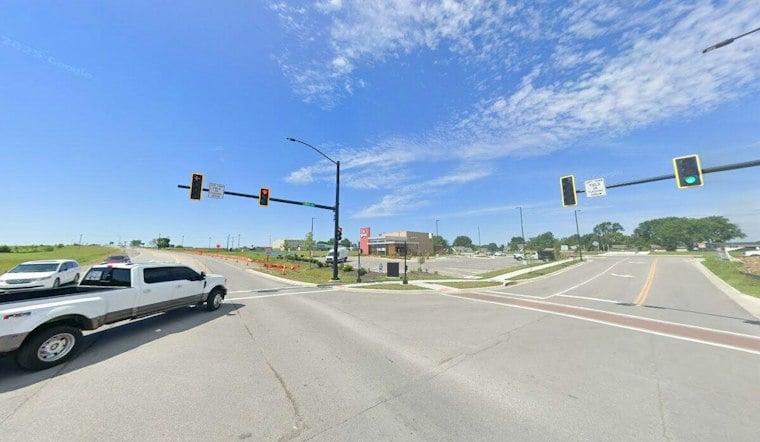
Eudora Police Chief Wes Lovett wants an automated license plate reader posted at the city's only stoplight, but he has already crossed one major vendor off the list entirely: Flock Safety. The roughly $18,000 request is working its way through city hall discussions as officials also ask voters to approve a new public safety sales tax on the November ballot.
Lovett told KSHB 41 Kansas City that the department is researching an ALPR system with short-term data storage and limited data access, and that Flock-branded cameras have been eliminated from consideration. He said Eudora can learn from the mistakes other departments have made with license plate readers, framing the search as a deliberate attempt to avoid the backlash that has hit nearby communities.
That backlash has been hard to miss in eastern Kansas. In August, the neighboring cities of Gardner and Wellsville both terminated their Flock Safety contracts after residents pushed back over mass surveillance concerns and third-party vendor access to camera data, according to the Johnson County Post. Gardner had reportedly spent $33,000 on setup and $13,000 annually before pulling the plug, a detail Hoodline also reported in its own coverage of Gardner's Flock cancellation.
A Statewide Legal Fight Over Flock
The scrutiny extends beyond small towns. In July, the Kansas Justice Institute filed suit in Sedgwick County District Court challenging Wichita's network of roughly 200 Flock cameras, arguing in the case Grimmett v. City of Wichita that warrantless automated vehicle fingerprinting functions as a de facto GPS tracker, as reported by Reason Magazine. Civil liberties advocates have also pointed to a February case the ACLU documented in Lenexa, Kansas, where police reportedly used license plate readers to monitor a resident's vehicle movements and issue a be-on-the-lookout alert after he published a newspaper op-ed critical of local police.
Flock itself announced nationwide changes in August, cutting its default data retention period from 30 days down to seven calendar days and mandating internal auditing systems for police agencies that use its technology. The company's systems reportedly scan an estimated 20 billion plates per month nationwide, per a report from St. Louis Public Radio covered by Hoodline's earlier reporting on license-plate-camera privacy fears. Lovett has said the goal in Eudora is real-time crime-solving, not tracking residents, and he believes an ALPR could have helped solve several crimes in the city over the past year, including locating stolen vehicles and responding when an Amber Alert passes through town.
Where The Camera Would Go
If approved, the reader would likely be installed at the intersection of East 15th Street and Church Street, home to Eudora's only stoplight and a frequently used entrance and exit point for the city. Eudora Police are considering the system's cost alongside its data practices, and the roughly $18,000 purchase request is part of the city's 2026 capital improvement plan. City Manager Zack Daniel said the request is still being discussed among city officials, and the Eudora City Commission has not yet approved the purchase.
The request would not exist in a vacuum. The Douglas County Sheriff's Office already operates its own automated license plate readers across county roadways to help deputies identify stolen vehicles, missing persons, and wanted suspects, storing encrypted data in a CJIS-compliant cloud platform. Eudora's roughly 6,100 residents average two cars per household with a commute time of about 23 minutes, according to Data USA, underscoring how central car travel is to a city sitting between Lawrence and the Kansas City metro.
A Sales Tax Tied To Public Safety
Money is the other half of this story. Eudora's general fund, supported by property taxes, would cover an individually approved ALPR purchase, but the city is also asking residents to consider shifting public safety equipment costs onto a new 0.5% sales tax appearing on the November ballot. That tax would replace an expiring half-cent levy that has funded Community Center debt, which ends December 31, so the city's overall sales tax rate would not increase if voters approve the measure.
The new tax is projected to generate about $350,000 annually. If it passes, city officials say it would free up general fund budget space to hire three full-time firefighters at a cost of about $327,000 a year, allowing Eudora to provide around-the-clock fire protection for the first time in the department's 100-year history. Daniel said the sales tax strategy is meant to let public safety operations grow alongside the community. Lovett has also noted that the department's weapons, tasers and other equipment are aging, adding another layer to the city's broader public safety funding needs.
The debate over how departments should be allowed to use license plate data has also become a statewide political flashpoint. During an October debate, candidates for Kansas Attorney General found common ground on consequences for ALPR misuse: Kobach supported job loss, fines and possible jail time for officers, and both candidates supported holding private companies accountable, as discussed in Hoodline's coverage. Under current Kansas law, captured license plate data and the specific physical locations of ALPR systems are exempt from public disclosure, while questions about data-retention limits and audit policies remain.





