

























































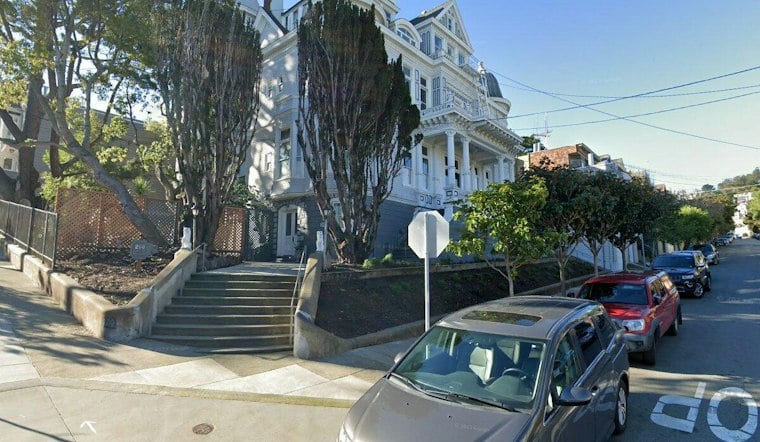
The towering Queen Anne known as the Alfred E. Clarke Mansion, a fixture of Eureka Valley since 1893, is back on the market at 250 Douglass Street — this time asking $6.5 million, with its fifteen rental units pulling in nearly $500,000 a year and a second, separate parcel that brokers say could unlock even more value.
A $6.5 Million Ask, Up From Its 2021 Sale
The listing, later reported by The Real Deal, covers roughly 8,220 square feet across two parcels and includes 15 apartments ranging from studios to two-bedroom units, a lower-level office, and a standalone cottage. According to marketing materials cited by SFGate, the building generates more than $495,000 in annual rental income. The property previously changed hands on September 30, 2021, for $5.85 million following the death of its long-term owner, whose family had held the estate since the 1970s, per SFGate's earlier reporting on the sale.
Compass agent Adam Filly, who holds the listing, has pointed to a specific feature as the deal's sleeper opportunity: a second parcel that houses the property's garden cottage. Filly told SFGate there could be substantial value in the chance to add accessory dwelling units there. Vanguard Properties' listing materials describe the main 15-unit building's breakdown as seven one-bedroom apartments, five studios, and three two-bedroom units, plus a single-car garage, with the garden cottage sitting on its own distinct parcel.
New Zoning Rules Could Reshape the Second Parcel
That ADU potential didn't exist in its current form until recently. Mayor Daniel Lurie signed San Francisco's Family Zoning Plan into law on December 12, 2025, and it took effect in January 2026, according to the city's own announcement on SF.gov. Separately, the San Francisco Board of Supervisors passed an ordinance in July 2025 implementing California's AB 1033, which allows property owners to convert and sell eligible accessory dwelling units as individual condominiums under Planning Code Section 207.4, per a client alert from Reuben, Junius & Rose, LLP. The Family Zoning Plan concerns housing, while the separate ordinance creates a framework for eligible ADUs to be sold as individual condominiums, subject to strict requirements. Restrictions on resale and rental use have limited ADU appeal.
The property has more than 50% potential rent upside, reflecting long-term tenant rents that sit below current market rates in the neighborhood.
San Francisco designated 250 Douglass Street as Landmark No. 80 in 1975.
From Sailor's Fortune to 45-Room Estate
The mansion's backstory is as outsized as its architecture. Alfred “Nobby” Clarke arrived in San Francisco as an Irish sailor in 1850, worked as a longshoreman, joined the police department in 1856, and had accumulated $200,000 by 1887 while working as a clerk to the city's Chief of Police, according to planning department records filed with the project's 2017 historic resource evaluation. Clarke used part of that fortune to buy 17 acres in what was then a sparsely built stretch of Eureka Valley — a neighborhood of modest one- and two-story cottages — making his sprawling, multi-towered mansion such an architectural anomaly that neighbors took to calling it “Nobby Clarke's Folly.”
Completed in 1893, the house stood on that 17-acre spread. Its grandeur didn't last in private hands for long: the Real Deal's reporting notes Clarke never actually lived in the mansion and lost his fortune within three years of its completion. The building went on to serve as the MacLean Hospital and Sanitarium and later the California General Hospital in the early 1900s, before becoming a rooming house for Standard Oil Company employees, according to a history compiled by NoeHill. It also survived the 1906 earthquake and fires before its eventual conversion into the apartment building it remains today.
The mansion has long been a neighborhood landmark in its own right — Hoodline's Castro green spaces guide once pointed walkers toward the estate near Douglass and Caselli streets, close to Kite Hill, and the property resurfaced again in Hoodline's roundup of Castro-area buildings under historic consideration. For now, its future rests with whoever takes on both the income-producing apartments and the regulatory puzzle of building anew beside a 133-year-old landmark.





