

























































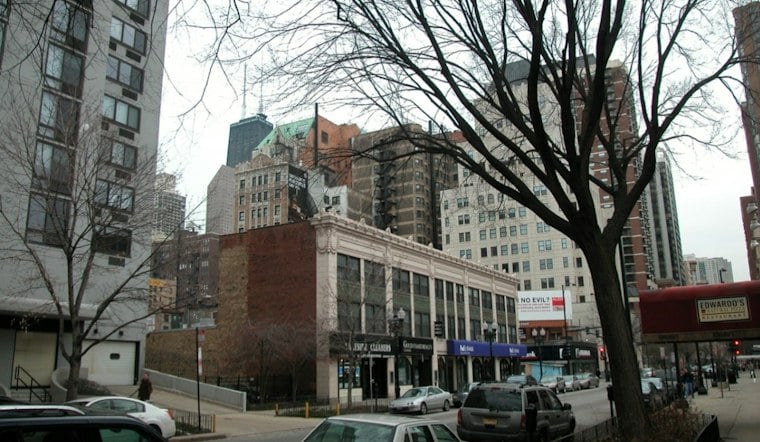
A seven-story office building in Chicago's Gold Coast neighborhood has traded hands for $6.8 million, with the buyer planning to strip out the cubicles and turn the property into an 80-unit apartment complex. Chicago-based developer NewStreet closed on the 74,500 square feet of office space above the ground-floor CVS at 1165 N. Clark St., marking the firm's first foray into office-to-residential conversion.
The deal, first reported by The Real Deal, caps a yearlong negotiation between NewStreet and seller Goldman Sachs. NewStreet's acquisition excluded the ground-floor retail and parking, isolating only the upper office floors — a structure Goldman Sachs set up years earlier. The investment bank bought the entire 110,000-square-foot building for $22.8 million in 2015, then sold off roughly 18,000 square feet of ground-floor retail space to YFP, a South Carolina limited liability company registered to Jeffrey S. Yager, for $21.3 million in 2022. That single retail sale let Goldman Sachs recoup nearly its full original purchase price before offloading the remaining office space at a steep discount.
Cook County's assessor had pegged the building's total market value at just $11.5 million as of 2025, underscoring how far office valuations have fallen since Goldman Sachs's 2015 purchase. Before Goldman Sachs owned the property, former owner R2 Companies bought it for less than half of the $22.8 million price tag, then renovated the lobby, corridors, and elevator cabs, pushed office occupancy from 60% to 85%, and locked in a 25-year lease extension with CVS as ground-floor anchor, according to R2 Companies.
Financing the Conversion and What's Planned
NewStreet financed the purchase with a $5.5 million loan from CRE Bridge Capital, with NewStreet and an anonymous equity partner kicking in another $1.3 million. Alex Milanoski, development director at NewStreet, said the firm hopes to start construction by June 2027. The building is currently about 60% occupied, and most existing office leases are slated to end in 2026 or early 2027; NewStreet is offering early termination options to tenants holding longer lease terms, per the same account.
The finished project would convert the office floors into 80 apartments — a mix of one-bedroom, one-bedroom-plus-den, and two-bedroom units averaging 880 square feet. Eckenhoff Saunders has been tapped as architect for the project. Because the building is zoned B3-5, NewStreet can build apartments above the ground floor by right, without pursuing a zoning amendment — a distinction the developer is leaning on to avoid a lengthy entitlement fight.
A Transit-Adjacent Site With a Familiar Neighbor
The building sits directly above the CTA Red Line's Division station, which underwent a $90 million modernization in 2016, and sits across the street from The Sinclair luxury apartment tower, according to R2 Companies. That combination of transit access and residential density at the corner of Clark and Division — on the border of the Gold Coast and Near North Side — is part of what makes the office floors attractive for conversion.
NewStreet, rebranded from Initium Development, isn't new to North Side residential projects even if this is its first adaptive reuse deal. The developer broke ground in March 2026 on a 48-unit multifamily project at 2600 N. Clark St. in Lincoln Park, securing full building permits that May, according to Chicago YIMBY. NewStreet has also listed a separate 48-unit ground-up construction project at 200 W. Ohio St. Milanoski said the firm is actively seeking further opportunities in the Gold Coast, Lincoln Park, and Lakeview submarkets.
Chicago's Broader Housing Squeeze
Milanoski framed the acquisition against a backdrop of scarce new construction, saying Chicago's biggest affordability challenge is simply building new units. He pointed to a lack of new construction as a contributor to record buyer demand in desirable neighborhoods, which has triggered bidding wars for listings. Illinois ranked second-to-last nationally in new home construction, issuing just 157 permits per 100,000 residents between June 2025 and May 2026. Housing supply has become a flashpoint in Chicago City Council debates over renters' rights, though those discussions remain stalled in City Hall.
The deal also lands amid a citywide push to absorb vacant office space through residential conversion. As of July 2026, the Chicago Department of Planning and Development reported 26 active office-to-residential conversion projects underway downtown, projected to create more than 4,000 apartment units and repurpose roughly 4 million square feet of vacant office space, according to the City of Chicago. That same month, the city broke ground on a $162 million conversion of 500 N. Michigan Ave., turning floors 3 through 23 of the 25-story tower into 320 apartments while keeping ground-floor retail like Chick-fil-A and Bank of America intact.
Earlier this month, city officials celebrated the opening of The Bellwether Residences at 79 W. Monroe St., the first completed conversion under the LaSalle Street Reimagined initiative — a $64.2 million project that turned 11 floors of vacant office space into 117 mixed-income apartments using $28 million in Tax Increment Financing and historic tax credits. Hoodline previously reported it was 57% leased shortly after opening. Unlike that publicly subsidized project, NewStreet's Gold Coast conversion is being financed entirely through private debt and equity, reflecting how smaller developers are chasing similar deals in prime residential submarkets without waiting on city financing.
Direct office vacancy across Chicago's Central Business District reached 23.2% in the second quarter of 2026, a 20-basis-point drop from the prior quarter and the market's first quarterly vacancy reduction in 26 quarters, according to BNP Paribas Real Estate. Conversions like NewStreet's, which remove obsolete office inventory from the market, are among the factors credited with helping stabilize that metric. Under the city's Affordable Requirements Ordinance, residential developments that receive zoning approvals or density increases must set aside 20% of new units as affordable or meet off-site or fee compliance standards — though because 1165 N. Clark St. can convert by right under its existing B3-5 zoning, that citywide mandate's applicability to NewStreet's project depends on the entitlements it ultimately uses.


