

























































Shoreline springs near Great Salt Lake State Park are actively flowing again, according to a Facebook post from Great Salt Lake State Park & Marina, the latest sign that conditions are falling into place for one of the strangest natural phenomena in Utah to reappear. The springs feed a rare mineral formation known as mirabilite, a crystalline mound that only grows under very specific winter conditions and has been documented in just a handful of places on Earth.
What Mirabilite Actually Is
Mirabilite is hydrated sodium sulfate, chemically written as Na₂SO₄·10H₂O, and is also known by its old-world nickname, Glauber's salt, according to Great Salt Lake State Park & Marina. The mineral is picky about the weather: it requires subfreezing temperatures to crystallize, and when the air warms back above freezing, those crystals lose their water content and crumble into a powdery white dust called thenardite. Scientists studying the lake have found that sustained cold air actually speeds up how fast the crystals form and grow, according to a study published on sciencedirect.com.
The science traces back to a specific moment. As lake elevation dropped below roughly 1,278.6 meters, or 4,195 feet, beginning in the fall of 2019, crystalline mounds began forming on the lake's southeastern shore near the state park, per the same study. The sciencedirect.com research describes how sulfate-saturated spring water, measured at a relatively warm 10 to 15 degrees Celsius, meets much colder lake water sitting at 0 to 3 degrees Celsius — and when that spring water hits cold winter air, the sodium sulfate precipitates out as mirabilite.
A Ranger's Accidental Discovery
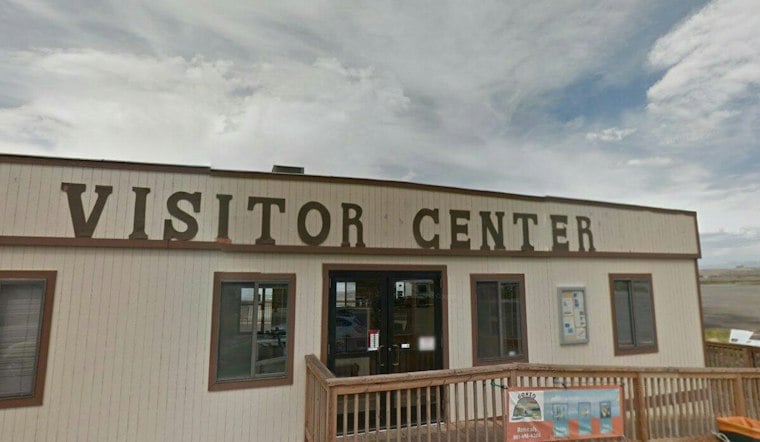
Nobody was looking for a rare mineral formation when this all started. A ranger at Great Salt Lake State Park first noticed a white mound forming on the sand flats behind the visitor center back in October 2019, as recounted by wildaboututah.org. The white mound turned out to be mirabilite being carried to the surface by an upwelling freshwater spring, and at least one of those early mounds eventually grew to about 3 feet tall, the outlet reported.
Since that first sighting, the formations have shown up again in subsequent cold seasons. Rare mirabilite formations were spotted on Great Salt Lake on Nov. 21, 2024, according to ksl.com, which noted the formations are spring-fed and have only appeared since October 2019. The same report cautioned that the mounds are not permanent fixtures: warmer water temperatures could erode them down to thenardite, and rising lake levels could reduce them as well.
Crystals Shaped by Continuous Flow
Up close, these aren't just lumps of salt. The spring mounds at Great Salt Lake contain clear, bladed and tabular mirabilite crystals that run roughly 1 to 10 centimeters long and 1 to 5 centimeters wide, per the sciencedirect.com study. The same research describes how continuous brine flow builds up crystalline micro-terraces, rimstone dams and pools that gradually merge vertically into the taller mounds visitors have photographed in past seasons.
The mounds have also drawn scientific interest well beyond their novelty as a photo opportunity. The sciencedirect.com study reports that biosignatures and evidence of microbial sulfate reduction are preserved within the mirabilite matrix and inside fluid inclusions trapped in the crystals. That same cold-brine chemistry has caught the attention of researchers studying Mars, since similar cryobrine processes that form crystalline structures are of interest to scientists searching for evidence of groundwater on the Martian surface.
One of Only a Few Places on Earth
Mirabilite spring mounds like the ones near Great Salt Lake State Park have been documented in only a handful of places worldwide, including Antarctica and the Arctic. The sciencedirect.com research lists comparable mirabilite-bearing environments in the northern Great Plains of western Canada, the Qinghai-Xizang plateau and Qaidam Basin, Russia, the Caspian region, and coastal lake basins on Banks Island in the Canadian Arctic Archipelago. Similar subaerial crystalline spring mounds have also been documented in sulfate-rich spring waters in Burgas, Spain, and in halite-saturated brines on Axel Heiberg Island in the Canadian High Arctic, according to the same study.
Separately, wildaboututah.org has described the mounds as having been seen in just four places in the entire world — the Canadian Arctic, Antarctica, Central Spain and Utah. Mirabilite itself shows up in other wet, cold, salty environments too, having been mined historically by Native Americans in Mammoth Cave and other parts of the Smoky Mountains, and more recently forming on China's Yuncheng Salt Lake, as reported by atlasobscura.com. That outlet has also noted that the lake's railroad causeway has created two distinct water chemistries, one on the north side and another on the south, and has described Great Salt Lake as sitting alongside Chile's Atacama Desert and Iceland's lava fields as a natural laboratory for studying alien-like environments.
For now, the confirmed piece of the puzzle is simply that the springs are running. Whether this season's cold snaps are enough to trigger a fresh batch of mounds remains to be seen, but the ingredients — flowing sulfate-rich spring water and the approach of Utah's freezing winter air — are already in place along the lake's southeastern shore.





