

























































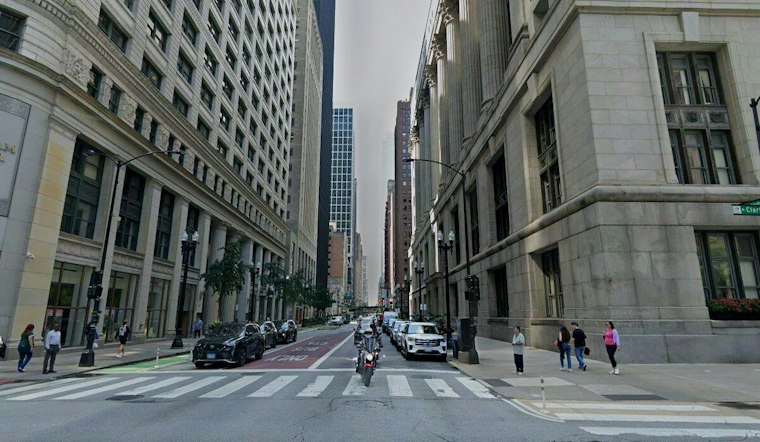
Dozens of city and other government vehicles sat parked in marked tow zones across downtown Chicago without a single visible ticket, even as nearby private drivers got slapped with citations for parking in the same type of restricted spots. The finding comes from an ABC7 I-Team investigation that spent time watching parking enforcement activity along Washington and Clark streets in the Loop.
According to the ABC7 I-Team, reporter Jason Knowles documented a line of government vehicles parked in restricted areas on Washington Street between LaSalle and Clark streets, as well as on Clark Street between Washington and Madison streets. Knowles said he examined the vehicles and saw no tickets on any of them, including a U.S. Postal Service van parked in a tow zone. Meanwhile, he said, private citizens parked nearby were receiving citations.
The I-Team also captured a parking enforcement attendant actively ticketing a private vehicle while government vehicles remained untouched in the same tow zone just steps away, and observed a separate attendant who did not ticket any of the government vehicles in view. When Knowles asked a parking enforcement attendant whether municipal vehicles were getting ticketed, the attendant did not respond, per the station's report.
An Attorney Calls It a Double Standard
Mark Horwitz, an attorney with the Horwitz Law Group, told the I-Team that parking enforcement changes have made it so his clients can no longer stop in areas marked no standing or no stopping, even when someone stays behind the wheel. He said the rules have shifted so private citizens can no longer use those spaces the way they once did.
Horwitz argued the disparity amounts to a double standard for taxpayers, saying city vehicles from every department seem to park wherever they want while regular drivers face strict enforcement. He also pointed to the cost drivers absorb when they cannot find street parking, noting that downtown garages start at $14 to $15 just for the first half hour.
City Finance Official Defends the Practice
Michael Belsky, comptroller for the city's Department of Finance, which collects revenue from parking violations, told the I-Team that government employees are permitted to park in restricted areas while conducting regular city business. He said the city tries to make parking convenient for people doing important city work, but added that an employee parking to go to a restaurant would be ticketed if that conduct were determined to have occurred.
The I-Team said it did not receive a response from the mayor's press office. The outlet also said it contacted several government agencies, including the United States Postal Service, but the USPS did not respond to the inquiry before the report aired. Federal agencies including the Postal Service have long asserted that their vehicles carry sovereign immunity from local parking citations and automated camera tickets, a legal doctrine previously detailed by CBS Philadelphia that leaves municipalities unable to bill federal agencies for such infractions.
A Growing Push to Expand Automated Enforcement
The uneven enforcement comes as Chicago moves to widen its automated camera ticketing of private drivers. On Friday, October 9, 2026, the City Council's Pedestrian and Traffic Safety Committee advanced legislation, backed by more than half of all aldermen, to expand the city's Smart Streets program citywide and make it permanent, according to the Chicago City Council
. The Smart Streets pilot began issuing automated parking violations in December 2024, later expanding to CTA bus stop enforcement in fall 2025 and adding meter and commercial loading zone enforcement in early 2026, per the
City of Chicago Department of Finance
.
Some violations carry steep fines: $250 for blocking a bike path and $90 for standing in a bus lane. Fines double after 25 days unpaid, the Department of Finance notes.
Chicago leans heavily on this revenue stream to balance its books. The city budgeted $345 million in revenue from fines, forfeitures, and penalties in 2025, equal to $127 per resident and up from just $35 per resident in 1996, according to an analysis by the Illinois Policy Institute. Yet collection remains a struggle: data obtained by WGN Investigates showed the city was owed more than $2.6 billion in total unpaid vehicle fines and traffic violations as of June 30, 2026.
The city's ticketing practices have also drawn legal scrutiny. In October 2026, a Cook County Circuit Court judge ruled that Chicago had systematically overcharged drivers on roughly one million parking and compliance tickets issued since 2012 by exceeding the state's $250 fine limit, leaving the city liable for more than $163 million, FOX 32 Chicago reported. Separately, the city's Finance Committee approved a $15.5 million settlement in May 2025 with private concessionaire Chicago Parking Meters LLC after the firm claimed the city had shorted it on revenue by failing to adequately enforce meter violations.
Hoodline has previously reported on related friction over Chicago's parking enforcement, including a plan letting residents film scofflaws and a Chatham parking ban dispute that pitted businesses against the city over enforcement. Taken together, the pattern raises the same question Horwitz and the I-Team's findings point to: why government vehicles can sit in tow zones without consequence while private drivers pay steadily rising fines for the same violations.





