

























































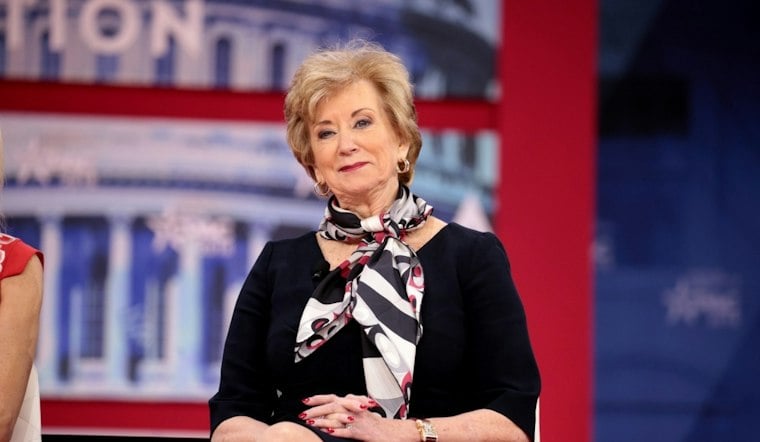
Education Secretary Linda McMahon stood inside American Preparatory Academy's West Valley K-12 campus Tuesday morning and praised what she called accelerated reading levels among the students she observed, holding up the charter network as a model for the Trump administration's push to shrink federal education oversight. At the very same campus, a very different story has been unfolding: a Utah state auditor has petitioned against the school's private management company over records the charter school withheld, seeking details about how much public money goes toward paying its top administrators.
A National Tour Lands at a School Under Scrutiny
McMahon's stop in West Valley City on October 20 kicked off “The Next 250: American Education,” a four-stop speaking campaign, according to the U.S. Department of Education. During the visit, part of a broader national tour promoting the administration's effort to decentralize federal education authority, McMahon highlighted $1 billion in federal investments meant to expand charter school options nationwide and argued that oversight of education should return to the states. She also said Trump administration had made a major turnaround in American education focused on students, and according to the Salt Lake Tribune, she said state reporting requirements for private management companies should be followed — a comment that lands awkwardly given the network's ongoing legal fight.
American Preparatory Academy is a charter network with eight campuses across Utah, and its Draper High School ranked among the state's top 10 in U.S. News & World Report's 2026-27 rankings, per the same report. But the West Valley K-12 campus McMahon toured carries a different distinction: it's been designated for Comprehensive Support and Improvement by the Utah State Board of Education, meaning the school lags significantly in performance metrics and must demonstrate improvement. According to USBE data cited in the Tribune's reporting, the campus has underperforming Black students and students with disabilities compared with peers statewide, with just 14% of students with disabilities in grades 3-8 scoring proficient on English language arts during the 2025-26 school year, compared with roughly 23% among students with disabilities across American Preparatory Academy campuses overall.
Founder Defends the Network's Record
Network founder Carolyn Sharette told the Tribune the schools are accelerated-learning and high-performing according to state rankings, and that the school accepts a wide variety of students through free public education and open enrollment. She said two state-designated student subgroups, including students with disabilities, perform at the low end of state testing and trigger the CSI designation, but that the school works to help students in those groups improve regardless of their starting point. Sharette gave opening remarks during McMahon's visit to the campus.
The $31 Million Question Auditors Can't Get Answered
While McMahon toured classrooms, State Auditor Tina Cannon's year-long legal battle against the network remained unresolved. In a February 2026 petition against private management firm American Preparatory Schools, Cannon alleged that American Preparatory Academy transferred more than $31 million in public funds to the company since 2022, according to the Salt Lake Tribune. She also alleged that the academy withheld detailed payroll records for its top administrators. The petition seeks to clarify whether charter management organizations receiving state funds can claim private exemption from the state's public transparency laws.
Cannon's office first requested the charter operator's financial records in September 2025, and the Tribune reports that American Preparatory Academy officials eventually provided some financial records but withheld detailed records of payments to the private company dating back to when the management contract began in 2022, disclosing only yearly lump-sum amounts instead of itemized payment records. Cannon took formal legal action over the refusal to disclose administrator pay in February 2026, and in July 2026 she asked a 3rd District Court judge to expedite a ruling. American Preparatory Academy received approximately $55 million in state funds in 2025, according to Cannon's court petition, and she has argued the charter should not transfer public funds to a separate entity in order to shield their handling from state auditor review.
How the Charter and Its Manager Are Legally Separated
American Preparatory Academy was established in 2002 by Carolyn Sharette and Laura Campbell under Utah Charter Academies, but in 2008 both resigned from the board to create the private management company American Preparatory Schools, which then signed a contract to manage the charter network's operations, according to the American Preparatory Education Foundation. That corporate split is now at the center of the dispute: the management contract names Sharette as American Preparatory Schools' executive director, and she told the Tribune she is exclusively an employee of American Preparatory Schools, not the charter academy itself. The academy argues its top administrators aren't technically employed by the school because American Preparatory Schools pays them directly, funneling public money to the private operator, which then issues the paychecks. American Preparatory Schools, in turn, argues that the state auditor may audit the charter school but lacks authority over the privately held management company — meaning its separation from the charter should shield payroll records from public view entirely. Utah charter schools operate independently from school districts while remaining public schools, and they must comply with laws governing public education, including financial disclosure requirements, which is precisely the standard Cannon's office is trying to enforce.
A Pattern of Oversight Disputes
This isn't the network's first run-in with state regulators. A January 2020 audit authorized by the Utah State Board of Education questioned about $2.8 million in special education expenses at American Preparatory Academy. In January 2019, the ACLU of Utah demanded that the network rescind rules restricting non-English languages after allegations that students at the West Valley campus were disciplined for speaking native languages outside class under strict cultural conduct guidelines — a campus that serves a diverse student body with a substantial population of immigrant and English-language learner families.
Even as the payroll dispute drags on, state authorizers have kept approving the network's growth. In February 2026, the Utah State Charter School Board authorized a new K-6 campus in Ephraim on 5.2 acres within the Ephraim Crossing development, marking the network's expansion into central Utah. On May 7, 2026, the Utah State Board of Education granted an administrative rule waiver allowing a satellite campus in Cedar Fort for Fall 2026 to accommodate roughly 130 students displaced by the closure of Cedar Valley Elementary; the temporary site will operate for two years while a permanent Eagle Mountain campus is built for 2028.
Local and National Threads Converge
The West Valley campus McMahon visited also made local headlines 36 days earlier, when a driver was killed after an SUV crossed Bangerter Highway and crashed into the building, which Hoodline previously reported burst into flames. McMahon's broader federal agenda has also drawn scrutiny closer to home: in September, special education official Kelly Rogers resigned after McMahon moved to shift the Department of Education's Office of Special Education and Rehabilitative Services to the Department of Health and Human Services, a restructuring disability rights advocates opposed without congressional approval. And Cannon herself has faced political pressure well beyond this case — outgoing Utah Senate President Stuart Adams sent her formal legal letters in August 2026 demanding retractions under threat of defamation lawsuits, which Cannon publicly refused following Adams' primary election loss in June.



