

























































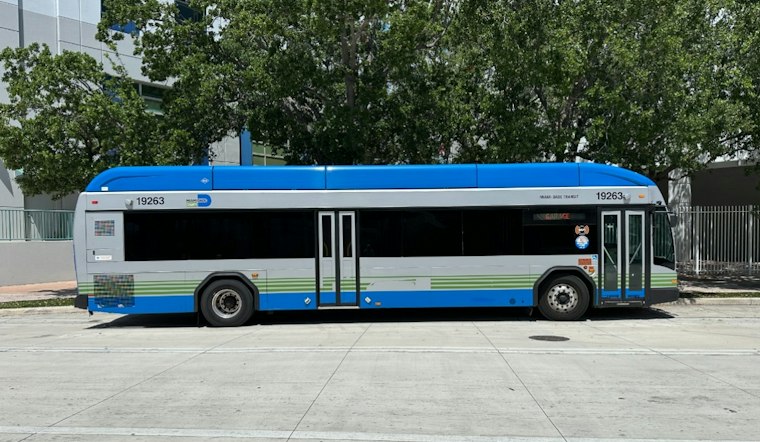
Miami-Dade County has launched its first-ever joint community shuttle linking Districts 2 and 3, a new route designed to carry residents to transit hubs, stores and medical appointments across North Miami, Opa-locka, Liberty City, Little Haiti, Overtown and surrounding neighborhoods. Commissioners Marleine Bastien and Keon Hardemon announced the shuttle together, framing it as a direct response to gaps in how residents in their districts get to work, school and doctor's appointments without a car.
Two Districts, One Ride
According to a post from Miami-Dade County
on its official X account, the shuttle is the first of its kind to serve both districts, connecting residents to transit hubs, stores, medical care and more. District 2, represented by Bastien, covers North Miami, Opa-locka, and portions of Hialeah and Miami, and it holds the county's largest concentration of Haitian-American residents, according to
Florida Politics
. District 3, represented by Hardemon since November 2020, spans urban core neighborhoods including Liberty City, Little Haiti, Overtown, Wynwood, Midtown and Edgewater, per the outlet's earlier reporting on county leadership.
Bastien won re-election in August with 78% of the vote, securing a second and final four-year term on the 13-member county commission through 2030, the outlet reported. Hardemon, a former four-term chair of the Miami City Commission, brings his own track record of pushing transit access projects in District 3 — including a $2.9 million naming-rights deal that renamed the Civic Center Metrorail station to improve links to UHealth and Jackson Health System.
Funded by the Half-Penny Surtax, Bound by County Rules
Shuttles like this one typically draw funding from Miami-Dade's half-penny transportation surtax, which requires 20% of proceeds to flow directly to municipalities for local transportation projects, including community shuttles and circulators, according to Miami-Dade County. That surtax dates back to the People's Transportation Plan approved by voters in 2002. County code also restricts these on-demand shuttle services to trips no longer than five miles per journey, a constraint that shapes how far the new District 2-3 route can realistically stretch.
Both Bastien and Hardemon also sit as voting members on the 25-member Miami-Dade Transportation Planning Organization Governing Board, which sets regional transit policy and funding allocations, according to the Miami-Dade Transportation Planning Organization. That dual role gives the two commissioners direct influence over how countywide transit dollars get divided between big Metrobus routes and smaller neighborhood connectors like this new shuttle.
A Lifeline Launches as Metrobus Faces the Knife
The timing matters. Miami-Dade Mayor Daniella Levine Cava presented a $14.3 billion budget proposal in July that includes eliminating 12 Metrobus routes, which provide about 4,400 weekday rides, and eliminating service before 6 a.m. or after 10 p.m. on dozens of other routes, according to Mass Transit. Commissioners were expected to cast final votes on the proposals September 17. Transit officials have also been grappling with a roughly $25 million annual hit to county sales tax revenue from commercial leases, the result of a change in Florida state law, which has strained operating funds for the broader system.
That financial squeeze has forced transit officials to weigh main-line reductions while trying to preserve local connector routes like the one Bastien and Hardemon just launched. The new shuttle arrives as a kind of counterweight — a hyper-local fix aimed at preserving first-mile and last-mile mobility even as the county's bigger bus network faces contraction.
Part of a Broader District Push
The shuttle launch follows a district-level move by Bastien this year. Bastien attended a community town hall in District 2's Westview neighborhood in April to address resident concerns over infrastructure and environmental impacts tied to a new 150,000-square-foot data center.
For residents in North Miami, Opa-locka, Liberty City and Little Haiti, the shuttle represents a concrete, near-term answer to a question that's been looming over Miami-Dade Transit all year: as the county trims its main bus lines, what happens to the neighborhoods that depend on them most? For now, Bastien and Hardemon are betting that smaller, targeted routes can help fill that gap.




