

























































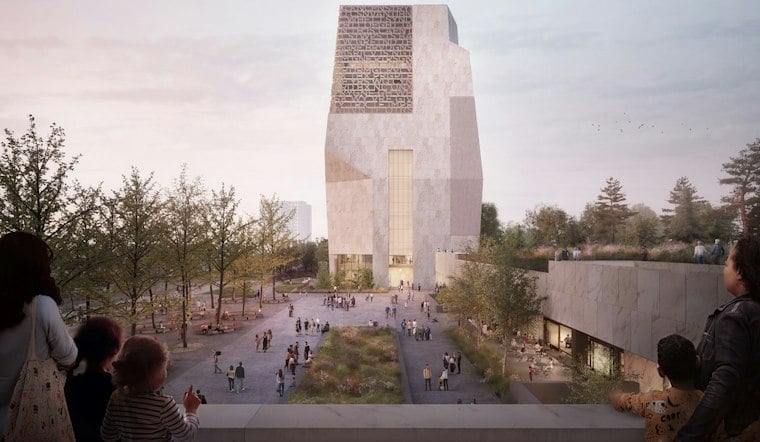
More than 175,000 people walked through the Obama Presidential Center's museum and ticketed events during its first 100 days of operation after opening in June 2026, with visitors arriving from all 50 states and 39 countries. The South Side institution's early numbers have become something of a case study for developers and policymakers across Chicago, who are pointing to the center as proof that big, ambitious projects can still work in a city where new construction has otherwise slowed to a crawl.
A Blockbuster Opening on the South Side
According to a press release from the Obama Foundation, the center's newly expanded CTA Route 10 bus line averaged 6,360 weekly rides during that stretch, while 1,715 one-way Divvy trips started at the center and 1,662 ended there. WTTW, however, put the average weekly bus ridership figure at about 6,300 trips, a modest discrepancy from the Foundation's own count. For comparison, the station notes that the George W. Bush Presidential Library and Museum drew more than 170,000 visitors in its first 100 days after opening in 2013.
Michael Strautmanis, chief corporate affairs officer at the Obama Foundation, said tourism spending has already begun reshaping the surrounding commercial strip. He said new restaurant and store ideas are emerging because tourism spending has entered the community, as visitors pick up everything from t-shirts to Obama burgers while they're in the neighborhood. Event panelists have pointed to the center's success as a reason for optimism among Chicago developers working on their own large projects, according to Bisnow.
The $7 Billion Bet Near the United Center
The most visible test of that optimism sits just west of downtown, where United Center owners Wirtz and Reinsdorf broke ground on the 1901 Project, a $7 billion privately funded development set to transform more than 55 acres of surface parking lots into a mixed-use district, as reported by the Chicago Sun-Times. Plans call for 1,900 affordable residential units and 1,309 total hotel rooms, with the first phase alone valued at $500 million. The city separately described an estimated $54.7 million property-tax saving over a 12-year term tied to the project, according to the City of Chicago.
Job estimates for the project vary depending on the source. The Sun-Times reported in June that the full project is expected to create an estimated 2,400 construction jobs and thousands of permanent jobs over its lifetime, while an earlier Sun-Times report from March projected Phase 1 alone would create nearly 2,000 construction jobs, 600 permanent jobs and 180 part-time positions. GMA Construction Group CEO Cornelius Griggs, whose firm works on projects in historically disinvested neighborhoods, said large megaprojects in those areas create real opportunity for local communities, and he urged developers to follow transit expansion with new projects. The 1901 Project sits near the United Center in a neighborhood Bisnow describes as disinvested for over 75 years, and Griggs argued that expanded access benefits historically disinvested communities as projects break ground.
Transit Expansion Meets a Housing Shortfall
Chicago's broader transit picture includes the CTA's Red Line Extension, a project the city describes as running 5.5 miles along the South Side with four new stations planned at 103rd, 111th, Michigan and 130th streets, according to the City of Chicago. The agency has said the extension will give underserved communities new access to downtown, though the Chicago Tribune has reported that the CTA is in settlement talks with federal officials over a related lawsuit, with the matter's final resolution not yet established.
That transit investment arrives amid a housing market developers describe as constrained. J.R. Berger, president of Magellan Development Group, said unbuilt but approved housing units point to a financing problem that surfaces before developers even reach the permitting stage, a view echoed broadly among developers who attribute limited construction primarily to financing difficulties rather than permitting hurdles. Berger, whose firm is also developing a mixed-use project next to the University of Tennessee's football stadium, said successful developments need to connect with the local community every day, not only on game days, and identified avoiding a Disneyland-style feel as a key challenge for megaprojects built in established neighborhoods.
Why So Little Is Getting Built
The numbers back up the sense of a slowdown. Downtown Chicago has about 4,500 residential units under construction, including both conversions and new construction, and Mike Potter, executive vice president at Riverside who tracks residential supply across downtown, said he expects one in three residential units delivered over the next two or three years to be conversions rather than ground-up projects. Separately, Bisnow has reported that West Loop/Fulton Market carries a proposed pipeline of roughly 8,500 apartment units, more than the proposed pipelines in the other downtown submarkets combined, and accounts for 1,280 of the 3,000 multifamily units under construction downtown.
Nick Melrose, CEO of Melrose Ascension Capital, said property taxes, government fiscal issues and perceived crime are hindering some investment in Chicago. He argued that active investors generally prefer buying in-place assets over new development because investors cannot build cheaper than they can buy existing properties, and can instead benefit from the city's long-term fundamentals, which he and others describe as strong even as office space has traded at deep discounts in recent years. Molly Phelan, a partner at Siegel Jennings, said Chicago and Cook County have lacked sufficient development of any kind over the past decade, and argued that government should offer better incentives to attract development investors — allowing investors to bring jobs, development and tax revenue that she said could help make Chicago great again. She also said the city lacks enough critical mass to support retail for a genuinely vibrant downtown.
A Mayoral Candidate's Housing Target
Rep. Mike Quigley, who is running for Chicago mayor, has set a goal of adding 50,000 housing units over the next four years and has urged developers to dramatically increase supply. He has argued that faster permitting and updated building codes could enable more housing construction, and has said he believes Chicago can grow its way out of its housing problem.
Beyond downtown's office towers, the conversion trend is already reshaping the skyline. In downtown Chicago, 35 office-to-residential conversion projects are proposed, underway or completed, representing $2.1 billion in new investment and expected to create at least 4,466 residential units, according to The Real Deal. Hybrid work policies left Chicagoland with more office space than it needed, the outlet reports, depressing the value of some downtown properties and pushing owners toward residential conversions instead. Nearly two dozen privately initiated conversions are in the pipeline and are expected to create nearly 4,000 units, according to Construction Dive, which also notes that the Bellwether — the first of six conversion projects considered under the city's LaSalle Street Reimagined initiative — turned 11 floors of the Rector building into 117 residential units, 41 of them income-restricted, using $28 million in city tax increment financing and $7.8 million in federal historic tax credits.
Even with that momentum, supply remains tight. Downtown Chicago is expected to receive no more than 3,000 new apartment units across 2025, 2026 and 2027 combined, with 2026's growth only a modest increase over 2025's decade-low delivery pace, according to a report from rejournals.com. The same report notes the Chicago metro area has a shortfall of roughly 165,000 housing units, ranking among the top three metro areas nationwide for housing underproduction — a gap that helps explain why developers and officials alike are watching the Obama Center and the 1901 Project so closely for signs that Chicago's megaproject math can still work.




