

























































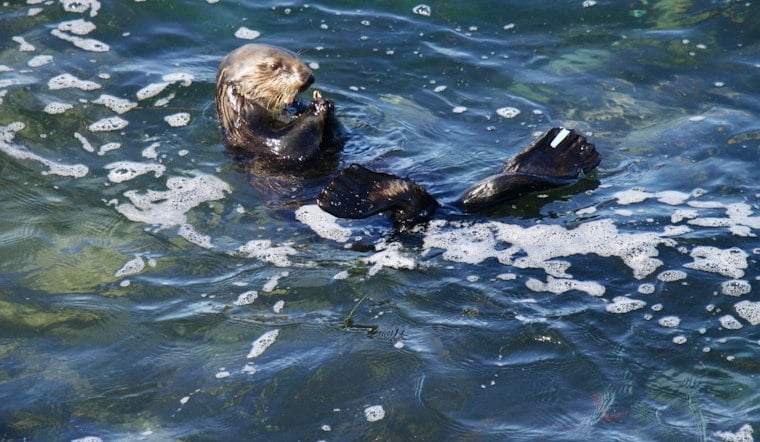
A sea otter approached a youth surf club at Steamer Lane on Thursday, climbing onto one surfer's board in a tense encounter caught on video by an onlooker. The otter appeared, per the onlooker, to be moving in for an attack with unclear exact intentions, before one surfer charged toward it multiple times and scared it off, creating a safe distance for the rest of the group. No injuries were reported.
The incident, first reported by ABC7 San Francisco, adds to a growing list of unusually bold otter encounters along the Santa Cruz coastline. It is not an isolated case: in October 2025, an aggressive sea otter bit surfer Isabella Orduna's foot and took over her surfboard at the same break, according to Surfer, prompting an emergency response from the Santa Cruz Fire Department and local lifeguards.
A Pattern Dating Back to Otter 841
The most famous surfboard-stealing marine mammal in Santa Cruz, known as Otter 841, gained global fame in mid-2023 after repeatedly commandeering boards from surfers and kayakers, as detailed by Snopes, before successfully giving birth to a pup that October. Federal and state wildlife personnel spent months attempting to capture and relocate her without success. Otter 841 was born around 2018 at the UC Santa Cruz Coastal Science Campus and raised by her mother at the Monterey Bay Aquarium with minimal human interaction before being released into the wild at Moss Landing in June 2020, per Wikipedia's entry on the animal. Her mother, Otter 723, was also known for approaching watercraft.
Why do otters off West Cliff Drive keep closing in on surfers? Research by Sea Otter Savvy found that sea otters inhabiting developed coastal zones in central California experience human-caused disturbances an average of six times per day, a drain on vital caloric energy that can cause the animals to lose their natural fear of humans, according to reporting from Afloat.ie. Sea otters must consume large quantities of food daily just to maintain body heat in the cold coastal waters, which may help explain the bold foraging and approach behaviors documented at the break.
Federal Rules Carry Steep Penalties
Marine biologists from Sea Otter Savvy and research partners recommend that surfers, kayakers, and boaters stay at least 60 to 100 feet — roughly five boat-lengths — away from wild sea otters to avoid disturbing their resting and foraging habits, according to The Wildlife Society. Studies cited in that same reporting indicate a 50 percent likelihood that an otter will scatter if approached within 30 feet.
Under the federal Marine Mammal Protection Act and Endangered Species Act, approaching a wild sea otter closely enough to alter its behavior is classified as illegal harassment, punishable by federal fines of up to $100,000 and up to one year in prison, according to the U.S. Fish and Wildlife Service. Federal authorities advise water sports enthusiasts that approaching otters puts both humans and animals at risk — a warning that cuts both ways when an otter, rather than a person, closes the distance first.
Steamer Lane's Dual Identity
Steamer Lane is a world-famous point break designated as a central anchor of the Santa Cruz World Surfing Reserve, which encompasses 7 miles of coastline and 39 surf breaks formally recognized in April 2012 by the Save The Waves Coalition, making Santa Cruz the fourth World Surfing Reserve dedicated globally. In 2022, local stakeholders updated the reserve's Local Stewardship Plan to address rising user congestion, coastal erosion along West Cliff Drive, and marine habitat conservation, combining surf leaders and conservationists on local stewardship councils.
California's southern sea otter population hovers around 3,000 animals across central California, according to the U.S. Geological Survey's 2024 rangewide census, a slow recovery from historical fur-trade exploitation while the species remains listed as federally threatened. Recovery goals require a three-year average exceeding 3,090 animals before delisting could even be considered. The Steamer Lane encounters arrive as regional conservation groups and state agencies continue exploring plans to restore sea otters to former habitats like the San Francisco Bay and the Oregon coast, where the species has been locally extinct since the 1980s — part of a broader push that treats otters as key kelp forest ecosystem engineers that keep sea urchin populations in check, as Hoodline has previously reported.



