

























































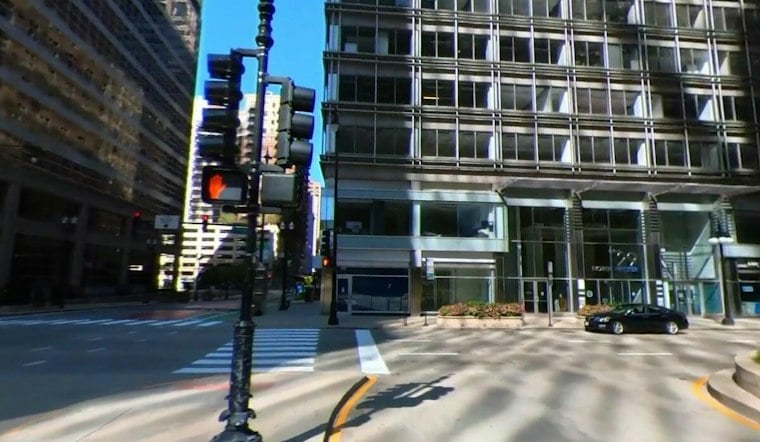
More than 1,000 birds were injured or killed over the weekend after colliding with buildings across Chicago and Evanston, as volunteers worked through downtown high-rises and Northwestern University's lakefront campus collecting the dead and rescuing injured birds. The toll, recorded Saturday and Sunday, reflects what has become a grim annual ritual for a region sitting directly beneath one of the busiest bird migration corridors in North America.
Chicago Bird Collision Monitors volunteers canvassed downtown Chicago and Northwestern's Evanston campus, rescuing injured birds and documenting those that did not survive, according to FOX 32 Chicago. Annette Prince, director of Chicago Bird Collision Monitors, said major collision events happen because Chicago sits along a major migratory path used by millions of birds each spring and fall. Reflective glass can mirror trees and sky, Prince explained, making transparent windows nearly invisible to birds flying at speeds of about 30 miles per hour — fast enough to cause fatal injuries or trauma requiring medical care.
A Known Danger Zone on the Flyway
The weekend's casualties are not an anomaly. A 2019 study led by the Cornell Lab of Ornithology, detailed by the Cornell Chronicle, identified Chicago as the most dangerous metropolitan area in the country for migratory birds during both spring and fall seasons, pointing to the city's intense light pollution layered on top of its position along the Mississippi Flyway. Researchers reached that conclusion after analyzing satellite light pollution data alongside weather radar tracking bird migration density across 125 U.S. cities.
Northwestern's Evanston campus alone logs roughly 700 bird collision casualties each year, with the glass-heavy Kellogg School of Management Global Hub standing out as a high-risk site because its reflective windows mirror the nearby Lake Michigan shoreline and surrounding foliage, per CBS Chicago. Downtown, Chicago Bird Collision Monitors typically recovers between 5,000 and 6,000 injured or dead birds annually within just a 1.5-square-mile zone, according to WTTW News. Surviving birds go to wildlife rehabilitation centers, while dead specimens are transported to the Field Museum, where they feed long-term ecological research.
Proof That Fixes Work
The clearest evidence that intervention works comes from McCormick Place. Bird Friendly Chicago says nearly 1,000 birds died in a single collision event at the convention center in 2023, prompting the venue to add visible markers to its glass that same year — a step that cut collisions there by 95%, per the organization's figures cited by FOX 32 Chicago. That initial fix was followed by a far larger undertaking: in summer 2024, McCormick Place completed a $1.2 million retrofit applying 120,000 square feet of bird-safe dot-pattern film to its windows, a project that reduced recorded bird collision fatalities at the venue by 98.6% during the fall 2024 migration season, according to the U.S. Fish and Wildlife Service.
The science backs up why glass treatments matter so much. A June 2021 study in PNAS, drawing on more than 40 years of Field Museum salvage records collected at McCormick Place under curator emeritus David Willard, found that cutting a building's illuminated window area in half slashes bird collision deaths by a factor of 11 in spring and six in fall, according to findings published by the Field Museum.
Scale of the National Toll
Chicago's crisis is part of a much larger national pattern. Building collisions kill between 365 million and 1 billion birds annually nationwide, according to U.S. Fish and Wildlife Service estimates cited by the National Audubon Society. A 2024 study in PLOS ONE, which evaluated outcomes for more than 3,100 collision victims, found that 60% of birds brought to wildlife rehabilitation centers alive after a strike ultimately die, underscoring that initial strike counts understate the true death toll from internal trauma.
A Stalled Ordinance in City Hall
Bird Friendly Chicago is pressing the City Council to pass the proposed Bird-Friendly Building Design Ordinance, which would establish bird-safe standards — such as patterned glass, exterior screens and other treatments that make windows visible to birds — for qualifying new construction in Chicago, per FOX 32 Chicago's reporting. Alderwoman Maria Hadden introduced the measure in March 2026, and it moved out of the City Council Rules Committee in July. It currently sits in the Zoning Committee, where its language is still being revised, a status Hoodline also reported in earlier coverage of a September migration alert.
Prince said Chicago must require future buildings to use bird-friendly designs and materials to avoid adding further to the toll on bird life. In the meantime, Bird Friendly Chicago is urging residents and building operators to support the city's existing Lights Out program, which encourages buildings to turn off or dim nonessential lighting during migration — a voluntary step that helps prevent collisions even without a mandate in place.
Chicago is not legislating in a vacuum. The Illinois Bird Safe Buildings Act, enacted in July 2021 and effective since January 2022, already requires state-owned or substantially renovated state buildings to use bird-friendly glass or non-glass materials on at least 90% of lower exterior facades, according to the Illinois General Assembly. Neighboring Lake County went further in May 2025, becoming the first county in the nation to require bird-friendly design for residential construction, developed in partnership with the American Bird Conservancy. At the federal level, U.S. Representative Mike Quigley has introduced the bipartisan Federal Bird Safe Buildings Act, which would require GSA-built or renovated public buildings to incorporate bird-safe glass and lighting strategies, according to the New York City Bar Association.





