

























































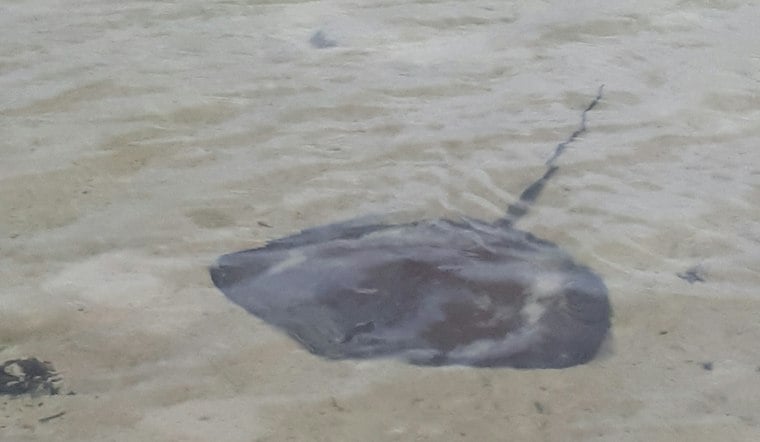
Five beachgoers wading in knee-deep water off Pacific Beach felt a sharp, sudden pain in their feet within about two hours of each other, part of a surge that has pushed the neighborhood's stingray sting count past the totals recorded in each of the previous two years. Alba, Lou, Eva, Brandon and Alex all ended up soaking their feet in hot water at the Pacific Beach lifeguard station after the encounters, comparing notes on a sting that, for some, was far more painful than others.
According to CBS 8, Alba rated her pain a nine out of 10, while Eva, stung the same day, put hers at a three. Another beachgoer, Bulka, said the pain traveled from his foot all the way up to his hip. Brandon told the outlet he felt less alone once he realized several other people around him had been stung that same afternoon. Lou, taking the whole ordeal in stride, said he would rather be stung than serve as chum.
Lifeguards treated around 40 people for stingray injuries on the day the group was stung, per the same CBS 8 report, and the station's account describes lifeguards having treated hundreds of beachgoers for stings this year. Marine Safety Lt. Charlie Knight said anyone stung should head straight to the nearest lifeguard tower, where the recommended treatment is soaking the affected foot in tolerably hot water for 45 minutes to an hour.
A Three-Year Climb Toward a Record Year
The numbers back up what lifeguards are seeing on the sand. San Diego Fire-Rescue Department data cited by CBS 8 recorded 396 stingray injuries in Pacific Beach from January through the end of August 2026 alone, and the neighborhood's full count for the year has already exceeded the prior full-year total by 60 and the 2024 total by 68. As reported by Times of San Diego, Pacific Beach had the highest number of stings reported to lifeguards so far this year of any beach citywide, with those figures covering the stretch south of the pier from Crystal Pier to Mission Beach.
Lifeguard Lt. John Maher told the outlet that Pacific Beach has already logged more stings year-to-date than it saw in all of last year combined, continuing what the report describes as a three-year trend of rising injuries. Maher also cautioned that the real number is likely higher still, since many beachgoers never report a sting to lifeguards at all.
By contrast, Black's Beach, Mission Beach and Ocean Beach have reported fewer stingray injuries this year, according to CBS 8's reporting, and La Jolla Shores logged 203 stingray injuries from January through August, a figure that came in 24 below its prior full-year total and 35 below its 2024 total. A separate Times of San Diego report on the La Jolla area found that La Jolla Shores, Blacks Beach and Scripps Beach combined for close to 400 stings so far in 2026, compared with 763 reported stings across those same three beaches in 2024. Blacks Beach alone dropped to 150 stings this year from 278 in 2025, while Scripps Beach recorded just 46 stings by October, down sharply from 304 in 2024.
Warmer Water and Calmer Surf Draw a Crowd
Scripps Institution of Oceanography Ph.D. student Zach Merson told Times of San Diego that two factors are likely driving the increase: more people in the water and warmer water itself. Merson added that stingrays tend to be most heavily concentrated at low tide, and that warmer conditions could stretch peak stingray season through the end of October and possibly into November.
The pattern isn't confined to San Diego. A state park superintendent cited by NBC Los Angeles pointed to ocean temperatures consistently staying in the 60s as a major contributor, with experts describing a marine heat wave pulling both stingrays and swimmers toward Southern California shores. More than 900 stingray stings were recorded across San Diego beaches in just the first half of 2026, outpacing the first-half totals of each of the previous five years, per that same report. Chris Lowe, cited in the same NBC Los Angeles piece, said declining numbers of predators like sharks, sea lions and giant sea bass may also be allowing stingray populations to grow.
Farther north, Huntington Beach Fire Department Battalion Chief Derek Peters told KTLA that stingray activity tends to climb whenever surf size drops. Bolsa Chica and Huntington State Beaches have logged more than 3,100 stingray incidents so far this year, twice the total for all of 2025, while Huntington Beach itself has already topped 2,000 incidents, more than it saw in the entirety of last year, according to the NBC Los Angeles report.
How To Avoid A Sting And What To Do If You Get One
Lifeguards recommend the stingray shuffle for anyone wading in shallow water: keeping both feet in contact with the sand while sliding forward instead of stepping down normally, which is meant to scare off any stingray resting nearby before you step on it. Stingrays feed on shrimp and small crabs buried in the sand, which is part of why they tend to settle in the shallow, nearshore areas where swimmers wade.
If a lifeguard tower isn't staffed when a sting happens, beachgoers can use the emergency call boxes located along San Diego beaches to reach a 24-hour dispatch center, per Times of San Diego. California State Parks lists hot, fresh water soaks as the primary treatment for a stingray injury, according to the agency's own guidance. Exact temperature recommendations vary by source, so anyone stung should let lifeguard staff on scene guide the water temperature rather than guessing at home.





