

























































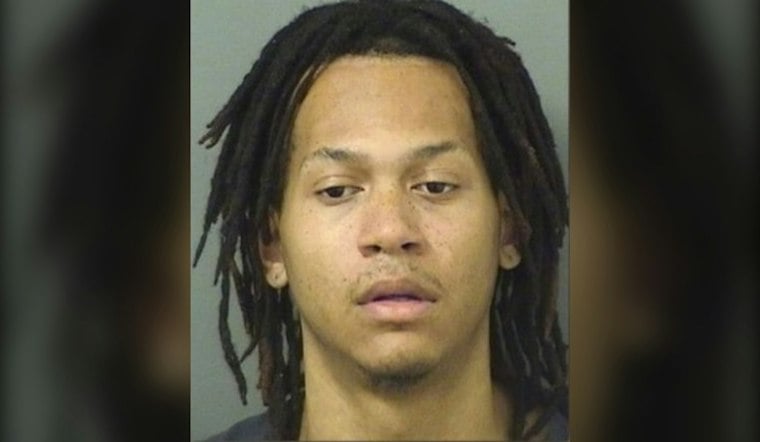
A 23-year-old Palm Beach Gardens man is facing extortion, stalking, and cyberharassment charges after police say he called a former girlfriend 219 times using No Caller ID, threatened to share explicit photos of her, and even applied for jobs at her workplace. Rodney Michael Chavers was arrested following the filing of a warrant request, according to investigators.
Chavers and the victim had a prior dating relationship, according to an affidavit cited by WPEC. The woman blocked Chavers' phone number in March 2026, but police say that didn't stop him — he allegedly called her 219 times using No Caller ID and texted her from multiple other phone numbers in the months that followed.
Investigators say Chavers didn't stop at calls and texts. According to the affidavit, he threatened to share explicit photos with the victim's family, friends, and workplace unless she communicated with him. Police also say he applied to jobs at the victim's workplace and contacted members of her family, actions investigators characterized as part of a broader pattern of stalking.
Charges Carry Serious Statutory Weight
An arrest warrant was ultimately issued for Chavers, who now faces four separate charges: extortion by threat, stalking, sexually cyberharassing another person, and making repeated or continuous harassing telephone calls. Under Florida Statute § 836.05, extortion by threat is classified as a second-degree felony punishable by up to 15 years in state prison, 15 years of probation, and a $10,000 fine, according to the Florida Legislature.
Notably, the extortion charge does not hinge on whether Chavers ever actually distributed the photos. As Galanter Law explains, extortion charges do not require the accused to successfully compel the victim's actions or publish explicit material — the offense is legally complete the moment a malicious threat is communicated with intent to force someone to act against their will.
The sexual cyberharassment charge stems from Florida Statute § 784.049, enacted in 2015 specifically to address the distribution or threatened distribution of nonconsensual intimate images. A first offense is a first-degree misdemeanor punishable by up to a year in county jail and a $1,000 fine, while repeat offenses escalate to a third-degree felony carrying up to five years in prison, according to the Florida Senate.
Anonymous Calls and Stalking Statutes Explained
The hundreds of alleged anonymous calls also carry their own legal consequences. Florida Statute § 365.16 classifies repeated harassing phone calls or withholding one's identity using No Caller ID to intimidate or annoy someone as a second-degree misdemeanor, punishable by up to 60 days in jail and a $500 fine, per the Florida Legislature.
Separately, Florida's stalking law distinguishes between misdemeanor and felony-level conduct. Under Florida Statute § 784.048, standard cyberstalking is a first-degree misdemeanor carrying up to a year in jail, but it escalates to aggravated stalking — a third-degree felony punishable by up to five years in prison — if it involves a credible threat of physical injury or violates an existing injunction, according to West Palm Beach criminal defense attorney Roger P. Foley.
Privacy Rights Don't End With the Relationship
One legal misconception this case may help clarify involves the privacy expectations tied to consensually shared intimate images. Under Florida Statute § 784.049, a person who consensually shares explicit photos during a dating relationship retains a legally protected expectation of privacy — meaning an ex-partner has no right to share or threaten to share those images once the relationship ends, according to the Law Offices of Anthony G. Ryan, P.A. Beyond criminal prosecution, Florida Statute § 784.049(5) also allows victims of sexual cyberharassment to pursue civil lawsuits against alleged perpetrators, seeking injunctive relief, attorney fees, and statutory damages of $5,000 or actual financial damages, whichever is greater, according to the Broward County Criminal Team.
Cases like this one reflect a broader pattern across Florida. Data from the CDC's National Intimate Partner and Sexual Violence Survey indicates that an estimated 25.5% of adult women in Florida — more than 2.2 million women — have experienced stalking during their lifetime. Nationally, roughly 1 in 4 stalking victims report experiencing cyberstalking through digital means such as persistent unwanted texts, emails, or online threats, according to Florida Tech.
The case was investigated by the Palm Beach Gardens Police Department, which operates with 128 sworn officers and 61 civilian staff under Police Chief Dominick Pape. The charges against Chavers remain allegations at this stage, and the case is expected to proceed through Palm Beach County court, where arraignment proceedings and formal charging decisions from the State Attorney's Office are anticipated.



