

























































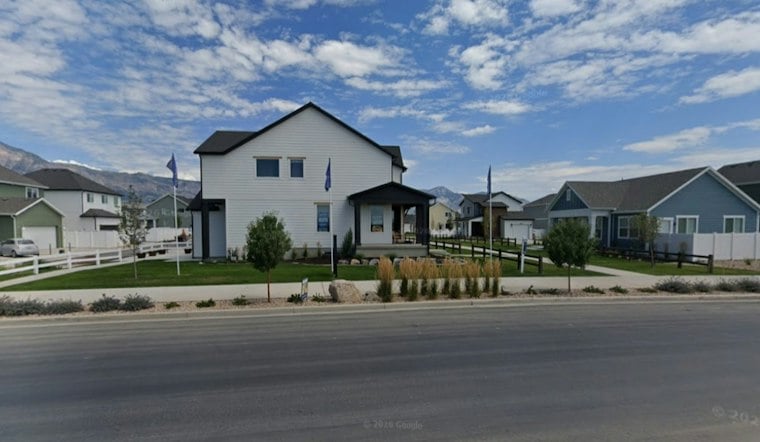
A Weber County developer is betting that Utah homebuyers will trade a second garage stall for a lower mortgage payment. At JDC Ranch in Plain City, Nilson Homes is building 275 starter homes with smaller floor plans and smaller lots, but the same finishes and craftsmanship found in the company's pricier market-rate houses.
Maggie Wells is one of the buyers who made that trade. She bought a 1,900-square-foot house with a one-car garage in Plain City for less than $450,000, according to The Salt Lake Tribune. With help from the state's down-payment assistance program, Wells was able to purchase it on her single income. She has three children, including two teenagers living at home, and told the Tribune that homeownership is empowering and more accessible than people think.
Nilson Homes owner Jed Nilson, who started building houses in 1999, designed the starter homes with a one-car garage or no garage at all, rather than the two-car garage that has become standard in new Utah construction. For inspiration, he looked to older Utah neighborhoods, including the Avenues and Sugar House, the same report notes. Nilson has said he wants his children — he has five, with a sixth on the way, after 46 years living in Utah — to be able to stay in the state he grew up in.
From 725 Homes to 1,000 — With a Catch
The JDC Ranch plan wasn't always built around smaller homes. Nilson met with Steve Waldrip, who advises Gov. Spencer Cox on housing strategy and leads Utah's Division of Housing and Community Development, to discuss increasing the development from 725 homes to 1,000. Per Waldrip, that expansion added 275 homes priced below $450,000 to the plan, and it reportedly took local officials months to sign off on the change.
Once built, the starter homes are dispersed throughout the development so they blend into the broader neighborhood rather than clustering in one visibly cheaper section. Other city and county officials have since asked Nilson for similar developments in their own communities, the same report states.
Why Smaller Lots Matter on the Wasatch Front
Waldrip has argued that land prices along the Wasatch Front make affordable homes on traditional larger lots nearly impossible to build, and that smaller homes are required to create affordability for working Utahns. He's pointed out that many Utahns grew up in homes smaller than 1,500 square feet without garages — Nilson's own father, for instance, lived in a fourplex and then in a roughly 1,000-square-foot house. By contrast, newer starter homes built today run about 4,000 square feet on a quarter-acre lot, reflecting how much the baseline has grown.
Waldrip has framed the stakes in broader terms, saying homeownership is a major vehicle for spreading wealth across the middle class and that a weakened middle class poses risks to society's future. He's also said Utah is losing too many of its kids and grandkids to places with more affordable housing, and that smaller homes tend to attract nurses, teachers, and other good neighbors. Returning to older housing practices, he's argued, is an acceptable trade-off.
The Statewide Math Still Falls Short
JDC Ranch is part of a bigger push: Gov. Cox announced in December 2023 a goal to build 35,000 new starter homes by the end of 2028, plus thousands of additional units. The attainable units at the Plain City project were originally pegged at under $400,000 before add-ons like garages or landscaping, according to KUER.
Progress toward that 35,000-home target has been uneven. At a May housing summit, Cox said only about 5,100 starter homes had been built or begun, and NPR reported that builders have generally been slow to sign on to the initiative. Housing starts statewide have also been sliding, falling from 37,000 in 2021 to 19,000 in 2023, with early 2024 estimates around 15,000, according to Builder magazine. Meanwhile, Utah is expected to gain roughly half a million new residents by 2033, a pace that would require nearly 28,000 new housing units annually just to keep up, per KUER.
Pricing Still Out of Reach for Many
Even with smaller floor plans, the math is tight. At JDC Ranch, Nilson sells his three-bedroom starter model for just under $400,000 and a smaller two-bedroom for about $370,000, NPR reported. Separately, state officials have floated condo units that could be built for $350,000 or less and sold at or near cost to lower-income buyers, according to Deseret News. Preferred applicants at JDC Ranch, including first responders and active-duty military, get a two-week window to secure homes before they're opened up to the general public.
That system is how Kameron Chancellor, a 26-year-old who works for Nilson Homes, ended up house hunting in the first place — she and her husband began looking after their rental was put up for sale and found most other options either above their price range or old and run down, per the Tribune's reporting. Utah's broader price pressure isn't easing on its own: the state's typical listing price hit $579,000 in September, the ninth-highest in the country, according to the Federal Reserve Bank of St. Louis, a figure largely driven by a supply shortfall amid population growth and rising demand.
A Similar Bet in Saratoga Springs
Nilson isn't alone in testing smaller square footage as a price lever. Oakwood Homes has been experimenting with smaller homes at its Wander development in Saratoga Springs, and Malcolm Thacker, who oversees Oakwood's Utah market, said the homes have attracted buyers who previously didn't think they could afford to become homeowners. Oakwood reportedly asked buyers and prospective buyers directly what features mattered most to them before scaling back.
Thacker has said affordable homebuilding requires economic viability at every stage, from land acquisition and density approval through design and efficient construction, and that greater density is often difficult to sell to local officials. His takeaway: not everyone needs granite or quartz countertops or a finished backyard. What Oakwood's buyers want, he said, is a home and an opportunity to build wealth.





