

























































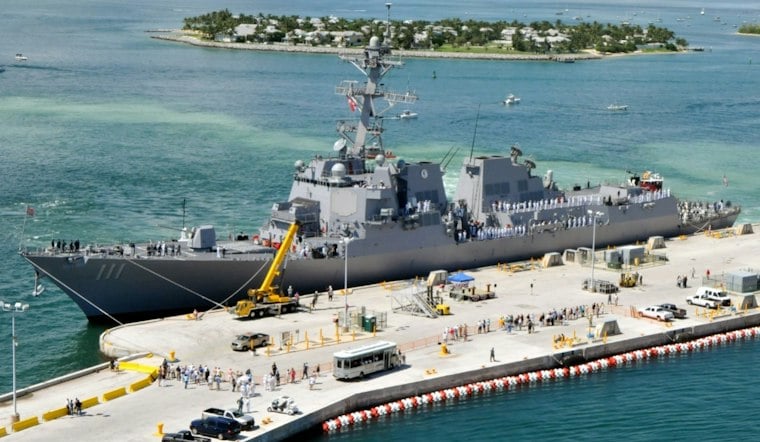
A San Diego-based Navy destroyer has now reached the 339-day mark in the longest deployment by a U.S. destroyer since the end of World War II. The USS Spruance left Naval Base San Diego in November 2025 expecting to be gone for about seven months, but the ship's deployment stretched on for nearly a year after the United States went to war with Iran.
The Navy confirmed the milestone to the San Diego Union-Tribune, which reported the Spruance has roughly 330 sailors aboard, though KPBS has previously cited the crew at about 320. The destroyer, which is 510 feet long and carries the name of Adm. Ray Spruance, was among the first American warships to fire missiles at Iran when the conflict erupted on Feb. 28, launching a Tomahawk Land Attack Missile in support of Operation Epic Fury, according to a DVIDS image caption documenting the strike.
From Missile Strikes to a Disabled Tanker
The Spruance's mission didn't end with that opening salvo. The destroyer also helped enforce a U.S. naval blockade in the Strait of Hormuz, and in April it intercepted the Iranian-flagged tanker M/V Touska in the north Arabian Sea after the vessel attempted to reach the port of Bandar Abbas in violation of that blockade, per a separate DVIDS report. The Spruance disabled the Touska's propulsion by firing several rounds from its 5-inch MK 45 gun into the tanker's engine room, stopping the vessel from completing its run.
Beyond that direct confrontation, the destroyer also helped shield the USS Abraham Lincoln from drone and missile attacks while serving as an escort ship for the carrier's strike group, and the Spruance was at one point assigned to patrol the Indo-Pacific as well. The Abraham Lincoln departed for its San Diego home base on Aug. 20, arriving at Naval Station North Island two weeks ago, on Oct. 8.
No Firm Date Yet for the Homecoming
The Navy has not announced an arrival date for the Spruance, though it is expected to return to San Diego sometime in November. The deployment's extension traces directly back to the outbreak of war with Iran in February, which kept the ship at sea far beyond its original seven-month assignment.
The Spruance's record-breaking stretch is not an isolated case. The destroyer USS McFaul returned to its homeport in Norfolk, Virginia, on the same Oct. 23 timeframe after what the Union-Tribune described as a 333-day mission, while USNI News reported 332 days. A Navy release distributed through DVIDS described the McFaul's deployment as concluding an 11-month stretch in the 5th and 6th Fleet areas.
A Stretched Fleet Across the Navy
These marathon deployments reflect a broader strain across the fleet. A Navy official has told families that ship deployments and patrols, stateside and overseas, will run 10 to 12 months long for the foreseeable future, according to Defense One, a sharp departure from the six- or seven-month deployments the Navy has generally maintained in recent decades, per a Center for a New American Security analyst cited in that report. Chief of Naval Operations Adm. Daryl Caudle has told sailors and their families to expect longer deployments until the Navy can grow, and the service's battle force currently sits at about 290 warships, down from 295 two years ago.
Other ships have faced even longer stretches away from home. Defense One reported that the destroyer John Finn's deployment was extended to 14 months after repeated extensions, and the destroyer Mustin left its old San Diego homeport in February, arrived in Japan in March, and was later expected to remain deployed until April 2027. U.S. Fleet Forces commander Adm. Karl Thomas told USNI News that the traditional model of naval ship maintenance is no longer viable in the current high-demand operational environment.
The Abraham Lincoln's own homecoming carried similar complications. USNI News reported the carrier strike group returned after 321 days, while Defense One referred to Lincoln's record-breaking 322 days. NPR described the deployment as lasting 10 months, with the carrier logging a record 265 consecutive days at sea according to NPR's account. That deployment broke from the Navy's Optimized Fleet Response Plan, which normally places carriers on a 36-month schedule of maintenance, training and deployment, USNI News noted. NPR has reported that extended naval deployments can wear on service members away from home for long stretches, while Forbes has reported that they can also wear on ships and their equipment.
The Ship's Namesake
The Spruance carries the name of Adm. Ray Spruance, who once commanded destroyers based in San Diego and led the United States to victory over Japan at the Battle of Midway in 1942, where historians say he destroyed four Japanese fleet carriers. That battle marked a turning point in the war that helped lead to Japan's surrender three years later. Separately, the Forbes publication has reported that ships including aircraft carriers are missing scheduled repairs amid the strain, a dynamic it says is creating job uncertainty for U.S. repair workers and adding operational stress across the fleet.





