

























































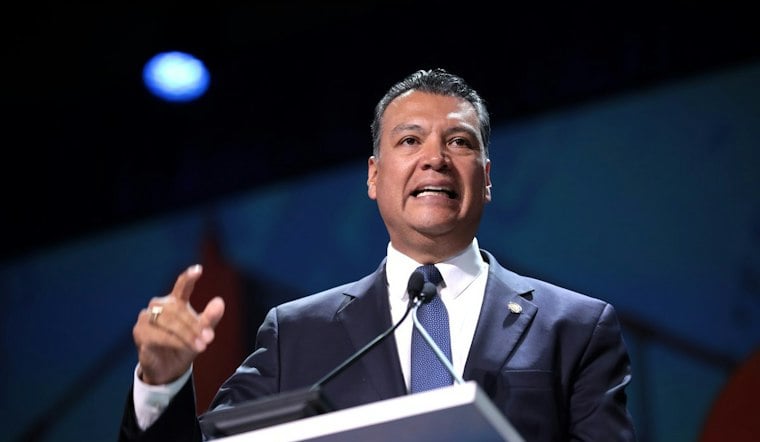
U.S. Senator Alex Padilla showed up unannounced at San Francisco International Airport's ICE holding facility on Thursday, knocking on several doors before Customs and Border Protection officers let him inside — making him the second known federal lawmaker to enter the site after Rep. Kevin Mullin was initially turned away in August.
Padilla approached an entrance marked as a restricted area, knocked on doors, and when no one answered, he called the phone number posted on the facility's sign. “Hi officers, this is Senator Alex Padilla. I am here, I think at your door at SFO,” he said, according to KRON4. CBP officers spoke with him and allowed him to enter. Padilla said his office had heard reports of people being detained at the airport and decided to inspect the facility himself after landing there.
Padilla said the site is not a formal ICE detention facility but is sometimes used as one, and that it held only a few people during his visit. His office said constituents had reported concerns about conditions inside immigration detention facilities, and separately said valid green card holders and other immigrants were being detained at SFO for days without adequate medical care or legal representation.
Mullin's Earlier Visit Hit Resistance
Padilla's trip follows a rockier attempt by Rep. Kevin Mullin, who represents California's 15th Congressional District encompassing SFO. When Mullin tried an unannounced oversight inspection of the holding facility on August 20, CBP officers initially turned him away before permitting him entry six days later, on August 26, when he observed five detainees, according to SFist.
Mullin said people were held at SFO for days on end and that detainees had varying legal statuses, including some lawfully in the country. He said he was shocked by the sleeping conditions at the facility. Per the same account, investigative reporting and legal records showed more than two dozen immigrants were detained at the SFO facility for longer than three days during 2026, exceeding CBP's standard 72-hour holding limit. Those held reportedly slept upright in chairs under continuous 24-hour lighting, ate meals from airport food stands, and were restricted to supervised five-minute phone calls.
Why Lawmakers Can Walk In Unannounced
Padilla's ability to enter without warning rests on Section 527 of the annual Department of Homeland Security Appropriations Act, which grants members of Congress explicit authority to conduct unannounced visits to immigration detention facilities — a right reaffirmed by federal court decisions in late 2025 and 2026 after executive attempts to require advance notice, according to Rep. Juan Vargas's office. Padilla said he has a constitutional responsibility to conduct oversight of immigration detention facilities and that he and other lawmakers will continue watching the site.
San Francisco International Airport management has confirmed that because the CBP facility sits on federally controlled property, neither the airport nor the City of San Francisco has legal authority to stop federal detentions or ban ICE and CBP operations inside the terminals — a limit that holds despite the city's sanctuary ordinance, SFist reported.
Padilla said conditions at the SFO site were not as severe as those he has seen elsewhere, noting that other facilities have more deplorable conditions. He pointed to the California City Detention Facility in Kern County, which he and Sen. Adam Schiff toured in January. That site, a former state prison run by private contractor CoreCivic under a two-year, $130 million ICE contract signed in August 2025 with a capacity of 2,560 beds, was the subject of an investigation by Padilla and Schiff into unsanitary and unsafe conditions, inadequate medical and mental health care, insufficient access to legal counsel, lack of accommodations for people with disabilities, and unnecessary use of solitary confinement, according to KQED.
New State Law Faces Immediate Legal Challenge
The oversight push comes just days after Governor Gavin Newsom signed Senate Bill 942 on September 29, creating the Civil Detainees' Bill of Rights Act of 2026 to guarantee standards for healthcare, clean water, nutrition, and legal counsel access for civil immigration detainees in California, per the bill's path to Newsom's desk. The law was authored by Sen. Anna Caballero and sponsored by Attorney General Rob Bonta.
Private prison company The GEO Group wasted little time pushing back, filing a federal lawsuit against Bonta on October 1 in the U.S. District Court for the Eastern District of California, alleging SB 942 unconstitutionally interferes with federal immigration detention operations, according to the Daily Journal.
Padilla's office attributed the broader detention system's lack of transparency and accountability to the Trump administration, saying the system operates without adequate oversight. Nationally, federal immigration detention data from July 2026 showed that 70.6 percent of the 65,765 individuals held in ICE custody had no criminal convictions, Hoodline has reported. By August, eight federal appeals courts — including the 9th Circuit in Rodriguez Vazquez v. Bostock, which covers California — had ruled against mandatory interior ICE detentions without bond hearings, finding that mandatory lockups apply strictly to border encounters.
Padilla said CBP personnel at SFO were doing their best despite difficult circumstances, but he said lawmakers can access the facility and will keep public attention on it. He added that he and his colleagues plan to continue holding the federal government accountable for how it treats people in its custody.


