

























































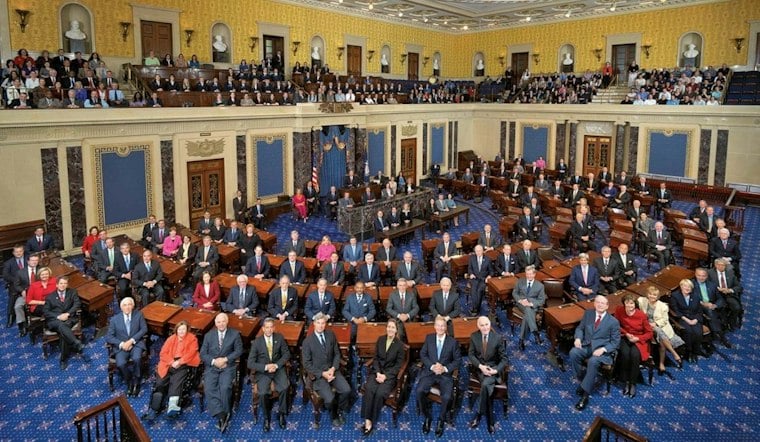
The U.S. Senate rejected a war powers resolution aimed at curbing President Donald Trump's war with Iran, failing by a single vote, 49-50. Three Republicans — Lisa Murkowski of Alaska, Rand Paul of Kentucky and Susan Collins of Maine — broke with their party to support the measure, while Democrat John Fetterman of Pennsylvania voted against it, siding with the majority of Senate Republicans.
The vote, reported by News From The States, marked the latest in a long string of failed attempts by lawmakers to force an end to the eight-month-old conflict. Fetterman has now voted against more than a dozen similar war powers measures throughout the war, according to the outlet. Senate Minority Leader Mitch McConnell was absent for the vote while in medical rehabilitation, the outlet reported.
Even if the resolution had passed, it would have faced a steep constitutional hurdle. Under the War Powers Resolution of 1973, a president must end unapproved foreign hostilities within 60 days unless Congress explicitly authorizes the conflict — but forcing a withdrawal over a presidential veto requires a two-thirds supermajority in both chambers, according to the Richard Nixon Museum and Library. The law was enacted over President Richard Nixon's veto in 1973 to restore congressional oversight after Vietnam.
A Pattern of Symbolic Votes
Legal experts note that concurrent war powers resolutions, which don't require a presidential signature, function more as political statements than binding law. Just Security points to the Supreme Court's 1983 decision in INS v. Chadha, which invalidated legislative veto mechanisms that bypass executive presentation, as the reason these measures carry symbolic weight without legal force. Before the October vote, the Senate had already considered war powers measures on 14 separate roll calls during the conflict, according to PBS News.
One of those came in June, when Hoodline reported on a narrow 50-48 win for a similar resolution that ultimately stalled against the same veto-proof threshold. The House passed its own version of a war powers resolution on July 23, when four Republicans defected; a later House vote in September drew support from seven Republicans, a vote Hoodline covered in a September report. Republicans hold majorities in both chambers, according to News From The States, which has made any override mathematically improbable throughout the conflict.
How the Fighting Escalated
The war between the United States, Israel and Iran began in late February 2026. Fighting reignited during the week of October 19–25, after Trump had announced a pause in the fighting, per the outlet's reporting. Trump ordered retaliatory strikes alongside Saudi Arabia's armed forces on Iran-backed militias in eastern Iraq on Tuesday, October 20, 2026, which U.S. Central Command said targeted terrorist logistics and weapons sites in response to Iranian drone attacks on U.S. forces.
On Wednesday, October 21, 2026, Trump told Fox News, “We are going to beat the f—-- s—- out of them.” The United States launched a heavy wave of strikes on Iranian military sites that Wednesday, which Central Command said was in response to attempted Iranian missile attacks on U.S. forces. The renewed fighting came after the United States and Iran had traded rocket fire for nearly two weeks following the collapse of ceasefire talks.
Mounting Casualties and Costs
Trump attended the dignified transfer for four U.S. service members on July 22. Three service members were killed in an Iranian strike at a U.S. airbase in Jordan on July 17 and 18, and a fourth was killed during a controlled detonation of an Iranian drone at a U.S. base in Iraq two days later. As of the Senate vote reported by News From The States, 18 U.S. service members had been killed and 653 injured in the conflict, though the Pentagon had categorized the latest deaths and injuries as casualties of overseas operations starting July 7 rather than combat deaths in Iran.
More recent Pentagon figures tell a starker story. The Defense Casualty Analysis System, updated through mid-October, recorded 21 U.S. service member fatalities and 865 military injuries linked to Operation Epic Fury and subsequent Middle East operations since February, according to LiveNOW from FOX. Hoodline previously reported on a Fort Bragg soldier's death and the congressional pushback over how the Pentagon classifies such casualties.
The financial toll has grown just as fast. Defense Secretary Pete Hegseth told Senate appropriators on July 21 that the war had already cost $37.5 billion, and the administration is asking Congress for an additional $67 billion. A Congressional Budget Office report released September 15 put direct military operations against Iran at $38.1 billion through August 1, with ongoing expenses running between $2 billion and $3 billion per month, according to CBS News. The assessment was requested by House Budget Committee Ranking Member Brendan Boyle.
Depleted Stockpiles and Rising Prices
Replacing munitions consumed during the conflict accounts for $21.7 billion of total war expenditures, including $13.1 billion spent specifically on missile defense interceptors covering Patriot, THAAD and Standard Missile systems, according to Breaking Defense. Between June 2025 and late 2026, U.S. armed forces expended between one-half and two-thirds of their key missile-defense interceptor stockpiles, and the Congressional Budget Office projects it will take at least five years to rebuild those stockpiles.
The war has also pushed oil prices higher, with the price per barrel rising to just over $90 on Wednesday, October 21, 2026, since the Strait of Hormuz carried one-fifth of the world's petroleum before the war began. AAA reported the U.S. national average price of regular gasoline reached $4.09 per gallon on Thursday, October 22, 2026. The Congressional Budget Office has projected that war-related energy disruptions in the Strait of Hormuz and Red Sea will push U.S. consumer inflation 0.5 percentage points higher in the first quarter of 2027 than pre-war forecasts, per Xinhua.
Midterm Politics Loom Over the Vote
The Senate rebuke comes as the war becomes an increasingly thorny issue for Republicans facing voters on November 3. An October review by Reuters of 62 competitive House and Senate contests found that 41 candidates sought distance from Trump; Iran was the focus in 12 races, while policy differences appeared in 23. Hoodline also covered swing-seat Republicans in earlier coverage. Hoodline also reported on Minnesota gubernatorial candidate Lisa Demuth breaking with Trump over the war's economic toll in a September report.
Trump announced on October 8 that the United States would hold off on new strikes against Iran before the midterms. The Navy dispatched a third aircraft carrier strike group to the Middle East. Hoodline covered the pause in a report. Despite the political theater surrounding each new roll-call vote, Congress remains structurally limited in its ability to force an end to the war absent a veto-proof supermajority — a bar that, as Thursday's 49-50 tally showed, remains well out of reach.



