

























































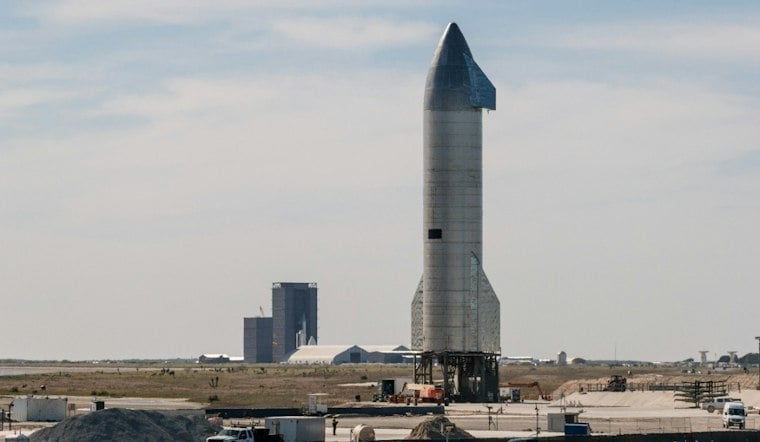
The Federal Aviation Administration has kicked off a formal environmental review of SpaceX's request to launch Starship rockets from Boca Chica up to 456 times a year, with as many as 912 landings annually — a staggering jump for a site that has never seen more than five launches in a single year. The agency published its Notice of Intent in the Federal Register on Wednesday, setting off a process that will determine what studies regulators require before any such expansion could move forward.
A Massive Leap From Current Limits
Right now, SpaceX is authorized for up to 25 launches and 50 landings annually at the South Texas site, a cap the FAA only approved in May 2025 after raising it from a previous limit of five, according to Teslarati. The newly proposed ceiling of 456 launches represents roughly an 18-fold increase over that current authorization, even though Starbase has only conducted three test flights so far in 2026. As News Radio 1200 WOAI reports, the proposal is structured in two phases, with Phase 1 capping out at a maximum of 100 launches before any move to the full 456-launch, 912-landing ceiling under Phase 2.
The FAA has not set a timeline for when Phase 2 might take effect, and per the agency's notice, that stage could still be years away. The agency says it will monitor operations and hold public meetings before any such transition, and any future increase in proposed landings would trigger additional review under the National Environmental Policy Act. SpaceX also has the option of splashing its Super Heavy booster in the Gulf of Mexico or the open ocean rather than attempting more landings, the station's report notes.
Public Comment Window Now Open
Residents and officials will get formal chances to weigh in before the draft environmental review takes shape. The FAA has scheduled four in-person public scoping meetings in Brownsville and Port Isabel for November 17 and 19, along with a virtual session on November 18, and it's accepting written comments through November 30 under Docket FAA-2026-12808, according to Teslarati. Those comments will help shape what environmental studies — covering air quality, noise, water resources, and local wildlife — are ultimately required in the draft impact statement.
Outside Texas, the agency has already cleared SpaceX for a parallel expansion in Florida, approving up to 44 launches annually from Kennedy Space Center's Launch Complex 39A and up to 75 per year from Cape Canaveral's Space Launch Complex 37, per the same Teslarati report. The doubled landing cap in the Boca Chica proposal reflects Starship's two-stage reusable design, since each mission involves separate recovery maneuvers for both the Super Heavy booster and the Starship upper stage, as Tech Insider explains.
Economic Upside, Local Friction
Economist Ray Perryman told News Radio 1200 WOAI the proposal could ultimately be a win-win for the region, though he cautioned there may be growing pains along the way. He said the expansion could encourage businesses to relocate or shift production to the industrial region, adding that proximity to launch operations could make South Texas more attractive to companies weighing where to set up shop. The expansion could also create jobs and generate additional state revenue, per the same report.
Not everyone is cheering the prospect of near-daily launches. Residents have raised ongoing noise and environmental concerns, with rocket launches known to set off car alarms in nearby communities, while beach closures tied to launch operations have also frustrated tourists, according to the station's reporting.
Legal and Regulatory Backdrop
The pushback has deep roots. The Environmental Protection Agency fined SpaceX $148,378 in September 2024 for discharging industrial wastewater from its launchpad deluge system into surrounding wetlands without Clean Water Act permits, a settlement that also addressed a 36,000-gallon liquid oxygen spill at the facility in 2022, according to the San Antonio Express-News. Three months later, three South Texas community organizations — Save RGV, the South Texas Environmental Justice Network, and the Carrizo/Comecrudo Nation — sued the Texas Commission on Environmental Quality, accusing the state regulator of illegally granting SpaceX a 300-day temporary authorization to run that same water deluge system without a full permit review, as The Texas Tribune reported.
Legal momentum has more recently tilted toward SpaceX. In June, the Texas Supreme Court unanimously dismissed a five-year lawsuit by local environmental groups challenging public closures of Boca Chica Beach and State Highway 4, ruling that private organizations lack standing to enforce the state's constitutional open beaches amendment, The Independent reported — a case Hoodline previously covered during oral arguments. Texas law has allowed county commissioners to close beaches near spaceports for public safety since a 2013 amendment.
That shift has coincided with a change in local governance. Residents around the Boca Chica site voted 212–6 in May 2025 to incorporate Starbase, Texas as its own city, transferring authority over Highway 4 road closures from Cameron County to the new municipality, which is made up primarily of SpaceX personnel, according to KFXV. SpaceX has also been building out supporting infrastructure: its subsidiary Lone Star Mineral Development submitted a proposal this month to the Railroad Commission of Texas for an 8-mile natural gas pipeline to supply the Starbase launch complex, feeding the propellant production needed for Starship's Raptor engines, as Hoodline previously reported on the pipeline bid.
For now, the FAA has set no firm timeline for moving forward with either phase of the expansion. The agency says it will continue monitoring operations and weighing public opinion as the environmental review proceeds, with the scoping period and November comment deadline marking only the first formal step in what promises to be a lengthy regulatory process.





