

























































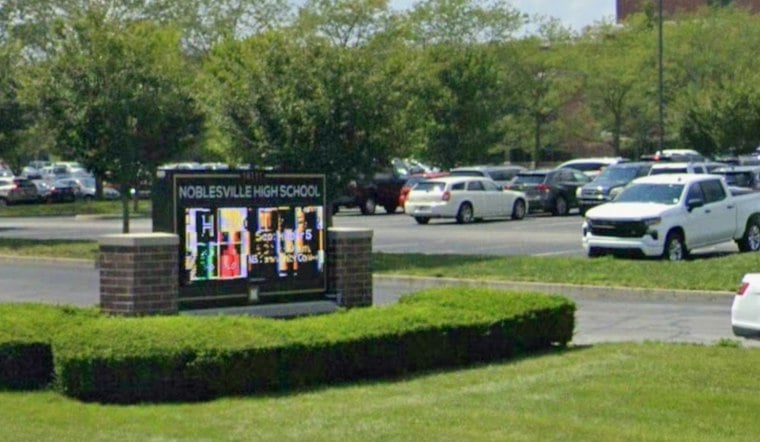
Three members of the Noblesville High School boys tennis team have each battled childhood cancer: senior Joey Beahrs, sophomore Finn Stallings and freshman Luke Davidson.
The players only learned of their parallel cancer experiences weeks before the story was published, according to IndyStar. Beahrs was diagnosed with Hodgkin lymphoma at age 10, Stallings was diagnosed with acute lymphoblastic leukemia at age 5, and Davidson was diagnosed with Philadelphia chromosome-positive acute lymphoblastic leukemia at age 9 — a rare, aggressive subtype. Pyle coaches a roster of 38 players.
Beahrs now competes in varsity doubles alongside Stallings, while Davidson, the team's freshman, plays mostly singles at a high junior varsity level. The outlet reports that Davidson runs four miles a day when his body allows it and hopes to become an anesthesiologist someday. He has said he works hard to keep up with his teammates because his treatment left him with reduced strength, and he plays tennis as an escape from the grind of cancer treatment.
A Program Built on Grit
The Noblesville tennis team the three players call home has its own history of overcoming long odds. The Millers ended a 35-year championship drought in September 2023, winning the IHSAA Sectional 56 title over Westfield, according to The Hamilton County Reporter. That 2023 sectional crown was the program's fifth overall and its first since 1988. Stallings, notably, follows in family footsteps on the team — his older brother Parker Stallings previously played varsity doubles for Noblesville and earned second-team All-State honors before Finn joined the roster as a sophomore.
Stallings was diagnosed after a week-long fever and leg swelling in the summer of 2016, and doctors made the diagnosis at Peyton Manning Children's Hospital. His father, Nathan Stallings, has said the family simply followed medical protocols after the diagnosis. Over the roughly three years that followed, Finn endured close to 30 spinal taps, with his cancer battle lasting until he was 8 years old; he still gets annual blood draws at the children's hospital until he turns 18. Finn has said that he and his teammates have moved on and continued pushing through sports.
Beahrs Turns His Recovery Into a Mission
Beahrs underwent four months of outpatient cancer treatment and two weeks of radiation in Cincinnati during his own fight with Hodgkin lymphoma. His family's response was to build something lasting: Joey's Journey Foundation, launched in 2019, supports children and families fighting pediatric cancer and other life-threatening illnesses, and has granted wishes, raised awareness and funded cancer research. Joey's mother, Jennifer Beahrs, who serves as the foundation's president, has said it was created because of parents who had gone through pediatric cancer themselves.
The foundation's reach extends well beyond the Beahrs family. It provides direct financial assistance and family programs for pediatric cancer patients across Indiana, including funding travel expenses for families forced to seek specialized care out of state, according to Joey's Journey Foundation. That kind of support matters: research on childhood cancer's toll shows that 30% to 50% of families have a parent leave the workforce during treatment, and non-medical costs like travel and temporary housing push an estimated 15% of affected families below the federal poverty line, as previously reported by Hoodline. The foundation also hosts an annual fundraising golf outing every August at Pebble Brook Golf Club in Noblesville and partners with Versiti Blood Center of Indiana on local blood drives. In January, Joey launched his own campaign for Blood Cancer United's Student Visionaries of the Year program, setting a $100,000 fundraising goal to support blood cancer research and patient services, per Towne Post Network.
Davidson's Rare Diagnosis and Ongoing Fight
Davidson's cancer story is the most medically complex of the three, and it is still being written. He was diagnosed at Riley's Children's Hospital in 2021 and underwent two and a half years of chemotherapy before his cancer returned during a routine check-up. Earlier in 2026, he underwent six weeks of CAR T-cell therapy in Philadelphia, a treatment that uses a patient's own T-cells to locate and destroy cancer cells, and he continues to undergo cancer treatment today.
Philadelphia chromosome-positive ALL, Davidson's specific subtype, is caused by a translocation between chromosomes 9 and 22 and accounts for only 2% to 4% of pediatric acute lymphoblastic leukemia cases, according to Blood Cancer United. The subtype has historically carried a higher relapse risk, which is part of why specialized, targeted therapies like the one Davidson received are often needed. The CAR T-cell treatment itself traces back to a 2017 regulatory milestone: the U.S. Food and Drug Administration approved the first such therapy, tisagenlecleucel, that August for pediatric and young adult patients up to age 25 with relapsed or refractory B-cell acute lymphoblastic leukemia.
Broader outcomes data underscore just how much progress has been made against pediatric leukemia in general, even as Davidson's rarer variant demands more aggressive treatment. Five-year relative survival rates for children diagnosed with acute lymphoblastic leukemia in the United States climbed from 57% in 1975 to over 92% between 2014 and 2020, according to the National Cancer Institute. Pediatric and adolescent Hodgkin lymphoma, the cancer Beahrs fought, carries an overall five-year relative survival rate exceeding 95% under modern risk-adapted chemotherapy and radiation protocols, per the American Cancer Society.
For now, three Noblesville athletes at very different stages of their cancer journeys play on the same tennis team.





