

























































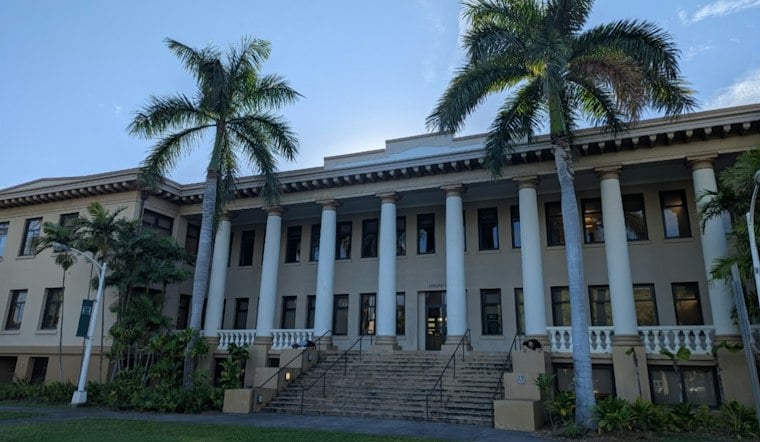
The University of Hawaiʻi at Mānoa is launching a Center for Ocean Policy that pairs ocean scientists with legal experts, betting that Hawaiʻi's ocean and climate problems need both disciplines in the same room. The new center brings together UH Mānoa's Department of Oceanography, housed in the School of Ocean and Earth Science and Technology, with the William S. Richardson School of Law, aiming to turn research into real policy solutions.
According to UH Mānoa, the center's purpose is to bring together ocean science and legal expertise to develop solutions to ocean and climate challenges. The university describes the effort as addressing ocean stewardship, climate resilience, resource management and justice, with students gaining hands-on experience through clinics, capstone projects and advocacy initiatives. As Maui Now reports, the center will offer interdisciplinary education, applied research and policy engagement, with environmental law professors David M. Forman and Richard Wallsgrove among the faculty involved.
A Clinic Built for Legislative Season
One of the center's first initiatives will be a Law-Ocean Clinic, pairing law and oceanography students with local nonprofit organizations. The clinic is designed to conduct policy research and advocacy during the Hawaiʻi legislative session, giving students a direct line into how ocean science gets translated into statehouse debate. Beyond the clinic, the center plans interdisciplinary seminars and will launch an annual symposium beginning in its second year, intended to bring together researchers, policymakers, legal practitioners and community members.
UH Mānoa Chancellor Vassilis L. Syrmos called the center a major institutional milestone, saying it is the university's kuleana, or responsibility, to apply its place-based knowledge and cutting-edge research to ocean stewardship. SOEST Dean Chip Fletcher said the center builds on both schools' existing work with Native Hawaiian and Indigenous Pacific communities, bringing science, law and Indigenous knowledge together. Camille Nelson, dean of the William S. Richardson School of Law, said the partnership will equip law students to address environmental challenges and advance coastal-resilience policies.
Why Science and Law Need Each Other Now
Margaret McManus, chief academic advancement officer in the Office of the Chancellor and director of the Uehiro Center for the Advancement of Oceanography, said the new center aligns with UH Mānoa's academic mission and is meant to prepare leaders capable of working across science, law and policy. That framing reflects a broader pressure point: climate change, biodiversity loss and competing ocean uses are placing mounting strain on marine ecosystems statewide, per the university's announcement.
Those pressures are already visible in state climate data. Hawaiʻi is exploring marine spatial planning, a data-driven approach meant to map ocean resources and minimize conflicts among competing uses like wind energy, aquaculture, recreation and shipping, according to the Hawaiʻi Climate Change Portal. Separately, federal researchers have projected that annual severe coral bleaching could begin as early as 2030 in some parts of Hawaiʻi and as late as 2066 in others, since the surrounding ocean is not warming at a uniform rate, per the National Oceanic and Atmospheric Administration.
A Foundation Already Invested in Climate Fellows
The center's creation builds on an existing relationship between the Healy Foundation and UH Mānoa's Institute for Sustainability and Resilience, which began in 2020 to support an annual research assistant position known as the Healy Foundation Climate Change Fellow. In 2024, that partnership expanded to three fellows, who have gone on to support the City and County of Honolulu Climate Change Commission. The foundation has also backed the Big Island Invasive Species Committee, the University of Hawaiʻi Maui College Hulihiʻa Center for Sustainable Systems, and GoFarm Hawaiʻi, according to Maui Now's reporting on the university's announcement.
Suzanne Geary, executive director of the Healy Foundation, said the new center creates a bridge between science and law to inform ocean-protection policies. Geary said the foundation is excited to support the initiative and to continue its partnership with the University of Hawaiʻi Foundation and UH Mānoa's Institute for Sustainability and Resilience. The foundation separately states on its own site that it partners with the institute to support an annual research assistant position, according to the Healy Foundation.
Part of a Wider Push on Marine Law
UH Mānoa's pairing of law and science students is not happening in a vacuum. A comparable course at Stanford, run jointly by the Center for Ocean Solutions and Stanford Law School, gives students a chance to approach solutions to illegal fishing from a policy perspective, according to the Center for Ocean Solutions. For now, UH Mānoa's own center is just getting underway, with its Law-Ocean Clinic positioned to give students a seat at the table as Hawaiʻi lawmakers take up ocean and climate questions in the coming legislative session.





