

























































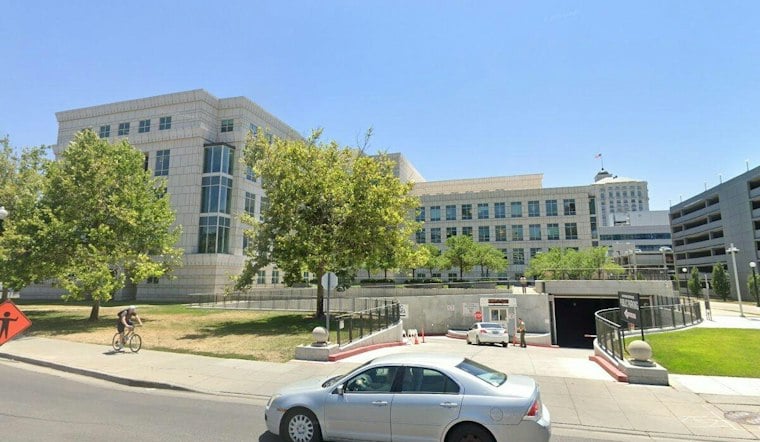
A Utah government watchdog group is demanding that newly appointed Utah Supreme Court Justice Michael Menssen step away from the state's high-stakes redistricting litigation, pointing to a petition he signed earlier this year seeking to repeal the very ballot measure now at the center of the case. Menssen signed the petition to repeal Proposition 4 on Feb. 12, roughly seven months before Gov. Spencer Cox appointed him to the state's highest court on Aug. 28.
Alliance for a Better Utah is calling on Menssen to recuse himself from the case and, as the group put it, “every related proceeding over” Better Boundaries' Proposition 4 and the broader litigation over Utah's congressional maps, according to Utah News Dispatch. Despite that signature, Menssen sat in on recent arguments over whether the redistricting case should be shifted to a newly created three-judge panel, and he did not step aside. Katie Matheson, executive director of Alliance for a Better Utah, said Menssen had every right to sign the petition as a private citizen but now sits on the court deciding a lawsuit seeking to enforce Proposition 4, according to ABC4 Utah.
Proposition 4, passed by voters in 2018, created an independent commission to draw Utah's congressional boundaries, per ABC4 Utah's reporting on the law's origins. The measure has been at the heart of a years-long legal fight after a district court restored the Prop. 4 commission and struck down the state's existing congressional map in a 2025 summary judgment, according to All About Redistricting.
A Signature With Consequences
Katie Matheson, executive director of Alliance for a Better Utah, said the public has reason to question Menssen's impartiality because he signed on to one side of the dispute before joining the bench. “Utah residents deserve fair judges” deciding whether the rules for fair maps are followed, Matheson said, per ABC4 Utah. Co-Equal Utah has argued that Utah's code of judicial conduct asks whether a reasonable Utahn could question a justice's impartiality, and the group contends Menssen's signature on an effort to repeal the law at issue clears that bar.
A spokesperson for Co-Equal Utah went further, saying Utah's judicial ethics rules require Menssen to step aside, and that if he declines to do so, he should explain his reasoning on the record. The spokesperson framed the stakes bluntly: recusal, the group says, is necessary when public trust is on the line. Co-Equal Utah has said its concern rests with Menssen's ethical obligation rather than his qualifications or experience on the bench.
Not everyone agrees the petition signature settles the question. Sen. Todd Weiler said Menssen's signature alone did not necessarily reveal his position on Proposition 4 or prevent him from weighing the issue objectively, according to KSL.com. The petition itself drew more than 161,000 signatories statewide but did not ultimately qualify for the 2026 ballot, per Utah Public Radio.
Court Says Normal Procedures Were Followed
Utah court officials have pushed back on the recusal push, saying the normal standards and procedures for recusal decisions have already been considered and followed. Alliance for a Better Utah has cited the state's judicial-conduct rule, which calls for disqualification in any proceeding in which a judge's impartiality might reasonably be questioned, as the basis for its demand, the same Utah Public Radio report noted.
Utah's own court rules offer some guidance on where that line falls. A separate Utah Courts provision defines a “de minimis” interest as one so insignificant that it could not reasonably raise a question about a judge's impartiality. The state's judicial canons also direct judges to perform their duties impartially, competently and diligently, while steering outside activities to avoid conflicts with those obligations, according to the Utah Courts' rules.
The recusal fight is playing out against the backdrop of an already tangled case. The Utah Supreme Court heard arguments on Oct. 5 over whether the redistricting case should be transferred to a newly created three-judge panel, then took the matter under advisement and recessed until November, per Utah News Dispatch's earlier coverage. Another justice, John Nielsen, recused himself from that same hearing because of past legal work he did for the Utah Republican Party in a prior appeal tied to the underlying anti-gerrymandering lawsuit, Utah Public Radio reported. Menssen, notably, did not follow suit.
The dispute carries added weight in a state that has grown faster than any other in the country. Utah's population jumped 18.4% between the 2010 and 2020 censuses, the largest percentage increase of any state, according to Democracy Docket, a growth surge that has only heightened the political stakes over how the state's congressional lines get drawn. For now, Menssen remains on the case, and it is not yet clear whether the Utah Supreme Court will act on the recusal calls before issuing a ruling on the three-judge panel question.





