

























































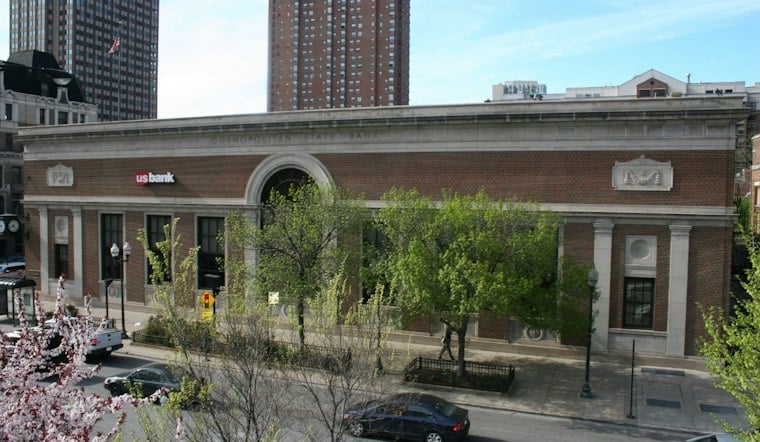
The century-old bank building at 801 West Madison Street in the West Loop was supposed to become a 76-key boutique hotel with ground-floor shops. Instead, its developer just handed the keys back to the lender, leaving one of the neighborhood's most recognizable landmark corners vacant once again.
Jonathan Gordon, founder of The Neighborhood Hotel, signed a deed-in-lieu of foreclosure for the property with lender Calmwater Capital, according to The Real Deal. The El Segundo, California-based lender had extended the maturity date on the original $9 million acquisition loan twice, pushing deadlines from May 2024 to October 2024 and ultimately to April 1, 2025, before the developer surrendered the property this September.
The Neighborhood Hotel bought the vacant former bank building for $14 million in 2022, borrowing $9 million from Calmwater Capital to finance the purchase, per the same account. The 82,000-square-foot building had sat empty for years, and the plan to convert it into a 76-key hotel with 20,000 square feet of ground-floor retail carried an estimated total budget of $53.1 million, according to the City of Chicago.
A Landmark Building With a Century of History
Completed in 1911 and remodeled in 1928, the building served as headquarters for Mid-City Trust & Savings Bank and later MB Financial Bank, sitting vacant for more than 15 years after bank operations ended in 2005, according to Chicago YIMBY. The Neighborhood Hotel's development entity had acquired the building in 2022 from a Monaco-based investment group that held it since the mid-1980s, Preservation Chicago notes.
The building earned official Chicago Landmark status in 2012 as part of a city initiative preserving historic neighborhood bank architecture, a designation that protects its exterior facades, rooflines, and original interior features, including the main banking hall and skylight, according to Preservation Chicago.
Public Incentives Couldn't Overcome Financing Hurdles
The project had cleared significant hurdles before stalling. The City of Chicago issued a full renovation building permit on August 1, 2024, listing Pappageorge Haymes Partners as architect of record and Bulley & Andrews as general contractor, authorizing structural and interior work across all six stories. That same May, the Chicago City Council approved a $1.3 million Adopt-A-Landmark grant to fund exterior masonry, roofing, and window restoration, alongside a Class L property tax incentive estimated to reduce property taxes on the site by $8.2 million over a 12-year term.
The project also carried $17 million in state and federal historic preservation tax credits and had the entitlements necessary to begin construction. City officials had projected the restoration would generate up to 10 permanent jobs and more than 60 temporary construction jobs. Despite that stack of public support, high interest rates and construction financing bottlenecks kept the $53.1 million project from breaking ground.
A Search for Partners That Never Panned Out
By March 2025, The Neighborhood Hotel had listed 801 West Madison Street with CBRE, seeking a buyer or partner to kickstart the stalled project. CBRE marketing materials described the property as a joint venture opportunity, and the owners said they were open to selling outright. Gordon said at the time that the company was seeking a new investment partner or outright sale to recapitalize the project, optimize loan sizing, and secure construction financing.
Gordon and representatives for Calmwater Capital did not respond to requests for comment about the deed-in-lieu of foreclosure, according to The Real Deal's reporting. The Neighborhood Hotel's own website had promoted a 2026 opening for what it described as a Gatsby-inspired hotel at the former bank building, a timeline that has now collapsed along with the deal.
Neighborhood Hotel's Broader Portfolio Remains Active
The Neighborhood Hotel platform is owned and managed by Experiential Capital Group, the Chicago real estate investment group Gordon founded that opened its first hotel in Lincoln Park in 2020. The brand currently operates apartment-style hotels in Chicago's Lincoln Park and Little Italy neighborhoods — the latter occupying the former National Italian American Sports Hall of Fame — along with locations in Grand Beach and New Buffalo, Michigan, specializing in adaptive reuse of historic structures into residential-style suites.
The West Loop setback arrives as Chicago's broader hospitality sector has had a strong run on paper. The city welcomed 57 million tourists in 2025, up 1.5 million from the prior year, generating $21.5 billion in spending, according to Choose Chicago. Yet capital-intensive ground-up and adaptive-reuse hospitality projects elsewhere in the city have hit their own snags: Bally's paused construction on non-gaming amenities at its $1.7 billion planned River West casino and hotel complex this past August, citing the city's legalization of video gambling terminals within Chicago limits as a factor it said it would not have agreed to so many concessions around had it known in advance.
For now, the landmark bank building at Madison and Green streets reverts to Calmwater Capital, its restored facade and historic banking hall still intact under landmark protections, but its interior renovation plans shelved indefinitely.



