

























































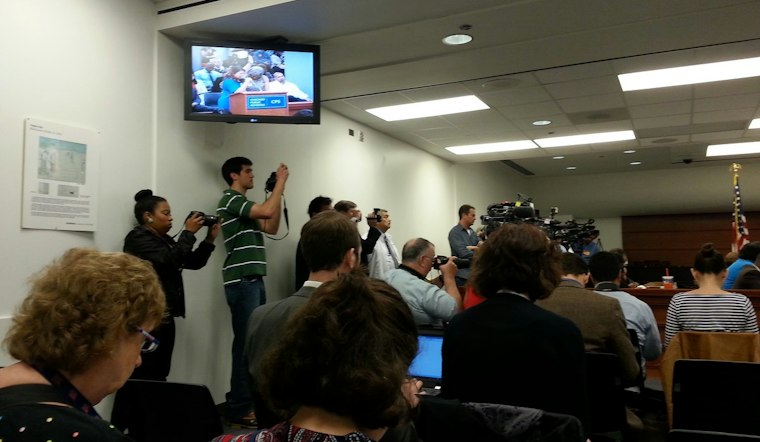
Three residents of Chicago's Austin neighborhood are facing off for a single seat on the Chicago school board representing District 5A, and the race has turned into a referendum on whether the West Side should get more independently run charter schools or fewer. Incumbent Aaron “Jitu” Brown is defending his seat against challenger LaPamela Williams and write-in candidate Kernetha Jones, with enrollment declines and struggling academic performance framing nearly every exchange between them.
All three candidates live in Austin, according to WBEZ, which reports that District 5A stretches from Austin west through sections of Garfield Park and Humboldt Park to Ukrainian Village east, covering neighborhoods including Austin, Humboldt Park, West Town and Montclare. The station's report frames the contest as centered on school choice amid declining enrollment and struggling schools across the district.
The sharpest divide among the three is over whether to allow more independently run charter schools in the area. Brown and Jones both oppose expanding charters, while Williams supports opening additional ones if there is community support behind them, the station notes. Brown wants to secure more state funding for Chicago Public Schools while trimming administrative overhead, and Jones says she wants to see test scores improve before more money goes into what she calls a “failed system,” per the same account.
A Write-In Bid After Being Pulled From the Ballot
Jones, a retired CPS special education teacher according to a Chicago Sun-Times candidate profile, was removed from the ballot on August 13, 2026, and is now running as a write-in. As of October 2, she had no major endorsements, according to a separate Sun-Times rundown of education endorsements for this year's school board candidates.
Williams, who attended Lane Tech College Prep, says she wants greater financial accountability and cuts to expenses that are not benefiting students, the WBEZ report states. Her campaign has drawn institutional support from charter advocates: the Illinois Network of Charter Schools has endorsed and is financially backing her candidacy, and she has also picked up endorsements from the Urban Center and the Common Ground Collective, which WBEZ reports is itself funded by billionaire Michael Sacks and has positioned itself in opposition to the Chicago Teachers Union.
Brown, meanwhile, carries the backing of organized labor. He has been endorsed by the Chicago Teachers Union, which is also financially supporting his campaign, and by Our Schools Chicago, a group that WBEZ identifies as funded by the CTU. The same institutional lines showed up in the Sun-Times endorsement roundup from September, which listed Brown with CTU and Our Schools Chicago backing him.
Empty Classrooms Fuel the Fight Over Charters
The policy argument is playing out against a backdrop of shrinking classrooms. District 5A schools serve mostly Black and Latino students and face what WBEZ describes as the challenge of stabilizing enrollment and bringing students up to grade level after decades of disinvestment. More than half of the district's schools received one of Illinois's two lowest academic performance ratings last year, the highest share of any district in the city, per WBEZ's reporting.
Sources differ on exactly how many schools make up the district: WBEZ puts the figure at 39 schools, while the Chicago Tribune reported in October that District 5A has 36 schools in all, including more than two dozen elementary schools and eight high schools. Less than 7% of high schoolers in the area chose their own neighborhood school, according to CPS data cited by Chalkbeat.
No school captures that trend more starkly than Frederick Douglass Academy in Austin, which enrolled just 27 students last year and has become a focal point in debates over how CPS should address declining enrollment, Chalkbeat reports. A separate WGN-TV investigation found that same enrollment figure amounted to just 2% of the building's capacity, making Douglass one of 13 Chicago high schools that were at least 80% empty; WGN's review of public data also found that 35% of the district's public schools overall were less than half full.
A Citywide Enrollment Slide
The pressures playing out in Austin mirror a broader contraction across Chicago Public Schools. Total enrollment has fallen 17% since the 2016-17 school year, according to Chicago Public Schools' own district overview, which projects further declines of between 0.9% and 7.9% over the next three years. An early headcount for the current school year showed more than 11,000 fewer students than before, The TRiiBE reported.
WGN-TV's investigation put the longer-term losses at more than 77,000 students since 2010. CPS says students can still attend their zoned school, apply to a citywide school, or seek another placement through the GoCPS application process.
Not every indicator is pointing downward. Chalkbeat's review of the newly released 2026 Illinois state report card found that the share of Chicago students considered proficient in English language arts rose 3 percentage points to nearly 46%, while the district's four-year graduation rate climbed for a second straight year, from 82.5% in 2025 to just over 83% in 2026.
Money Flowing Into Other Board Races
While District 5A's contest has drawn institutional endorsements rather than eye-popping donor totals disclosed in the dossier, campaign finance activity elsewhere in this year's school board elections shows how much outside money is moving through the broader races. The TRiiBE reported that board candidate Jessica Biggs had received $400,000 from billionaire investor Michael Sacks by the Oct. 15 campaign-finance filing deadline, with another $300,000 reported five days later. Candidate Hilario Dominguez, meanwhile, had received more than $600,000 from the Chicago Teachers Union's political action committee and its affiliates as of that same Oct. 15 filing, with more than $406,000 in additional contributions reported by Oct. 22.




