

























































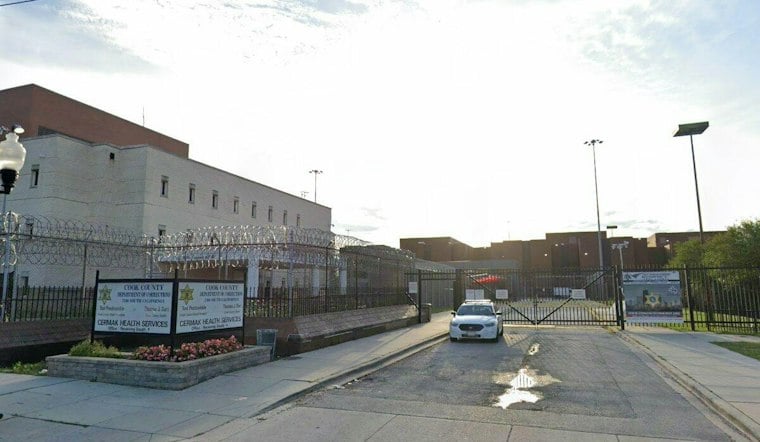
Cory Ulmer's family has agreed to drop its wrongful-death lawsuit against Cook County in exchange for $7.25 million, a settlement that would mark the largest single payout for a jail-related lawsuit the county has made since at least 2007. Ulmer, 41, died at Cook County Jail in June 2024 after what the medical examiner ruled a homicide. The deal still needs sign-off from county commissioners before any money changes hands.
The Cook County Board of Commissioners Finance Committee was scheduled to vote on the settlement Wednesday, according to the Chicago Sun-Times. If the full board ultimately signs off, the payout would stand as the county's largest jail-related settlement in nearly two decades, per the same analysis. Ulmer's stepfather, Robert Robinson, filed the federal lawsuit alleging officers used excessive force and that jail medical staff failed to provide adequate care or antipsychotic medication; the county denied those allegations in court filings.
What Investigators Found Inside the Jail
Ulmer had been taken to the jail just a day before his death for violating a court-ordered curfew, and he had faced charges of assault and armed robbery in 2023. He was held at least 24 hours in a bedless basement holding cell while awaiting transfer to a psychiatric unit. Officers struck him after he tried to run from the holding cell, then dragged him into the jail's emergency room, where an internal report leaked to Injustice Watch showed officers repeatedly struck him after he became combative.
Witnesses told investigators that officers kicked, punched, and kneed Ulmer while he was facedown and shackled, and he was injected with sedatives. A medical staff witness told investigators that correctional officer Jason Jackson hit Ulmer the most and kicked him in the head multiple times. Sgt. Enrique Reyes told medical staff to leave the area and turned off his body-worn camera, later telling investigators he did so because Ulmer was about to receive medical attention — an explanation investigators found to be untrue.
A Death Reported Hours Late, in a Scrubbed Room
Ulmer was declared dead soon after arriving at Mount Sinai Hospital. A legal duty calls for prompt notification of the medical examiner after a death in custody, but a Mount Sinai nurse did not notify the medical examiner's office until nearly six hours after Ulmer was pronounced dead. By then, the jail emergency room had already been cleaned. The medical examiner's office, which dispatches investigators to photograph scenes, interview witnesses, and produce reports, was not able to examine the room as it looked at the time of the incident. The sheriff's office had told Ulmer's family only that he died following a medical emergency.
The sheriff's Office of Professional Review closed its investigation into Ulmer's death in December 2025, after probing the actions of 18 correctional officers. Investigators recommended firing Reyes and Jackson and suspending six additional officers for 45 to 120 days on findings that included unnecessary force and untruthfulness. Three officers also used force against Ulmer on the morning he died, when he fell and hit the back of his head.
Officers With Histories of Complaints
Reyes and Jackson had both been investigated for misconduct multiple times before Ulmer's death. Reyes faced alleged excessive-force complaints in 2012, 2013, 2014, and 2021, plus an alleged policy failure in 2023, though investigators did not sustain the prior allegations, exonerated him, or closed those probes without a final disposition. Jackson, hired in 2016, was recommended for firing as early as 2017 for allowing detainees into a visiting area without permission and failing to stop sexual behavior in view of visitors; an arbitrator instead ordered the sheriff's office to reinstate him six months later. Investigators later sustained misconduct allegations against Jackson in four additional disciplinary cases, including unnecessary force and threatening bodily harm, and he was suspended without pay for about 140 workdays — discipline the sheriff's office considered sufficient at the time, according to a spokesperson.
Both Reyes and Jackson were stripped of police powers and assigned to warehouse work after Ulmer's death. Reyes's firing is now before an arbitrator under the correctional sergeants' union contract, and the six other suspended officers remain in arbitration; one officer has already had a 45-day suspension reduced to five days. Teamsters Local 700 did not respond to requests for comment, and AFSCME Council 31 Local 3692 said it does not answer questions about pending grievances. Of the 11 medical staffers named in the lawsuit, one has since left the jail while the rest continued working there as of late October, and a Cermak Health Services spokesperson did not say whether any medical staff had been disciplined. Priscilla Ware, Cermak's medical director, was not named as a defendant in the lawsuit.
A Pattern Beyond One Death
Ulmer's case is not isolated. Since his death, at least 28 more detainees have died at the jail, according to the Sun-Times. The jail logged 18 deaths in 2023 alone — its highest annual total since 2013 — and a separate report, Dying on Dart's Watch, found inadequate medical care and supervision in at least half of those cases. The Chicago Tribune has separately reported that 61 people died at the jail between 2020 and 2025.
The Cook County Office of the Independent Inspector General has documented persistent problems with supervision, maintenance, sanitation, and housing conditions, according to CBS Chicago. Illinois Department of Corrections reports from 2022 through 2024 documented failures by staff to complete supervisory checks, alongside sanitation and maintenance problems, the station reports. Medical emergency response times averaged 70.2 minutes in 2023, improved to 45.2 minutes in 2024, then rose again to 57.5 minutes in 2025, per the inspector general's figures. An April staffing report also found that deputy coverage at the jail was not evenly distributed throughout the week or across shifts.
State inspectors have cited the jail for violations every year since 2022, and in six of the past nine years overall, with 2025 citations covering supervision, security, admissions, reporting, and sanitation standards. Dart, who won another four-year term in this month's general election, declined an interview for the Injustice Watch report, citing pending litigation.
The Stalled Push for Independent Oversight
Commissioner Tara Stamps, with co-sponsors Jessica Vasquez and Alma Anaya, introduced a resolution in September seeking an independent review of the jail focused on detainee health, safety, wellness, and confinement conditions. Stamps pulled the measure from a Health and Hospitals Committee vote after colleagues warned it could create legal liability, and Cathy McNeil Stein, civil actions bureau chief for the Cook County State's Attorney's Office, said the resolution would harm the county's litigation position and increase its financial jeopardy. The county board has asked the state's attorney's office for a formal legal opinion and is weighing whether to hold a hearing on the matter.
Stamps has said she intends to retool and reintroduce the resolution, though as of publication she had not done so. Interfaith clergy called on commissioners to advance her proposal in a Chicago Sun-Times op-ed published November 11. Matthew McLoughlin, campaign coordinator with the Illinois Network for Pretrial Justice — which works to reduce jail incarceration statewide — spoke about surveillance technology. Jennifer Vollen-Katz, executive director of the John Howard Association of Illinois, which has monitored the jail, has supported oversight.
Jesse Guth, whose comments on the case were cited in reporting, said there was no excuse for the brutality Cory suffered and called on lawmakers to open the jail to independent monitoring, warning that history will keep repeating itself until changes are implemented.
The Ulmer settlement would land amid a broader run of costly county payouts. In September, the finance committee approved roughly $22 million in settlements in a single day, including $3 million to Reginald Henderson, who spent 26 years in state prison before his 2021 exoneration, and $5.7 million to settle a class-action suit alleging hiring tests disproportionately disqualified Black applicants for correctional officer jobs, according to the Chicago Tribune.





