

























































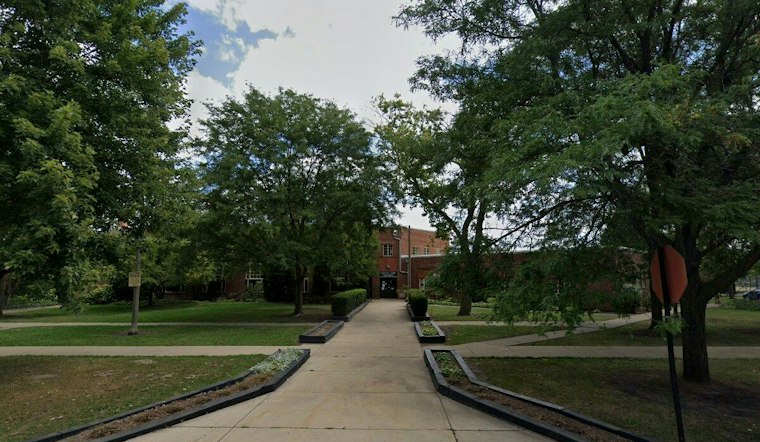
A retired Chicago police officer is trying to unseat a mayoral appointee for the Chicago School Board seat representing the Far Northwest Side, in a race that pits union-backed incumbency against school-choice-aligned challenge. Ed Bannon, a longtime community development advocate who was appointed by Mayor Brandon Johnson to represent District 1a, is hoping to fend off a challenge from Margie Luczak, who served on Chicago's police force for more than 25 years.
The two are competing for the District 1a seat on the Chicago School Board, according to the Chicago Sun-Times. The district roughly covers Edison Park, Forest Glen, Jefferson Park, Norwood Park and the western half of Dunning, according to the Chicago Tribune, placing the contest squarely on Chicago's Far Northwest Side. Chicago's school board elections are officially nonpartisan, but the ideological lines in this race are hard to miss.
Bannon has built his coalition around labor, earning endorsements from the Chicago Teachers Union and the SEIU Illinois State Council, which represents school support staff. Those endorsements, the Sun-Times reports, stem in part from his voting record: he voted last year in favor of the CPS budget plan that Johnson's other appointees were trying to block in 2025. Luczak, meanwhile, has backing from groups that favor school choice and charter schools, including contributions from the Illinois Network of Charter Schools and The Urban Center, which advocates for centrist leadership and school choice, including private schools.
Luczak's Largest Donor and Her Pitch to Voters
Campaign finance records examined by The TRiiBE show Luczak's largest single contribution, more than $10,000, came from INCS Action, a PAC affiliated with the Illinois Network of Charter Schools. Luczak has pushed back on the idea that she's simply a vehicle for outside interests, saying she is not a CTU puppet, and she's allied with two local aldermen as part of her campaign. Her stated priorities include lowering property taxes and returning school resource officers to schools, according to a voter guide from Chalkbeat, which also notes that Luczak acknowledges she doesn't have much direct experience with education.
Bannon, by contrast, has leaned into his background in community development to make his case for another term. The station's report describes him as someone who has spent years working on neighborhood-level issues before Johnson tapped him for the board seat.
A District Where Neighborhood Schools Still Rule
District 1a stands out in CPS for how strongly its families stick with their local schools. The district's 22 schools see families choosing neighborhood public schools at a 75% rate, far above the roughly 46% citywide average, per the Sun-Times. Those schools also enroll more white students than Chicago Public Schools as a whole, even as they remain more diverse than the district's voting population, the outlet reports.
That pattern fits into a longer citywide trend of families drifting away from assigned neighborhood schools. The share of CPS students attending their assigned neighborhood school fell from 74% in 2000 to just 62% by 2014, according to WBEZ data, during a period when the district also lost 50,000 elementary school students compared to 2001. Against that backdrop, District 1a's high rate of neighborhood-school loyalty makes it something of an outlier.
A Conservative-Leaning Pocket of a Progressive City
The Far Northwest Side's political character adds another layer to the race. Voters there have been more receptive to conservative candidates than much of Chicago, as WBEZ notes, pointing to 2023, when many voters in the area picked former CPS CEO Paul Vallas over Johnson, and to 2024, when the Far Northwest Side was one of the few parts of Chicago that leaned toward Donald Trump.
The contest echoes a dynamic playing out elsewhere on the board. In District 1b, home to 20 Chicago public schools among the fewest of any voting district, candidates Michelle Pierre and Claudia Peralta have been at the center of more than $830,000 in PAC and super PAC spending, the most of any school board district, according to the Sun-Times. More than half of that outside money came from the anti-CTU Common Ground Collective, which backed Pierre and opposed Peralta, underscoring how union-versus-choice fault lines are shaping multiple races across the city this cycle.




