

























































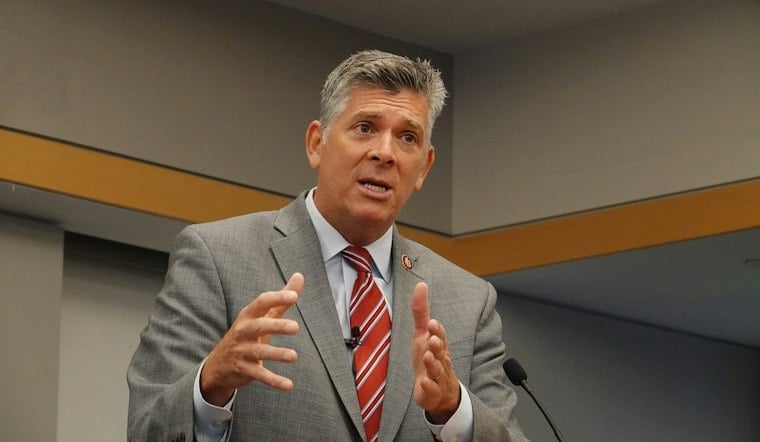
Republican Congressman Darin LaHood has secured a seventh term representing Illinois' 16th Congressional District, defeating Democratic challenger Paul Nolley in Tuesday's election. With 94% of estimated votes counted, LaHood held 58.8% of the vote, a wide enough margin that the Associated Press called the race in his favor just three hours after polls closed.
Vote Totals Point to a Decisive Win
According to the Chicago Tribune, LaHood had collected 173,228 votes to Nolley's 121,383 as of that 94% count. The same outlet reported earlier in the week that LaHood faced just one challenger on the ballot, Democrat Paul Nolley, in his bid for another term in Congress. Vote-count snapshots varied throughout election night as more ballots were tallied, with the final tally continuing to shift in LaHood's favor as reporting progressed.
Other outlets captured the race at different stages of counting. A report from Shaw Local said the Associated Press called the race for LaHood at 9:01 p.m. Tuesday with 56% of votes counted, when he held 113,355 votes to Nolley's 79,037. Separately, IPM Newsroom reported that with 60% of votes tallied, the Associated Press had announced LaHood defeated Nolley by a 17-point margin.
A District Stretching From Peoria to the Iowa Border
Illinois' 16th Congressional District spans portions of 21 counties, according to the Tribune's reporting. WGLT describes the district as including parts of Bloomington-Normal and Peoria along with mostly rural areas across north-central Illinois that stretch all the way to the Iowa and Wisconsin borders, a geographic mix that has long shaped the district's political character.
That character has consistently favored Republicans. IPM Newsroom reported that the Cook Political Report gave Republicans an 11-point advantage in the district in 2025. LaHood ran unopposed and won in 2024, and he defeated Democratic challengers in both 2022 and 2020 by what the outlet described as staggering margins.
Data Centers Emerged as a Campaign Flashpoint
Policy differences between the two candidates surfaced during the campaign, particularly around data centers. As WGLT reported, LaHood said he wanted local governments to set policy on data centers, while Nolley argued the federal government should take the lead on the issue.
A political science professor cited by Central Illinois Proud pointed to the concentration of Republican voters in the district as the core obstacle facing any Democratic challenger, saying “it's really hard to knock that party out.” A separate count from that station had put LaHood at 59% of the vote with 92% of precincts tallied, a figure broadly consistent with the trajectory seen across multiple reports as counting continued toward its final stages. Despite the shifting percentages reported at different points on election night, every available count showed LaHood maintaining a commanding lead over Nolley throughout the evening and into the following days.




