

























































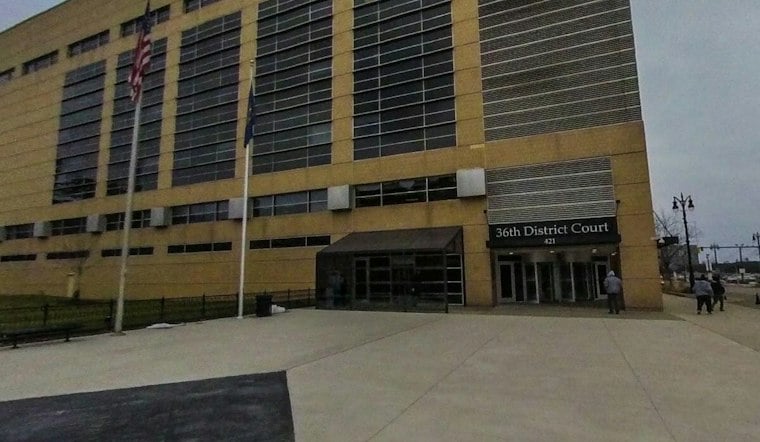
About a dozen tenants from College Grove Manor, a complex on Detroit's west side, walked into court Thursday afternoon for their first termination-of-tenancy eviction hearings. They say the notices to appear arrived just four days after they met to organize a tenants union over mold, rotting floors and other unresolved problems in their homes.
According to ClickOnDetroit, tenants Calandra Jones and Daniel Truscott both said the court notices landed four days after their union meeting, and tenants told the station they believe the timing amounts to retaliation for organizing. Truscott described the conditions pushing him toward that meeting in blunt terms. “There are still spots in the floor that are sinking, that are starting to get mushy, and now I have mold,” he said, describing sinking, soft spots and mold growing in his bedroom and closet.
Jones said tenants felt they had no other option. “We felt like we had no choice but to organize,” she said, according to the same report. Tenants also told ClickOnDetroit they learned the building was not in compliance with local housing requirements, and said they had been setting rent money aside rather than paying through the Cash App and other electronic methods the complex directed them to use, because they did not consider those payment channels secure.
Management Points to Unpaid Rent, Denies Retaliation
The property manager, identified in the station's report as Daniel, pushed back on the retaliation claims directly. “We're not trying to retaliate, we're trying to get things in order,” he said, adding that nonpayment of rent is at the center of the cases rather than any response to the union effort. He said his team recently took over operations at College Grove Manor and is working to bring the complex into compliance, with improvements on the way.
Daniel also said tenants with unresolved repair issues should have entered Detroit's Rental Escrow Program instead of withholding rent on their own, and said the property would be in better shape if tenants returned in three months. The city's escrow program page states that it is meant to help resolve rental housing issues such as a lack of essential repairs, unsafe living conditions and the absence of a certificate of compliance, while giving landlords and tenants a process to resolve disputes, ensure timely payment and maintain financial transparency, aiming to reduce evictions and improve rental housing citywide, per the City of Detroit. The same city page notes that repair-dedicated escrow funds can only be accessed by a landlord for repairs, with advance payments capped at 50% or less of the estimated cost.
Attorney Plans Retaliation Defense, Jury Trial
Attorney Marie Reimers, who represents the tenants, said she plans to pursue a retaliation defense built around the sequence of the union meeting followed by eviction notices, and intends to demand a jury trial as part of that strategy. She also cautioned that retaliation cases can be difficult to win. A judge scheduled a follow-up hearing for the tenants for Dec. 3 at 8 a.m.
Michigan's own courts benchbook lays out when a presumption of retaliation can arise in a landlord-tenant dispute: when a tenant formally attempted to secure or enforce rights against a landlord, or filed a complaint, through an official action involving a court or government agency within 90 days before the landlord started summary proceedings — provided that attempt or complaint wasn't dismissed or denied, according to the Michigan Courts benchbook. That excerpt does not establish that organizing a tenants union by itself satisfies those conditions.
A Citywide Pattern of Shaky Compliance
The College Grove Manor case lands amid broader scrutiny of how Detroit enforces its rental certification rules. On Oct. 21, three Michigan Court of Appeals judges unanimously ruled that a lease is invalid and unenforceable when a property lacks a required rental certificate, as reported by Outlier Media. That ruling arrives against a backdrop of widespread noncompliance: when Detroit's City Council approved updated rental rules in late 2024, only 10% of rentals citywide had a certificate of compliance, and that figure has since risen to just 14%, far short of the 30% rate city officials had hoped to reach within two years, Outlier Media reported separately.
The scale of the problem shows up in court filings, too. Detroit recorded 20,370 landlord-tenant filings in 2025, following 20,593 in 2024 and 20,989 in 2023, according to Metro Times. That outlet also reported that 73% of represented right-to-counsel cases between March 2023 and December 2025 involved rental properties without an active Certificate of Compliance, and cited a University of Michigan Poverty Solutions finding that roughly 90% of 25,500 eviction filings in the 36th District Court between March 2020 and March 2022 were brought by landlords lacking that certificate.
Other Detroit renters have faced similar standoffs in recent months. At Alden Towers, tenants in 98 units went more than a month without heat over the winter while the building lacked a Certificate of Compliance, the Metro Times report noted. And at another property, tenant Nuballa Hollings received an eviction notice in April; her case was ultimately dismissed, though she agreed to move out by June 8, according to Outlier Media's reporting.




