

























































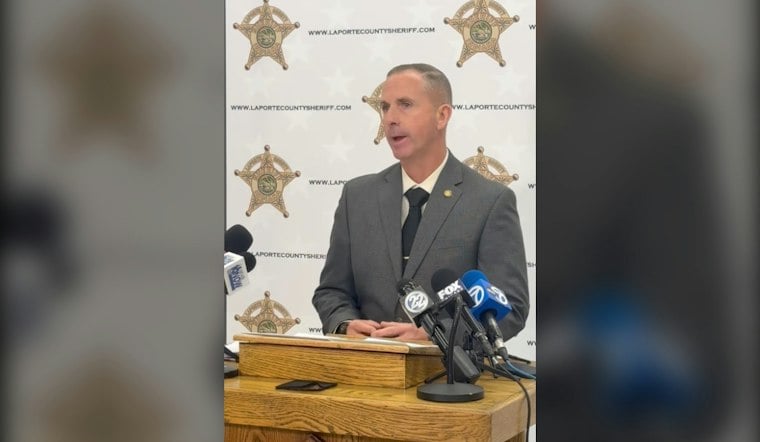
Forty-five years after Juanita Boyd vanished from a La Porte tavern, investigators say they finally know who killed her — a man who died in 2017 without ever facing charges. The La Porte County Sheriff's Office announced Tuesday that DNA evidence identified Carl David Phillips as the suspect in Boyd's 1981 murder, closing out a 45-year-old cold case even as it leaves her family without a courtroom reckoning.
Boyd, 31, was last seen on February 21, 1981, at Snyder's Corner Tavern in La Porte, according to WNDU. Six days later, on February 28, her car was found abandoned in a rural area with her body inside, according to CBS News. WNDU reports her green 1970 Pontiac Catalina was discovered stuck in the mud off Forrester Road in rural Coolspring Township, with Boyd's body in the trunk. Her death was ruled a homicide caused by asphyxiation, the station reports.
A Case Built on Preserved Evidence and Patience
Investigators tested body fluids recovered from Boyd's undergarments at the crime scene, developing a DNA profile that initially matched no one, per WNDU's reporting. The sheriff's office reopened the investigation using new DNA technology in 2013, and detectives continued building out a family tree from that genetic evidence over the years that followed, according to CBS News. The DNA testing was conducted with help from Parabon, a genetic genealogy lab, and the Indiana State Police Lowell lab, per the outlet's report.
Lead investigator Andrew Hynek said he was indebted to the detectives who worked the case from 1981 to the present, according to CBS News. Hynek credited the careful preservation of crime-scene evidence with giving cold-case detectives decades later an advantage once modern DNA technology caught up, the outlet reports.
Boyfriend Cleared, Then a July Breakthrough
Boyd's boyfriend at the time, identified by FOX 32 Chicago as Jack Pearson, was initially considered a suspect in 1981. Investigators ruled him out after reopening the case, and prosecutors filed no charges against him, per CBS News. DNA evidence ultimately excluded him as a suspect, according to police cited by the outlet.
The case's turning point came in July, when investigators collected DNA from a relative of a potential suspect; detectives learned in October that the profile matched Phillips, per WNDU's reporting. Police said they relied on a combination of physical and circumstantial evidence to identify Phillips, according to CBS News, noting he had access and familiarity with the rural area where Boyd's body was found and had no relatives in the area with whom the DNA could be confused.
No Known Link Between Victim and Suspect
Investigators said there is no known connection between Phillips and Boyd, though they believe the two had some type of interaction, according to the same FOX 32 Chicago account. Phillips died September 24, 2017, in La Porte County, per the station's reporting.
Police presented their findings to the La Porte County Prosecutor's Office, and prosecutors said they would have filed murder charges against Phillips had he still been alive, according to CBS News. The sheriff's office said the case is resolved, though investigators acknowledged that identifying a suspect does not provide complete closure, per WNDU.
Part of a Broader Shift in Cold-Case Science
Boyd's case reflects a wider push across Indiana to clear decades-old homicides through genetic genealogy. The Indiana State Police's formalized forensic investigative genetic genealogy unit has existed in its current form for about two years, according to the Indiana Capital Chronicle, and its lab team includes four scientists and a genealogist working alongside a separate team of detectives. A recent state budget boosted the agency's forensic laboratory funding by 20 percent, from roughly $15 million to $18 million, the outlet reports, while the governor's office cited a 50 percent increase in automated DNA batch processing and a 19 percent drop in the state's DNA backlog.





