

























































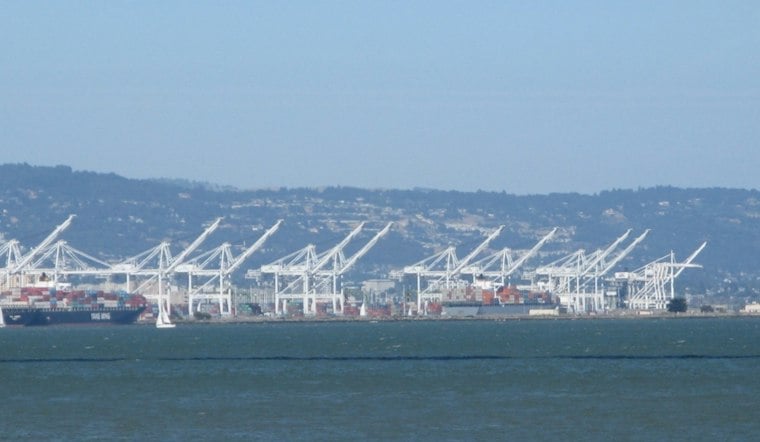
Diesel-powered top picks have hauled shipping containers around Oakland Seaport for decades, but that's starting to change. Everport Terminal Services has taken delivery of eight battery-electric top picks for its operations at the port, and the company has signed an agreement with Taylor Machine Works for 20 more of the machines.
The arrival of the new equipment was celebrated at Oakland Seaport on November 12, according to the Port of Oakland. Everport made the purchase as a private investment, buying American-made Taylor Machine Works ZLC996 electric container handlers — heavy-duty equipment used to stack containers and load them onto trucks, capable of lifting loads weighing up to 100,000 pounds. The delivery and the follow-up order for 20 additional units were confirmed by WorldCargo News.
Port of Oakland Executive Director Kristi McKenney called the equipment a major milestone toward zero emissions at the port, while Everport's Ron Neal said the company is committed to investing in efficient and sustainable operations. Top picks have historically run on diesel, so swapping even a portion of the fleet for battery power marks a notable shift in how cargo moves through the seaport.
Oakland's Earlier Steps Toward Electric Equipment
This isn't Oakland's first experiment with electric top picks. Back in December 2022, the port reported that two all-electric top picks were already running there as part of a zero-emissions demonstration project, with tenant Shippers Transport Express installing the charging stations and the port investing $2 million as a match to build the electrical substation that powers them. The port had also landed a $36.6 million Maritime Administration grant in October 2022 to build out more extensive and reliable electric infrastructure.
Elsewhere, Taylor's battery-electric top handlers have a track record. Back in August 2020, the Port of Los Angeles reported that two of the company's battery-electric top handlers, designed and built in the United States, were being used daily at Everport Container Terminal there, with a design meant to run up to 18 hours between charges. Taylor has also paired its ZLC series — introduced in 2019 as the first zero-emission, battery-electric container handling machines — with Proterra battery technology, and the company says its Generation II ZLC-996 handlers at Yusen Terminals can run 16 to 20 hours on a single charge using a 984 kWh Proterra battery system.
Matson Terminal's Separate Path to Zero Emissions
Everport's equipment purchase comes as the Port of Oakland pursues a broader, and separate, electrification push elsewhere on its property. The port began construction in October on infrastructure upgrades meant to help Matson Terminal transition to a 100% zero-emission cargo-handling equipment fleet, a project the port says is expected to wrap up in 2028. Once finished, Matson Terminal is expected to be the first marine terminal at the Port of Oakland to hit that milestone.
The California State Transportation Agency is backing that effort with $119 million in funding through the Port and Freight Infrastructure Program. Port officials say investments like these are meant to strengthen the port's competitiveness, improve freight efficiency, and cut emissions, while also supporting California's broader clean transportation goals and creating jobs at the port and in manufacturing towns across the country.
Oakland's Emissions-Cutting Goals
Oakland's push toward electrification is part of the port's effort to cut emissions. The port's environmental programs director at the time, Richard Sinkoff, said zero emissions at the seaport was the port's next goal.
The Port of Oakland oversees Oakland San Francisco Bay Airport, the seaport, nearly 20 miles of waterfront that includes Jack London Square, and a publicly owned utility. The port says its operations support more than 98,000 regional jobs and $174 billion in annual economic activity, underscoring the stakes as it works to combine that economic footprint with its stated push toward zero-emissions operations across the port.



