

























































Voters across six Far Southwest Side neighborhoods are deciding a Chicago School Board seat that pits a 35-year veteran of the district against a speech-language pathologist whose own kids came up through a Morgan Park neighborhood school. District 9b stretches through Roseland, West Pullman, Morgan Park, Beverly, Mount Greenwood and Washington Heights, an area home to 46 public schools, the vast majority of them neighborhood schools rather than charters or magnets, according to WBEZ Chicago.
The race pairs incumbent Therese Boyle, a retired Chicago Public Schools psychologist who spent 35 years working for the district, against challenger Katherine Dunneback, a speech-language pathologist and adjunct clinical faculty member at Saint Xavier University, according to the Chicago Sun-Times. Dunneback is a former CPS parent whose children attended a Morgan Park neighborhood elementary school, giving her a personal stake in the overcrowding concerns she says define her neighbors' worries. Boyle, meanwhile, already sits on the board and frames the district's core challenge in blunter fiscal terms.
Spending Priorities Versus Overcrowded Classrooms
Boyle told the Chalkbeat voter guide that residents in her area are focused on making sure the district is “spending money wisely,” a line that doubles as her critique of current CPS budgeting, since she also says the district is not spending wisely now. Dunneback, in the same Chalkbeat questionnaire, described a different set of kitchen-table concerns: her neighbors are worried about school overcrowding and the prospect of closures. In her Sun-Times candidate profile, Dunneback went further, saying overcrowding in her immediate neighborhood has already cost schools their libraries, science labs and music rooms, as reported by Chicago Sun-Times.
The two candidates agree on more than it might seem. Both back a focus on academics and want strict limits on classroom AI and electronic devices, per the same Chalkbeat reporting. Dunneback's version of that stance is specific: she wants artificial intelligence tools to review student work rather than generate it for them, she said. Neither candidate wants to raise property taxes to the maximum to fund schools, according to a CPS candidate questionnaire cited by Chalkbeat, though Dunneback said board members should instead work with other elected officials to fund schools through alternative tax policies.
Charter Schools and the Closure Fight
Where Boyle and Dunneback break sharply is on charter schools and the district's approach to consolidation. Boyle favors charter schools and supports school consolidation when it is equitable and cost-effective, the Chalkbeat voter guide reported. Dunneback opposes charter schools outright and has instead pointed to expanding the Sustainable Community Schools initiative, a CPS and Chicago Teachers Union program that converts neighborhood schools into community hubs, as noted by Chalkbeat, as her preferred alternative to closing buildings.
That disagreement lands against a backdrop of real financial pressure on the district. CPS enrollment for the 2026-27 school year fell to 304,687 students as of the 20th day of classes, a drop of 11,537 students from the same point a year earlier, according to WTTW. District officials pointed to migration trends and declining birth rates as the root causes. The station also reported that CPS's moratorium on school closures is set to expire at the end of the current school year, and education advocates have been pushing for its renewal.
The stakes of that debate are visible in the district's own utilization numbers. More than 140 of Chicago's roughly 500 schools use less than half of their available space, including 43 schools operating at less than one-third capacity, the Highland Park Herald reported. About a dozen of the 45 candidates running across the citywide school board races this cycle said they would support some closures as CPS grapples with enrollment that has fallen by 76,000 students over the past decade, per the same report. Chicago's last mass closure, in 2013, shuttered 50 schools in what WTTW described as the largest school closure in the nation, leaving deep wounds in the communities affected.
Union Money and Political Splits
The two candidates' coalitions reflect a broader fracture in Chicago labor politics. Boyle is backed by the Service Employees International Union, which represents thousands of CPS support staff, as well as by groups that oppose the teachers union and favor school choice, the Sun-Times reported. SEIU and the Chicago Teachers Union have split politically in recent years. Boyle's campaign has received contributions from the SEIU Illinois Council Political Action Committee and from Common Ground Collective, an anti-CTU PAC heavily funded by billionaire Michael Sacks, according to the Sun-Times.
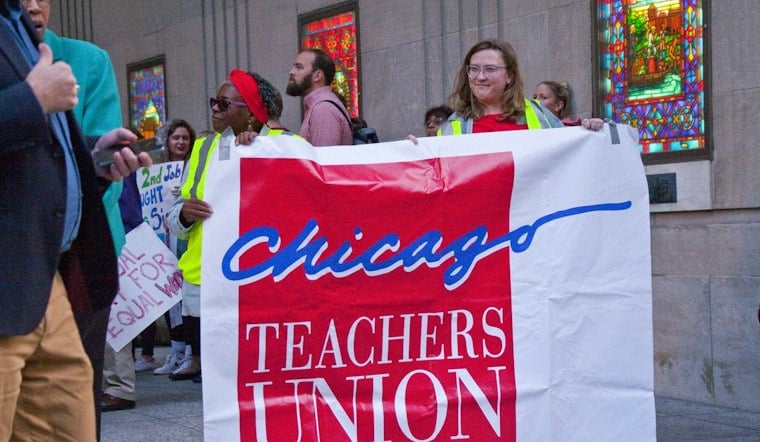
Dunneback, by contrast, is endorsed by the Chicago Teachers Union, and her top contributions have come from the CTU-affiliated Our Schools PAC and the CTU PAC itself, the Sun-Times reported. That split mirrors fundraising patterns elsewhere in this year's school board elections: candidate Hilario Dominguez had received more than $600,000 from CTU PAC and its affiliates and more than $355,000 from Our Schools Chicago as of an Oct. 15 filing, according to The TRiiBE. Sacks-aligned money has flowed elsewhere too — candidate Jessica Biggs had received $400,000 from Sacks as of mid-October, with another $300,000 reported later in the month, while candidate Kyna Lenhof was mostly funded by the INCS Action PAC along with contributions from Common Ground Collective, the outlet reported.
Who District 9b Serves
District 9b's roughly 46 schools serve a student population that is majority Black, with 10% Hispanic students and 11% white students, and a majority of the schools earned a Commendable rating in 2025, the state's second-highest school designation, per a report from WBEZ Chicago. Those numbers sit alongside a citywide pattern in school choice: just 13% of CPS students attend their zoned public high school, while nearly 57% choose their local elementary school, according to data compiled by Chalkbeat and cited by the Sun-Times.
For Far Southwest Side families, the vote comes down to whether they trust Boyle's insider experience and openness to charters and consolidation, or Dunneback's outsider pitch built on preventing overcrowding and closures through community-school expansion. Both candidates have staked out their positions publicly through the Chalkbeat and Sun-Times voter guides, leaving residents of Roseland, West Pullman, Morgan Park, Beverly, Mount Greenwood and Washington Heights to weigh competing visions for the same stretched district.





