

























































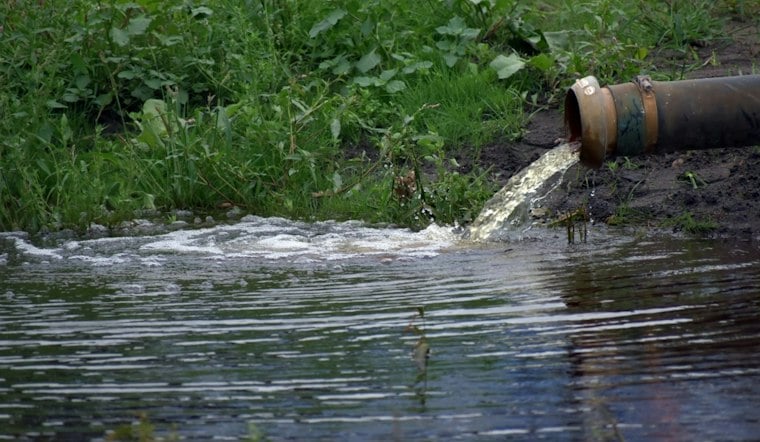
Groundwater pumped from the construction site of Microsoft’s sprawling data center campus in Granger will soon be flowing into two local waterways at a rate that could hit 200,000 gallons an hour, after the St. Joseph County Drainage Board signed off on the project’s dewatering plan Monday morning. The approval clears the way for crews to begin temporarily removing water from the ground so construction and infrastructure work can proceed, even as neighbors living near the site continue to press officials on what it could mean for their private wells.
The board’s vote, reported by WNDU, covers only temporary groundwater removal tied to construction and infrastructure work, not the campus’s eventual operational water supply once the facility is up and running. The dewatering system could discharge groundwater at an estimated maximum rate of 200,000 gallons per hour, though the station notes the total amount discharged will ultimately depend on how long the pumps run and how much water actually needs to be cleared from the site. Microsoft has not disclosed the total expected volume of groundwater removal, according to the station’s reporting.
Three separate wells are expected to operate at different times rather than simultaneously, with the pumping work tied to this winter and spring construction window. WNDU reported the wells are expected to run at different times between mid-December and early April, while WSBT reported that pumping is expected to begin in late February and continue through April, with the work lasting roughly 40 days and sending as much as 200,000 gallons into the creek each hour. The two outlets did not reconcile the differing timelines. Whichever schedule holds, the water discharged by the wells is set to flow into Willow Creek and Juday Creek, the station reported.
Residents Press Officials on Wells and Water Quality
Drainage Board member Anthony Hazen said officials do not expect the discharge to cause flooding or creek overflow, per the station’s account. The drilling company also plans to install monitors around nearby wells to track water levels, though Microsoft has not publicly established the monitoring frequency, baseline measurements, or response procedures that would follow if a problem turned up.
Residents living near the development remain concerned about how the project could affect their private wells and water quality, the same report noted. Separately, residents along roughly 14 miles of Juday Creek have voiced worries about potential erosion, pollution, and impacts on wildlife, according to WSBT’s reporting. For comparison, that station noted a similar groundwater discharge permit for Amazon’s data center near New Carlisle experienced several delays before it was approved.
From Farmland to a 929-Acre Tech Campus
The dewatering fight is the latest chapter in a project that began with Microsoft’s roughly $77.5 million acquisition of the former St. Joe Farm property near Cleveland Road and Bittersweet Road in Granger in May 2024, according to the South Bend Tribune. That same month, the St. Joseph County Council voted 6-3 to approve industrial rezoning of more than 900 acres at the site, with the county’s economic development director at the time describing the scope of possible development in the area as being in the billion-dollar range.
Microsoft’s campus, now addressed at 12501 Cleveland Road in Granger, covers approximately 929 acres and includes six planned data center buildings, with several hundred acres reserved for green space under the development plan, according to Construction Review. County officials estimate the completed campus could support approximately 300 permanent positions across the six buildings, a figure in line with earlier estimates from the 2024 rezoning discussions that pegged the project at up to 300 jobs. Microsoft has also discussed workforce training partnerships involving Penn High School and Ivy Tech Community College, per the outlet.
Infrastructure Deals Top $65 Million
Microsoft, St. Joseph County, and the city of Mishawaka approved an initial infrastructure agreement in March 2026 covering preliminary engineering, design, and pre-development work, with Microsoft’s contribution to that initial phase capped at approximately $12.6 million. Microsoft and local governments followed up with a second memorandum of understanding in October 2026 for additional infrastructure work, reported at roughly $53 million to $55 million and covering water and sewer extensions as well as surrounding road improvements, pushing combined infrastructure commitments past $65 million.
St. Joseph County is managing the water-line construction work, which an initial construction package estimates at approximately $6 million, according to WVPE. Mishawaka water lines are set to extend north along Bittersweet Road between Day Road and Cleveland Road, and the county is managing the project while Microsoft pays for it; the completed water-line infrastructure is expected to be transferred to Mishawaka for ownership and operation once finished. Microsoft plans to use Mishawaka municipal water for domestic purposes and plans to cap the three existing wells on the property, while the broader infrastructure program also includes widening Cleveland Road and adding turn lanes along Bittersweet Road, with Microsoft committing approximately $2 million toward that nearby road work. St. Joseph County has said Microsoft will pay for electrical infrastructure upgrades required to serve the facility, with American Electric Power involved in that electrical work, though project materials do not establish the campus’s total electricity requirement, new substation capacity, or precise transmission upgrades.
Air Permit Review Still Open Through Late November
Beyond groundwater, the project is also moving through a separate environmental review. The Indiana Department of Environmental Management disclosed receipt of the Microsoft EKI campus’s permit application on October 26, 2026, covering construction and operation of a new stationary data center under permit number F 141-50527-00655, which concerns equipment that will emit regulated air pollutants. IDEM has prepared a draft permit and supporting documents and opened a public comment period running through November 25, 2026, though the agency has not finalized authorization and will consider submissions before deciding whether to issue or deny the permit.
IDEM’s preliminary assessment indicates potential emissions would remain below federal major-source thresholds, but the public notice does not provide a complete emissions profile, nor does it establish the number or capacity of backup generators at the site. Interested parties may submit comments on the proposed equipment and its air-pollution implications and may also request a public hearing, according to the Indiana Department of Environmental Management’s notice.
Cooling System and Construction Timeline
Microsoft has described a closed-loop cooling arrangement for the campus using specially prepared cooling fluid transported in from outside St. Joseph County, which would circulate through the cooling system for approximately two years before being transported elsewhere for treatment and reuse. The arrangement is intended to reduce continuous water consumption for server cooling, though Microsoft has not publicly established projected annual domestic water consumption or total cooling-fluid requirements.
Community materials from Microsoft outlined site preparation beginning in June 2026 and targeted vertical construction for late 2026 or early 2027, with the first three buildings targeted for completion in mid-to-late 2029, subject to permitting and construction progress. Taken together, the latest milestones, utility extensions, the air permit decision, and progress toward vertical construction mark a project moving steadily forward even as groundwater monitoring details and the facility’s ultimate electricity demand remain unresolved.





