

























































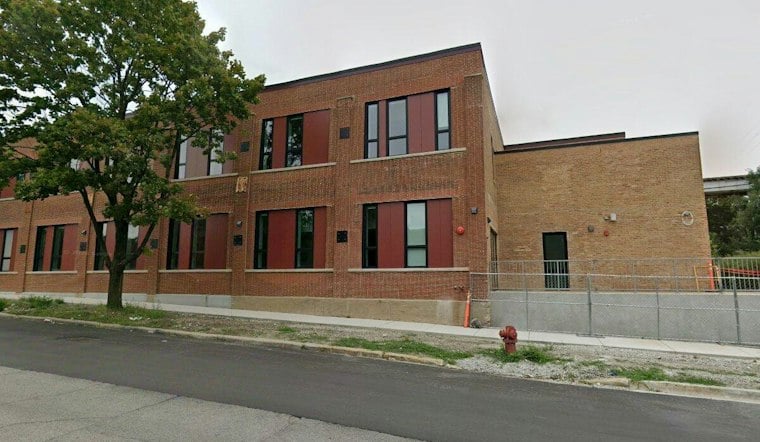
Franciscan Outreach celebrated the ribbon cutting of its new shelter in Chicago's Little Village neighborhood, marking a milestone for a $25.5 million redevelopment that will eventually offer 120 beds split between private and congregate rooms. The shelter sits at 2508 W. 21st, on a site between S. Rockwell Street and S. Western Avenue, in a stretch of the neighborhood near the CTA Pink Line.
The celebration doesn't mean guests can move in just yet. According to stevencanplan.com, “The ribbon cutting was earlier today, but an opening date for guests hasn't been set.” The same account describes the living arrangement guests will eventually have: “Eighty-four men will each get their own bedroom, and share a bathroom and shower with up to three others.”
That breakdown lines up with the project's long-stated design. As Block Club Chicago reported, the facility was planned to include “34 non-congregate units with 84 beds, shared bathrooms and two areas that can be used for emergency congregate shelter for up to 36 people.” Together, the non-congregate and congregate spaces bring the total to 120 beds, combined with supportive-service space for residents.
A 45,000-Square-Foot Redevelopment
The shelter occupies a 45,000-square-foot building that was previously vacant, per Urbanize Chicago's earlier coverage of the project breaking ground. The site includes an existing one- and two-story building that has been reworked into several distinct sections, according to Urbanize Chicago's report on the ribbon cutting, written by Lukas Kugler.
The furthest east building houses the non-congregate shelter space, arranged in “dorm-style sleeping room configurations of 2-4 sleeping rooms with a shared bathroom,” the outlet's earlier report noted. That same building also includes an elevator, dining space, and community space, and the planned shelter facilities throughout the site are designed to be accessible.
The next building over was rehabbed for staff space, case-management offices, and intake and entry areas. A third building will serve as flex space for congregate shelter beds and will also hold a commercial kitchen, laundry, and shared bathrooms — the same configuration described when the project broke ground. The furthest west building was adapted into services space, including room for partner organizations that support residents. The shelter was designed by LBBA Architects, with Walsh Construction serving as general contractor.
How the Project Was Funded
The $25.5 million project drew on a mix of public and private funding sources. Earlier coverage described the funding as expected to include a $7.5 million Department of Housing grant, $15 million in TIF funding, and $3 million in philanthropy and grantee equity. Franciscan Outreach partnered with the Department of Housing's Non-Congregate Shelter Acquisition program, which, per a separate Urbanize Chicago report on a different shelter project, is working citywide to convert roughly 300 traditional shelter beds into non-congregate settings. The redevelopment is intended to increase Franciscan Outreach's capacity to support people experiencing homelessness in the city.
Part of a Broader Shift in Shelter Design
The Little Village project adds to a wave of non-congregate shelters opening around Chicago. The Haven on Lincoln, for instance, transformed a former two-story motel once known as the Diplomat into a shelter offering transitional housing across 37 sleeping rooms alongside wraparound health and social services. Elsewhere, a planned shelter on the city's far northwest side was expected to offer 40 to 70 non-congregate beds and prioritize single adults aged 60 and older, according to Block Club Chicago. Non-congregate shelters have also recently opened in Rogers Park and Lincoln Square, with another planned for Humboldt Park.
The push for more non-congregate beds comes as the city's homelessness numbers tell a mixed story. Citywide counts showed the number of Chicagoans in shelters or on the streets fell 12% between January 2025 and January 2026, according to a report from news.wttw.com. The same point-in-time count, conducted January 22, 2026, found approximately 6,527 people lacked a permanent place to sleep — yet the number counted as completely unsheltered on the streets rose to about 1,641, nearly 25% higher than the prior year's survey. The city's 2025 annual report had estimated 7,452 people experiencing homelessness in shelters or unsheltered locations on January 23, 2025.





