

























































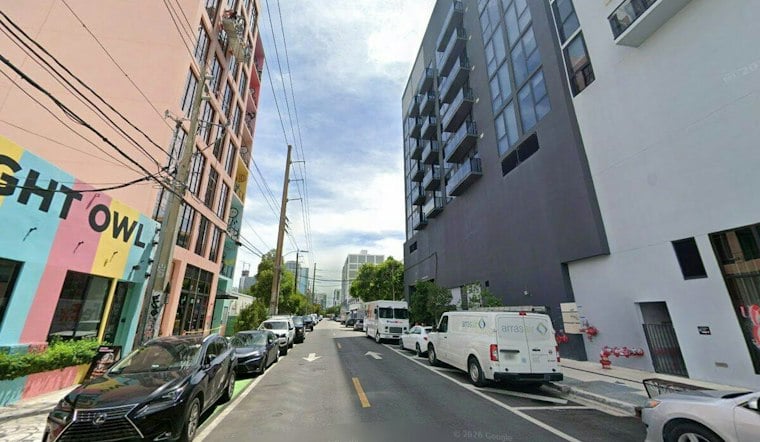
Miami officials are moving to loosen development rules across 30 acres of Overtown, a proposal that would let builders replace the neighborhood's duplexes and single-family homes with buildings up to three stories and double the current density. The plan covers 220 parcels between Northwest 15th and 20th streets, west of Northwest First Avenue, and commissioners are expected to vote on it November 19.
According to The Real Deal, the measure would allow up to three stories and 36 residential units per acre, compared with the current cap of two stories and 18 units per acre, according to commission agenda documents. The rezoning would shift the parcels from a T3-O suburban transect designation to T4-R general urban transect restricted, a classification that allows multifamily and for-sale residential development by right. Other construction types, including schools, child care centers and churches, would require a city warrant or waiver under the new designation.
The city's planning administrator has already recommended approval of the measure, the outlet reports. Commissioner Christine King, whose district includes Overtown, announced in a social media post that a town hall on the proposal will be held Thursday at 5 p.m. at the Overtown Performing Arts Center, 1074 Northwest Third Avenue, giving residents a chance to weigh in before the commission vote.
A Neighborhood Still Recovering From Decades of Disinvestment
Overtown's current mix of duplexes and single-family homes sits atop a much deeper history. The area had its heyday in the early to mid-20th century as a self-sustaining economic, arts and culture hub, with a jazz scene that once hosted Billie Holiday and Ella Fitzgerald, the report notes. That prosperity didn't last: the neighborhood's economic decline traces to the 1960s, when interstate construction cut directly through it, and city officials have said Overtown has not fully recovered from decades of displacement and economic disinvestment that followed.
Recent development in the area has leaned on affordable housing. Developers Michael Swerdlow, SJM and Alben Duffie completed the Sawyer's Walk project in 2024, which includes 578 senior affordable apartments alongside a 251,000-square-foot office and retail center anchored by Target and Aldi, per the same account. Housing Trust Group is separately planning a roughly 1,000-unit project on Overtown's northern edge near Wynwood, with a seven-story building expected to be completed next year.
16 Corner Shows a Different Model for Affordability
Elsewhere in Overtown, a smaller-scale approach has already delivered results without new construction. A project known as 16 Corner restored five aging buildings into 44 modern apartments without displacing a single resident, according to WLRN. The units are protected by a 30-year restrictive covenant and rent-stabilized for households earning between 30% and 90% of area median income, funded in part by a $3.8 million investment from the Omni Community Redevelopment Agency and about $1.2 million from Miami-Dade County.
The Overtown proposal arrives as Miami pursues similar density increases elsewhere, though the details vary by source. The Real Deal describes a Little Havana upzoning proposal targeting 661 lots across 136 acres, while the Miami Herald reports a separate rezoning covering about 460 properties and 100 acres in the same area. That Little Havana plan, which received preliminary approval from commissioners last month, would allow buildings up to eight stories and 150 units per acre in areas shifting to T6 zoning, compared with the current 36 to 65 units per acre allowed there. Miami's Planning, Zoning and Appeals Board voted 7-3 to approve the change, and city officials have said the rezoning could accommodate more than 16,000 additional residents, pushing the area's maximum population to roughly 27,600. Some residents objected that the plan doesn't guarantee any affordable housing and could worsen traffic and congestion.
Live Local Act Pressure Looms Over City Zoning Decisions
The broader push to rewrite zoning rules comes as Miami grapples with Florida's Live Local Act, which has already reshaped the city's skyline in ways officials say they didn't choose. City officials have said Miami has been forced to approve 82 projects under the state law, and Planning Director David Snow has told commissioners the city was obligated to approve dozens of Live Local projects, though only two were under construction at the time. The city has sought to loosen its own zoning rules around transit lines in part to steer developers toward alternatives to Live Local proposals, the Miami Herald reports, after four Live Local skyscrapers of more than 40 stories were planned for Wynwood, where a special city zoning plan ordinarily caps building height at 12 stories.
Wynwood itself has been drawing major investment in recent years, a shift that helps explain why density is creeping toward neighboring Overtown. Ken Griffin bought the Mana Wynwood complex for $1.1 billion, and Carnegie Mellon University has announced plans to build and open a satellite campus there. With that kind of capital moving next door, Thursday's town hall may be Overtown residents' clearest chance to shape what comes before commissioners cast their vote on November 19.





