

























































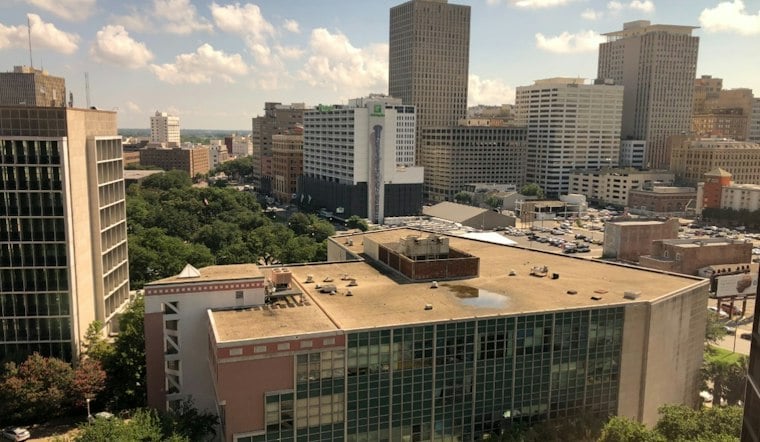
The Orleans Parish Assessor's Office has pulled out of plans to share space in a new Civil District Court courthouse, choosing instead to spend between $7.5 million and $8.5 million building its own permanent home on Canal Street. The office already closed on the property with cash, and it expects to move in by early 2028.
Assessor Erroll Williams formally notified Civil District Court Judge Omar Mason of the withdrawal in a letter dated Nov. 13, copying Judge Kern Reese, according to Biz New Orleans. Williams also notified the judicial building commission that it no longer needs to set aside the 20,000 square feet it had allocated for his office in the courthouse design. He cited the courthouse project's estimated $140 million to $190 million construction cost and, in his words, the absence of any long-term funding source to cover that liability.
A Cash Deal on Canal Street
The assessor's office purchased the former Blood Center properties at 2601 and 2609 Canal Street for $3.475 million in cash, a transaction recorded Nov. 9. The deal came in $515,000, or roughly 13%, below the $3.99 million asking price, and it includes about 28,283 square feet of building space on 1.6 acres. Renovations are estimated to run another $4 million to $5 million, with occupancy anticipated by early 2028, per the same report.
Williams said the purchase and renovation will cost roughly half of the office's restricted capital fund balance, and that the remaining capital reserve is expected to cover additional repairs and maintenance through interest income. He funded the purchase through that capital fund balance rather than the office's general operating funds, and described the move as the more financially responsible option. He also said the Canal Street site will meet the office's operational needs while offering bus access and free public parking.
Why Williams Says the Office Is Walking Away
Williams estimates the withdrawal will trim the courthouse's projected construction cost by about $14 million, since the facility no longer has to accommodate his staff. He separately estimated that annual interest payments tied to the courthouse financing could run $5 million, underscoring his stated concern that no long-term revenue source has been identified to cover the project's debt.
The assessor's office had been eyeing participation in the courthouse project since Act 289 of 2021 cleared the way for it to join. But the office's broader search for a permanent facility stretches back to 2019. A July 2020 report from the Bureau of Governmental Research found the office had outgrown its City Hall accommodations, had been unable to secure additional space, and had already earmarked $10 million for a new facility — reserves BGR pegged at roughly $23 million that year. BGR's report, titled Revisiting Assessment Issues in New Orleans, also recommended aligning the office's statutory funding formula with its operational needs and any proportionate courthouse contribution.
An earlier state effort to solve the space problem fizzled. Act 266, passed in 2019, established the Mid-City Economic Development District to help acquire and develop government property, and required the area's state senator to convene its governing board by Feb. 15, 2020. Williams said that meeting never happened, and state records show the district had not been fully organized as of June 30, 2020. The assessor's office asked the Legislature to repeal the law, and lawmakers did so in 2023.
A Growing Fund Balance Behind the Move
The office's finances have strengthened considerably in recent years. Its audited 2025 financial statements show a General Fund balance of $38.6 million, including $20 million assigned for construction of a new building and $18.6 million unassigned — up from a $12.3 million balance in 2016. The 2025 statements list $20 million assigned for construction of a new building.
Revenues have exceeded expenditures every year from 2016 through 2025, the office reports. Its primary funding source is a statutory allocation of property tax revenue equal to no less than 2% of ad valorem taxes levied, and that annual allocation climbed about 39% over the period, from nearly $11 million in 2016 to $15.2 million in 2025. The office also generated nearly $1.7 million in General Fund investment income in 2025 alone, and more than $5.1 million from 2023 through 2025 combined. It carried no outstanding debt at the end of 2025, transferred $16 million to the City of New Orleans in 2026, and returned $3 million to the city in 2025.
What the Courthouse Project Still Needs to Figure Out
The city's Municipal Complex Advisory Committee, established in July 2026, is still weighing facility requirements, development options, financing and long-term costs for the broader courthouse and municipal complex project. The committee met Oct. 28, when Lee M. Bressler, managing director of Raymond James, presented a financing model based on Baton Rouge's 19th Judicial District Court courthouse, which was funded through bonds backed by court recording and filing fees. Briefing documents from that meeting showed the Civil District Court Judicial Building Fund currently holds about $20 million and generates roughly $1.2 million a year; a sample $100 million bond with a 30-year repayment term would require about $7 million in annual debt service and $8.5 million in annual pledged revenue to support it.
At its Nov. 10 meeting, the committee reviewed a financial analysis from JLL laying out several paths forward. Building a new city hall and courthouse was estimated to cost $670 million to $860 million upfront; renovating existing facilities and retaining leased office space was estimated at $400 million to $490 million; and constructing a new courthouse and council chambers on city-owned land while acquiring and renovating an office building was pegged at $330 million to $380 million. JLL estimated that every additional 10,000 square feet of new construction would tack on roughly $10 million in upfront costs — a figure that frames just how much the assessor's 20,000-square-foot exit could have mattered to the bottom line.
For context on what office space costs in the surrounding market, a nearby building at 3501 and 3505 Gravier Street sold for $1.63 million, or $109 per square foot, in September 2026, according to Elifin Realty.




