

























































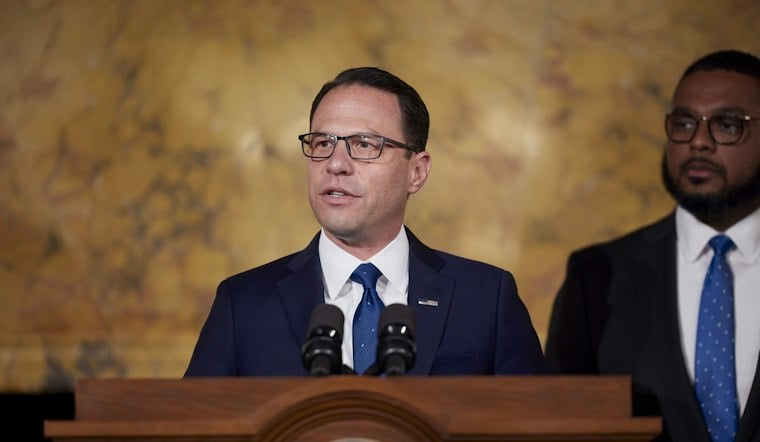
In a closing campaign push across Pennsylvania, Gov. Josh Shapiro is tying his reelection bid to Democratic gains in Congress and the state legislature. In a Sunday interview with CBS News’ Face the Nation, he argued that victories could give Democrats leverage to check President Donald Trump’s administration and advance policies in Harrisburg. The results, however, would determine who holds office—not whether any particular proposal becomes law.
The seats Shapiro is asking voters to change
Shapiro said he is campaigning for four Democratic congressional pickups in Pennsylvania. WHYY’s account of the contests identifies the 1st District, where Bucks County Commissioner Bob Harvie is challenging Republican Brian Fitzpatrick, and the 8th, where Scranton Mayor Paige Cognetti is challenging Rob Bresnahan. The outlet reported that the only public poll cited in the 1st District race put Harvie ahead by two points, within the margin of error; a recent poll in the 8th showed Cognetti ahead by five. Those results are snapshots, not predictions. The other contests Shapiro highlighted are Democrat Janelle Stelson’s rematch with Scott Perry in the 10th District and Bob Brooks’s challenge to Ryan Mackenzie in the 7th.
A state agenda that depends on the Senate
Shapiro’s Harrisburg case is more specific: Democrats would need to hold the state House and flip a Senate currently controlled by Republicans, 27-23, to gain unified control. He has described that outcome as the first Democratic trifecta since 1992. His proposed priorities include a $15 minimum wage, abortion-rights protections, an expanded window for survivors of sexual abuse to sue, and investments in transit, housing and roads, according to WESA and WHYY.
The minimum-wage proposal has already encountered the legislative process Shapiro’s campaign says a Democratic majority could change. Pennsylvania’s minimum wage remains $7.25 an hour, according to the governor’s office, which said it had been at that level for 17 years. House Bill 2189, which would raise it, passed the state House 104-95 on March 24, 2026, according to Pennsylvania Senate Democrats. As of June 10, the group said, the bill was awaiting Senate action. That earlier status illustrates the need for Senate approval; it does not establish the bill’s status after that date.
The broader legislative record offers context, but not a verdict on what a new majority would do. Spotlight PA counted 217 laws enacted in the 2023-24 session, among the lowest totals in the prior three decades. The outlet also reported in December 2024 that Democrats hoped to advance a long-stalled amendment allowing victims of child sexual abuse to sue perpetrators. The low law count alone does not explain why proposals stalled or show what would happen under different party control.
Election safeguards and the limits of precedent
Shapiro also told CBS he would take legal action if Trump or his allies tried to overturn lawfully cast Pennsylvania ballots, saying his administration had prepared for potential election challenges. He made a similar commitment to The Philadelphia Inquirer. A relevant, but not predictive, precedent came on November 29, 2020: The Guardian reported that Pennsylvania’s Supreme Court unanimously overturned a lower-court order halting certification of dozens of contests. In a concurring opinion, Justice David Wecht wrote that the plaintiffs had not alleged that even one mail ballot was fraudulently cast or counted. That ruling describes a past case; the facts and legal claims in any future challenge remain unknown.
Shapiro is presenting the election as a choice about who can shape policy and defend the state’s voting process. Yet a campaign pledge is not an enacted law, and CBS polling cited during the interview found that 57% of likely voters believed Democrats had not offered a clear governing plan. The contests will determine the balance of power; whether that balance produces the agenda Shapiro outlined will depend on subsequent legislative action.




