

























































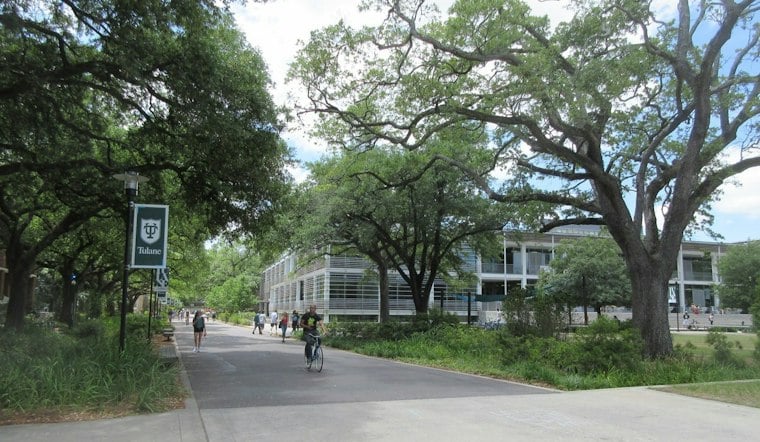
Tulane University gave a diploma to a student named Tate Weston while the school was still investigating a rape accusation against him, according to a Washington Post investigation. The report centers on a promise Tulane made four and a half years earlier to the student who accused him, a junior named Cameron Lewis, that he would not be allowed to graduate while the inquiry continued.
According to the Washington Post, Lewis accused a fellow student of rape in 2022, and Tulane assured her that spring that he would not be permitted to graduate during the investigation. The newspaper reports that by May 2022, eight months after the alleged attack, Tulane had already paused its own inquiry to defer to a parallel investigation being conducted by New Orleans police. The Post's reporting, authored by Amy Brittain, frames the case as part of a broader examination of how an accused student's path through multiple universities has exposed gaps in college disciplinary systems identified by experts.
What Tulane's Own Rules Say About Degrees and Delays
Tulane's student conduct materials lay out exactly the kind of authority the university could have used in a case like this, though the cited policies do not establish how, or whether, that authority was applied to Weston specifically. The university's 2022–2023 Code of Student Conduct states that Tulane reserves the right to withhold or revoke a degree pending completion of specific requirements, according to the Tulane University Code of Student Conduct. The same code says that at the request of law enforcement or the accused student, Tulane may agree to defer the fact-finding portion of its own investigation until after the initial stages of a criminal case.
Tulane maintains, per its student conduct FAQ, that its internal process and the criminal justice system are not mutually exclusive, meaning conduct proceedings can move forward even while a criminal case is pending. The university describes its standard of proof in conduct hearings as preponderance of the evidence — more likely than not, which the FAQ equates to 51 percent — and says the investigation and hearing process generally takes no more than 60 business days, though it stresses that timeframe is not a guaranteed resolution period, according to Tulane's own Formal Process page.
Conflicting Language on Sexual Misconduct Exceptions
Tulane's published rules do not entirely agree with each other on a key point. The student conduct FAQ says a student may request that conduct proceedings be deferred while a criminal case is pending, except in cases involving sexual misconduct. Tulane's separate Student Rights page, however, describes that same exception differently, framing it as applying to cases involving gender-based personal violence rather than sexual misconduct broadly. The university's materials do not explain the discrepancy or clarify which language governed any particular case, including Weston's.
Tulane's annual security report offers additional context on how the university typically handles reports involving students. All incidents reported to Tulane police that involve students are forwarded to the Division of Student Affairs for review and potential action, according to the university's Annual Security and Fire Safety Report. The same report notes that the New Orleans Police Department will generally be the primary investigating agency for most sex crimes occurring in Orleans Parish, which lines up with the Post's account of Tulane pausing its inquiry to defer to NOPD.
Part of a Wider Pattern on Campuses
The Tulane case lands amid a broader national debate over how colleges handle sexual assault complaints under shifting federal rules. In 2020, the Trump administration raised the burden of proof required in these cases and mandated that schools conduct live hearings with cross-examinations, according to NPR. The 2020 rules have been part of the broader debate over Title IX enforcement.
Other recent cases show similar disputes over how universities handle these allegations. A separate lawsuit against Tulane alleged the university ignored a student's polygraph results that had cleared him and gave no reasoning when it ultimately found him responsible for sexual misconduct, according to The College Fix. The Washington Post separately reported on unverified social media claims — which moved quickly across TikTok, Instagram and Fizz before it was clear where or when they started — that a Cornell student accused of gang rape and reportedly expelled had enrolled at Nova Southeastern University near Fort Lauderdale, though that enrollment claim was never confirmed.
The Post's reporting does not establish the outcome of the New Orleans police investigation into Weston, whether any charges were ever filed, or whether Tulane reached a formal finding of responsibility against him. It also does not include responses from Weston, Lewis, Tulane or New Orleans police about the sequence of events, leaving open exactly how a student under investigation for rape ended up with a diploma despite the university's earlier assurance that he would not graduate.


